

A pool table can look like a simple rectangle until you try to fit one into a spare room. Suddenly, the length is only half the problem: you also need room for the rails, your body, and a cue that can extend nearly five feet from your hands.
Most home pool tables fall into three popular sizes: 7-foot, 8-foot, and 9-foot. Their playing surfaces are typically around 39 × 78 inches, 44 × 88 inches, and 50 × 100 inches, respectively. The outside dimensions are larger because the rails and cabinet extend beyond the playing area.
Typical pool table playing surfaces measure approximately 78–100 inches long, or 6.5–8.33 feet, 198–254 centimeters, 1,981–2,540 millimeters, and 1.98–2.54 meters. The exact dimensions depend on the table model and size category.
This guide breaks down pool table dimensions in inches and feet, converts the measurements into metric units, and compares the tables with everyday objects. You’ll also learn how to estimate the room size needed for comfortable play before you buy a table.
Every Pool Table Size Converted
Pool table sizes are usually advertised by their approximate playing-surface length. This is an important distinction: a table called a 7-foot model does not necessarily have an outside cabinet that measures exactly 7 feet.
The table below shows common playing-surface dimensions for three popular sizes. Treat them as typical reference measurements, since manufacturers may use slightly different specifications.
| Table size | Playing surface (inches) | Playing surface (feet) | Playing surface (cm) | Playing surface (mm) | Playing surface (meters) |
|---|---|---|---|---|---|
| 7-foot | 39 × 78 in | 3.25 × 6.5 ft | 99.06 × 198.12 cm | 990.6 × 1,981.2 mm | 0.991 × 1.981 m |
| 8-foot | 44 × 88 in | 3.67 × 7.33 ft | 111.76 × 223.52 cm | 1,117.6 × 2,235.2 mm | 1.118 × 2.235 m |
| 9-foot | 50 × 100 in | 4.17 × 8.33 ft | 127 × 254 cm | 1,270 × 2,540 mm | 1.27 × 2.54 m |
Pool Table Dimensions in Feet
A typical 7-foot table has a playing surface about 6 feet 6 inches long and 3 feet 3 inches wide. An 8-foot table’s playing surface is around 7 feet 4 inches long and 3 feet 8 inches wide.
A 9-foot table has a playing surface approximately 8 feet 4 inches long and 4 feet 2 inches wide. These measurements describe the area where the balls move, not the full table cabinet.
How to Convert Pool Table Measurements
The conversion formulas are easy to remember:
- Inches ÷ 12 = feet
- Inches × 2.54 = centimeters
- Inches × 25.4 = millimeters
- Inches × 0.0254 = meters
For example, a 78-inch playing surface is 6.5 feet long. Multiply 78 by 2.54 to get 198.12 centimeters, or multiply it by 25.4 to get 1,981.2 millimeters.
When comparing models, always separate the playing-surface measurement from the overall length and width. Rails and cabinet edges add extra inches that matter when planning a room or moving the table through a doorway.
Where Pool Table Dimensions Fit on a Size Chart
The biggest difference between a 7-foot, 8-foot, and 9-foot table is the amount of playing area available. Larger tables generally require more room for longer shots and can make cue-ball positioning more challenging.
| Pool table size | Typical playing surface | Common setting |
|---|---|---|
| 7-foot | 39 × 78 inches | Bars, recreation rooms, smaller home setups |
| 8-foot | 44 × 88 inches | Home game rooms and recreational play |
| 9-foot | 50 × 100 inches | Tournament-style play and larger game rooms |
These are common examples, not universal specifications. Before ordering a particular table, check its official dimensions and any installation recommendations.
Is a 7-Foot Pool Table Big Enough for Home?
A 7-foot table can be a practical option for a home game room where space is limited. Its playing surface is about 6.5 feet long, making it smaller than the playing area of an 8-foot or 9-foot table.
Smaller does not mean you can squeeze it into any spare corner, though. You still need clearance for the cue and room for players to stand comfortably around the rails.
Is an 8-Foot Pool Table a Standard Home Size?
An 8-foot table offers a useful middle ground between a compact recreational table and a larger 9-foot model. Its playing surface is typically around 44 × 88 inches.
It can work well for casual games and regular practice if the room allows enough cueing space. The table’s exterior dimensions, not just the playing surface, should guide your room plan.
What Makes a 9-Foot Pool Table Different?
A 9-foot table typically has a playing surface around 50 × 100 inches. It provides a larger area for shots and is commonly associated with tournament-style pool.
That extra space can change how a game feels, but it also increases the room requirements. If the cue repeatedly hits walls or furniture, a smaller table may provide a much better playing experience.
12 Ways to Visualize Pool Table Dimensions
A table’s length is easy to underestimate when you only see a number on a product page. These comparisons give you a practical sense of the playing surface and help you picture how it might fit into a room.
1. A Standard Ping-Pong Table
A regulation table-tennis playing surface measures 9 feet long by 5 feet wide. Compared with a typical 7-foot pool table’s playing surface of 6.5 × 3.25 feet, the ping-pong table is both longer and wider.
Both are large rectangular game surfaces, but they have different proportions. A ping-pong table is broad enough for players to move along the sides, while pool requires clear space for a cue to move backward and forward.
If you have access to a table-tennis setup, it offers a useful reference for imagining a large game table. Just remember that the surrounding playing area is different for each sport.

2. A King-Size Mattress
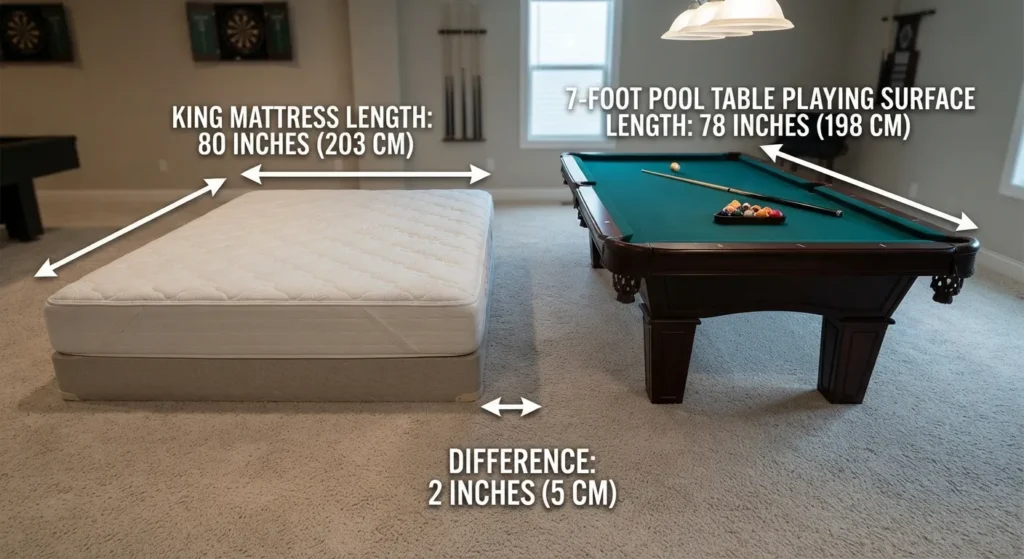
A standard US king mattress measures 76 inches wide by 80 inches long. Its 80-inch length is close to the 78-inch playing surface of a typical 7-foot pool table.
Imagine the mattress turned so its long side runs along the table’s length. The mattress will be almost the same length, although it is much wider than the pool table’s playing surface.
This is a useful household comparison because many people are already familiar with the footprint of a king bed. Keep in mind that the mattress dimensions do not include the bed frame, just as the playing-surface measurements do not include the pool table’s rails.
3. An Eight-Foot Area Rug
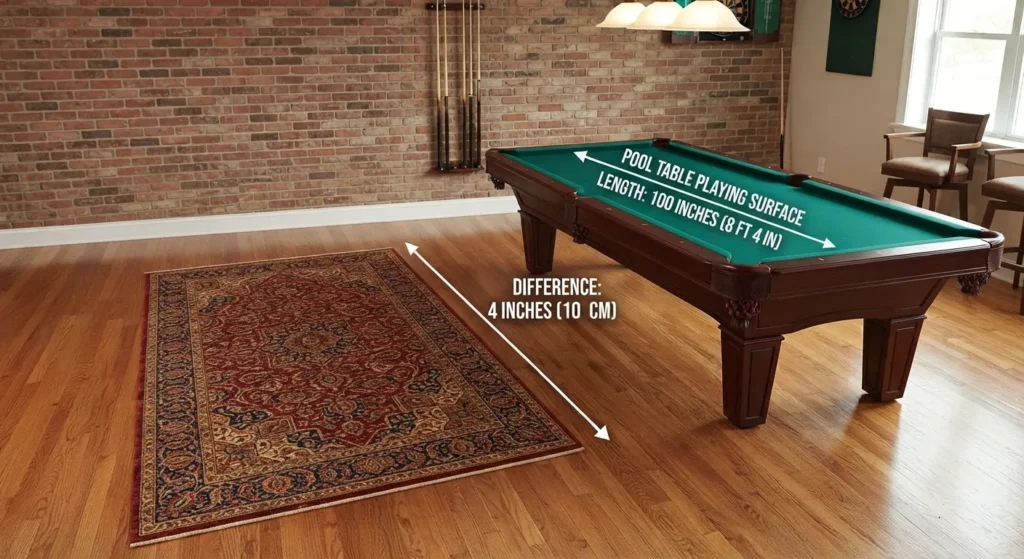
An 8-foot rug dimension equals 96 inches. That is only 4 inches shorter than the 100-inch playing surface of a typical 9-foot pool table.
A rug provides a useful floor-level comparison because it helps you imagine the table’s long dimension in a room. The other rug dimension varies, so the length alone does not represent the complete table footprint.
If you’re planning a game room, an appropriately sized rug or removable floor markings can help you visualize where the table might sit. You’ll still need to account for cue clearance around every side.
4. A Compact Six-Foot Sofa
A compact sofa around 72 inches long is a little shorter than a 7-foot pool table’s 78-inch playing surface. The difference is about 6 inches.
Sofas come in many widths and lengths, so this is an approximate comparison rather than a fixed furniture standard. Still, a familiar sofa can help you picture how much space the long side of the table occupies.
The important difference is the space needed around each object. A sofa can often sit close to a wall, while a pool table needs additional room for players and cue movement.

5. A Standard Interior Door
Many US interior doors are approximately 80 inches tall. That is close to the 78-inch playing-surface length of a 7-foot pool table.
The comparison works best when you imagine the door laid flat along the table’s long side. It provides a familiar way to visualize a measurement of just over 6.5 feet.
Doorways are also relevant when a table is delivered. The table may need to be disassembled or moved in sections, so check the delivery dimensions and route into the room before making arrangements.

6. A Six-Foot Folding Table
A common 6-foot folding table is about 72 inches long. The playing surface of a typical 7-foot pool table is around 78 inches long, making it roughly half a foot longer.
A folding table offers an easy comparison because it is another rectangular surface used for games, meals, or projects. Its width can vary, so compare the length rather than assuming the full dimensions match.
The pool table’s rails and cabinet extend beyond the playing area. For this reason, the complete table may take up more space than the folding-table comparison initially suggests.

7. A Standard Pool Cue
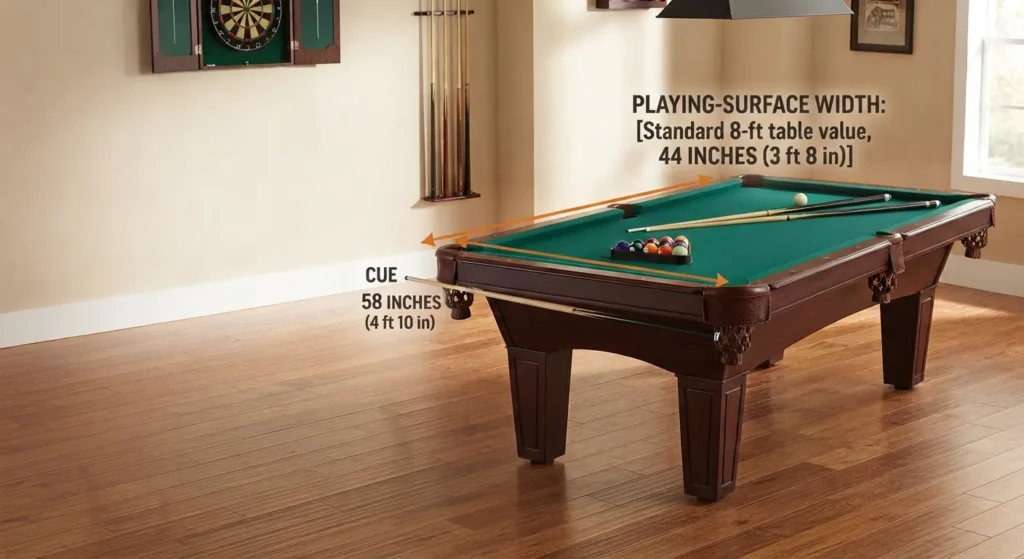
A typical pool cue is around 57–58 inches long, or just under 5 feet. It is shorter than the 78-inch playing surface of a 7-foot table, but it still needs plenty of room to move.
This is one of the most relevant comparisons because cue length affects how much clear space players need around the table. Shots near a wall can become awkward if there isn’t enough room to pull the cue back.
Imagine holding a cue beside the table’s short side. Its length makes it easier to understand why measuring only the table’s footprint is not enough when planning a game room.
8. A Three-Foot-Wide Desk
A desk that measures 36 inches wide is close to the 39-inch width of a typical 7-foot pool table’s playing surface. The table’s playing area is only 3 inches wider.
Desk dimensions vary, so use an actual measurement if you have a particular desk in mind. The comparison helps you picture the width, which is easy to overlook when pool tables are described mainly by their length.
The full pool table is wider than its playing surface because of the rails and cabinet. Allow extra space when planning where to place it.

9. A 100-Inch Projector Screen
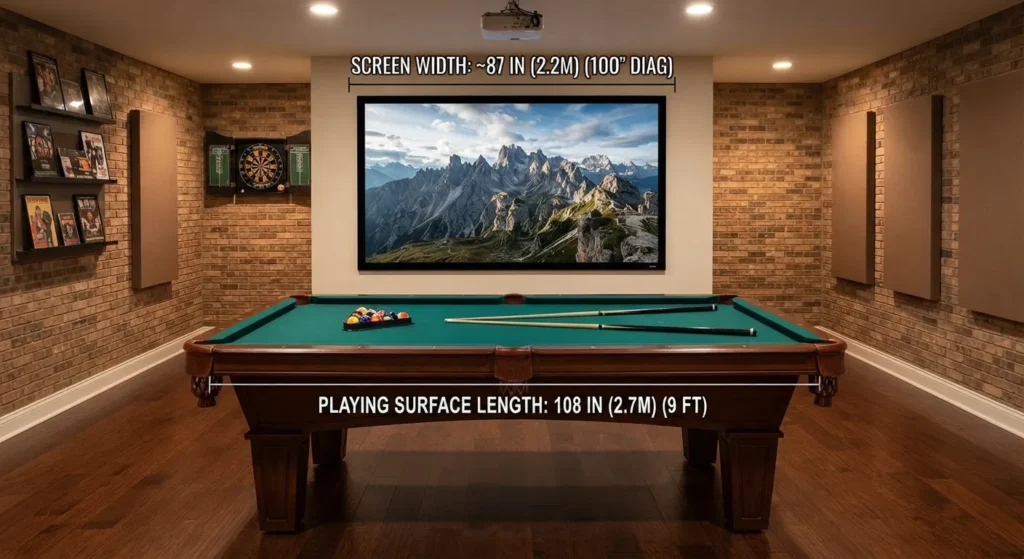
A 100-inch projector screen is usually measured diagonally. For a standard 16:9 screen, that diagonal corresponds to a width of about 87 inches, depending on the screen’s exact dimensions.
That is shorter than the 100-inch playing-surface length of a 9-foot pool table. The comparison is useful for home entertainment rooms, but remember that a screen’s advertised diagonal is not its width.
If you’re combining a pool table and a projector setup, consider where players will stand and whether the table or cue could obstruct the view. The room layout matters more than matching the two numbers.
10. A Six-Foot Yoga Mat
Many yoga mats are around 68–72 inches long. That makes a typical mat somewhat shorter than the 78-inch playing surface of a 7-foot pool table.
The mat is a useful reference for the long dimension, but it is much narrower than the playing surface. Place it mentally along the length of the table to picture the difference.
Yoga mats vary by brand and style, so this is an approximate comparison. Check the listed length if you want to use one as a planning reference.

11. A Four-Foot-Wide Workbench
A 48-inch workbench is close to the 50-inch playing-surface width of a typical 9-foot pool table. The difference is only about 2 inches.
This comparison helps make the width of a larger pool table more tangible. The table is more than 4 feet wide across the playing area, before adding the rails and cabinet.
A workbench’s dimensions are not a substitute for the actual table specifications. Use the comparison to visualize the scale, then confirm the table’s exterior width before planning the room.

12. A Ten-Foot Floor Marking
Ten feet equals 120 inches, which is longer than the 100-inch playing surface of a typical 9-foot pool table. A 10-foot line on the floor can therefore provide a quick reference for the table’s length.
Marking the floor with removable tape is particularly helpful when a room looks larger in photographs than it feels in person. You can outline the approximate playing area and see how it relates to doors, furniture, and walking paths.
The line only represents length. To plan the full setup, mark the width as well and leave room around the table for comfortable cueing.

How Much Room Do You Need Around a Pool Table?
The table’s playing surface is only one part of the space calculation. Players also need enough room to hold and move a cue without striking walls, furniture, or other obstacles.
A useful initial estimate is to allow about 5 feet of clear space beyond each edge of the playing surface for a standard-length cue. This is a planning guideline, not a universal guarantee; the table’s exterior dimensions and your actual cueing needs should be considered.
| Table size | Playing surface | Approximate room area with 5 ft clearance on each side |
|---|---|---|
| 7-foot | 6.5 × 3.25 ft | 16.5 × 13.25 ft |
| 8-foot | 7.33 × 3.67 ft | 17.33 × 13.67 ft |
| 9-foot | 8.33 × 4.17 ft | 18.33 × 14.17 ft |
These room estimates add 10 feet to both playing-surface dimensions—5 feet on each side. They do not include additional space for seating, walking routes, or obstructions, and they use playing-surface measurements rather than the larger exterior footprint.
Why Cue Clearance Matters
A standard pool cue is usually around 57–58 inches long. When the cue ball is near a rail, a player may need most of that length to line up and complete a shot.
If a wall is too close, the player may need to change stance, use a shorter cue, or play an uncomfortable shot. That is why a table can physically fit in a room without the room being suitable for enjoyable play.
Measure the Usable Room, Not Just the Walls
Check the clear floor space after accounting for furniture, cabinets, door swings, columns, and radiators. A room’s wall-to-wall dimensions can be misleading if something sticks into the playing area.
Before ordering, compare your measurements with the manufacturer’s room-size guidance. If possible, mark the table footprint and clearance zone on the floor to identify potential problems early.
Estimating Pool Table Dimensions Without a Tape Measure
You can get a rough visual estimate with everyday objects, but don’t rely on it for installation. Before purchasing, use a suitable measuring tool and confirm the manufacturer’s exact specifications.
- Use a pool cue. A typical cue is about 58 inches long. Two cue lengths placed end to end represent roughly 116 inches, which is longer than a typical 9-foot table’s playing surface.
- Mark the floor with removable tape. Use a verified length reference to outline the proposed playing surface, then add the clearance needed around it.
- Compare with a folding table. A common 6-foot folding table is about 72 inches long, making it a little shorter than a 7-foot pool table’s playing surface.
- Use known room measurements. If you know the length of a wall or a measured doorway, use it as a reference. Don’t assume all doors or pieces of furniture have the same dimensions.
- Check the product specification sheet. The manufacturer’s measurements are the most reliable reference for both the playing surface and the outside cabinet.
Frequently Asked Questions
What are standard pool table dimensions?
Common playing surfaces measure approximately 39 × 78 inches for a 7-foot table, 44 × 88 inches for an 8-foot table, and 50 × 100 inches for a 9-foot table. The outside dimensions are larger because of the rails and cabinet.
How many feet long is a pool table?
The playing surface of a typical 7-foot table is about 6.5 feet long, an 8-foot table is about 7.33 feet long, and a 9-foot table is about 8.33 feet long. The nominal size label does not always represent the exact outside length.
What are pool table dimensions in cm?
Typical playing-surface dimensions are approximately 99.06 × 198.12 cm for a 7-foot table, 111.76 × 223.52 cm for an 8-foot table, and 127 × 254 cm for a 9-foot table.
What are pool table dimensions in meters?
A 7-foot table’s playing surface is around 0.991 × 1.981 meters. An 8-foot table is about 1.118 × 2.235 meters, and a 9-foot table is approximately 1.27 × 2.54 meters.
What size pool table is best for a home?
A 7-foot or 8-foot model may suit a home game room, depending on the available space and your preferences. A 9-foot table provides a larger playing surface but needs more room for comfortable cueing.
How much room do you need for an 8-foot pool table?
As an initial estimate, allow around 17 feet 4 inches by 13 feet 8 inches of clear room for an 8-foot table using a 5-foot cueing allowance around the playing surface. Check the exact exterior dimensions and manufacturer’s room-size recommendations before buying.
Is a 9-foot pool table exactly 9 feet long?
Not necessarily. The name describes a nominal table category, and the playing surface is commonly around 100 inches long, or 8 feet 4 inches. The exterior dimensions depend on the rails, cabinet, and manufacturer.
Can I put a pool table in a small room?
Possibly, but the usable room dimensions and cue clearance are more important than the table’s footprint alone. Measure carefully, consider obstructions, and explore a smaller table or shorter cue if space is limited.
Where That Leaves You
A typical pool table playing surface measures about 78–100 inches long and 39–50 inches wide, depending on whether you choose a 7-foot, 8-foot, or 9-foot model. In metric terms, that is approximately 1.98–2.54 meters long.
For a quick mental picture, compare the 7-foot table’s 78-inch playing surface with an 80-inch interior door, or imagine a 100-inch playing surface just over 8 feet long. These familiar references make the numbers easier to picture, but the complete table takes up more space.
Before you buy, verify the exact exterior dimensions and mark out the table plus cueing clearance on your floor. The best pool table is not simply the one that fits—it is the one you can play around comfortably.

Jack Harrison is a passionate writer who creates informative, engaging and easy-to-understand content for online readers. He enjoys researching new topics and sharing practical insights that help readers discover useful ideas and information.


