

Have you ever tried to buy a desk online and noticed three numbers listed beside it, such as 48 × 24 × 30 inches? Those numbers tell you more than the desk’s overall size. They show how long, deep, and tall it is—and whether it will fit in your room.
Understanding the meaning of dimensions makes everyday decisions easier. You can use dimensions to compare furniture, check appliance sizes, measure a room, choose a shipping box, or understand the measurements listed on a product page.
The confusing part is that dimensions can appear in inches, feet, centimeters, millimeters, or meters. The order of the numbers can also change depending on the product or manufacturer, so it helps to know what each measurement represents.
In simple terms, dimensions describe the size of an object or space, usually through measurements such as length, width, and height or depth. There is no single conversion for the word “dimensions” because it describes a set of measurements rather than one fixed length. Let’s look at practical examples and learn how to read dimensions confidently.
What Does Dimensions Mean in Different Units?
The word dimensions refers to the measurements used to describe an object’s size. A rectangular object is commonly described by its length, width, and height. For some products, such as boxes or refrigerators, the third measurement may be described as depth instead of height.
For example, a desk listed as 48 × 24 × 30 inches may be described as 48 inches long, 24 inches deep, and 30 inches high. The units tell you how large each measurement is, while the dimensions tell you which measurements describe the object.
Common measurement units used for dimensions
| Unit | Equivalent |
|---|---|
| 1 foot | 12 inches |
| 1 inch | 2.54 centimeters |
| 1 inch | 25.4 millimeters |
| 1 foot | 30.48 centimeters |
| 1 meter | 100 centimeters |
| 1 meter | 1,000 millimeters |
| 1 meter | Approximately 3.281 feet |
| 1 yard | 3 feet |
These conversions are useful when dimensions are listed in a unit you’re less familiar with. If a cabinet is 36 inches wide, for example, you can divide 36 by 12 to find that it is 3 feet wide.
To convert inches into centimeters, multiply the number of inches by 2.54. A 24-inch measurement equals 60.96 centimeters, while a 30-inch measurement equals 76.2 centimeters.
What is the difference between dimensions and size?
The words are closely related, but they are not always used in the same way. Size is a general description, such as small, medium, or large. Dimensions usually give specific numerical measurements that explain the size.
For instance, saying that a table is large gives you a rough impression. Saying it measures 60 inches long, 30 inches wide, and 30 inches high gives you useful information for planning where it will go.

Where Dimensions Fit Into Everyday Measurements
Dimensions are useful whenever an object’s size matters. You will see them on furniture listings, appliance specifications, construction drawings, packaging labels, room plans, and many other everyday items.
The key is to understand which direction each number measures. Length usually describes the longest horizontal side, width describes the distance across the object, and height measures from bottom to top. Depth commonly describes how far an object extends from front to back.
However, there is no universal order that every manufacturer follows. Some products use length × width × height, while others list width × depth × height. Always check the product description or diagram before relying on the numbers.
| Example | Common dimensions | What the numbers describe |
|---|---|---|
| Desk | 48 × 24 × 30 in | Length × depth × height |
| Door | 36 × 80 in | Width × height |
| Shipping box | 12 × 10 × 8 in | Length × width × height |
| Refrigerator | 36 × 30 × 70 in | Width × depth × height |
| Room | 12 × 14 ft | Length × width of the floor |
These are illustrative examples, not universal product sizes. Actual measurements vary by design, model, and manufacturer.
One important detail: dimensions are not the same as area or volume. A room measuring 12 × 14 feet has a floor area of 168 square feet. If you also know the ceiling height, you can calculate its approximate volume.

12 Everyday Examples That Explain Dimensions
The easiest way to understand dimensions is to connect the numbers with objects you already recognize. These examples show how measurements describe different shapes, directions, and spaces.
1. A Desk: Length, Depth, and Height
A desk might measure 48 inches long, 24 inches deep, and 30 inches high. These three measurements tell you how much floor space it occupies and how tall the work surface will be.
The length measures from one side of the desk to the other along its longer edge. Depth measures from the front edge toward the back, while height runs vertically from the floor to the desktop.
These numbers are particularly useful when buying a desk for a bedroom or home office. A desk can be long enough for a monitor but too deep for a narrow room.
Picture the desk standing against a wall. The length runs along the wall, the depth extends into the room, and the height determines how high you sit or stand while using it.

2. A Door: Width and Height
A common interior door in the United States measures around 30 to 36 inches wide and 80 inches tall, although sizes vary. A door listing may therefore show two dimensions rather than three.
Width tells you how far the door extends horizontally when viewed from the front. Height measures from the bottom edge to the top edge.
These dimensions matter when replacing a door, checking whether furniture can pass through an opening, or planning a renovation. The door slab and the rough opening in the wall are not necessarily the same size.
Imagine standing in front of a doorway. Width runs from the left side to the right, while height extends from the floor to the top of the door.

3. A Shipping Box: Length, Width, and Height
A rectangular shipping box measuring 12 × 10 × 8 inches has three separate dimensions. Depending on the seller’s convention, these numbers commonly represent length, width, and height.
The length and width describe the base of the box, while height measures how far it rises from the bottom to the top. These numbers help determine whether an item fits inside and how much space the package takes up.
Packaging companies use dimensions to plan storage, transport, and shipping. However, the box’s external dimensions may be slightly larger than the usable interior space because the cardboard walls have thickness.
Picture the box sitting on a table. You can measure the longest side of the base, the shorter side across it, and the vertical distance to the lid.

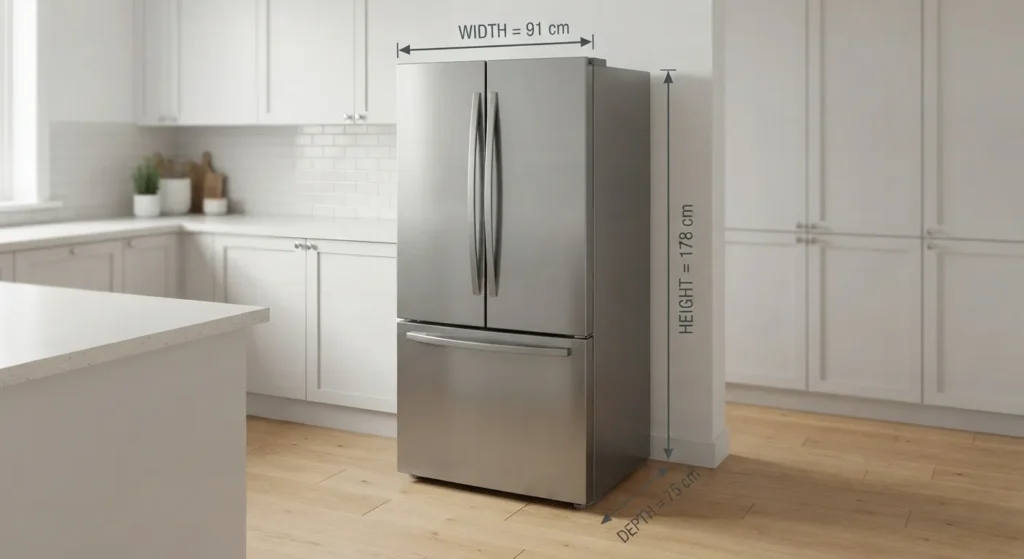
4. A Refrigerator: Width, Depth, and Height
A full-size refrigerator might be approximately 36 inches wide, 30 inches deep, and 70 inches high. The exact dimensions depend on the model and whether handles are included.
Width tells you how much space the refrigerator needs across the kitchen. Depth affects how far it projects beyond cabinets, and height determines whether it fits beneath overhead cabinets.
This is why checking only one measurement can cause problems. A refrigerator may fit between two walls but still extend too far into a walkway or fail to clear a cabinet above it.
Imagine the refrigerator in its intended position. Width is the side-to-side measurement, depth runs from the front toward the wall, and height rises from the floor to the top.
5. A Mattress: Length and Width
Mattress dimensions generally describe the sleeping surface’s length and width. A standard U.S. queen mattress, for example, measures 60 inches wide and 80 inches long.
Those two measurements help you compare bed sizes and check whether a mattress will fit a bed frame. The mattress thickness is a separate measurement and can vary considerably between models.
A mattress’s dimensions are particularly important in smaller bedrooms, where a larger bed may reduce walking space around the furniture. You also need to consider the frame, which may be larger than the mattress itself.
Picture a queen mattress from above as a rectangle. Its shorter edge is 60 inches across, and its longer edge measures 80 inches.

6. A Television: Screen Size Versus Overall Dimensions
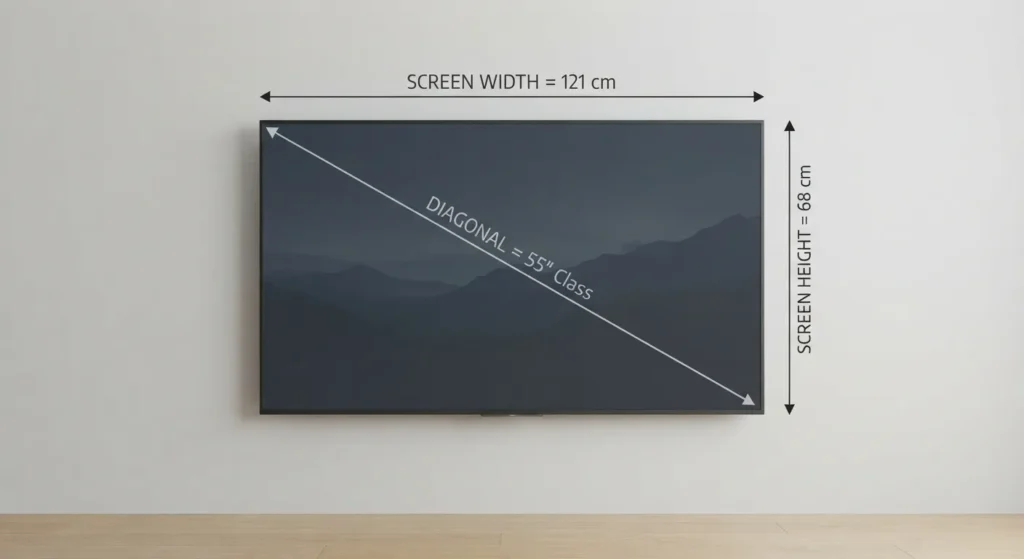
Television screen sizes are usually advertised by their diagonal measurement, not by their width or height. A 55-inch TV therefore has a screen diagonal of 55 inches, but it is not 55 inches wide.
For a typical 16:9 screen, a 55-inch display is approximately 48 inches wide and 27 inches tall, excluding the frame. The full television may be slightly larger depending on its bezel and design.
This distinction matters when fitting a TV into a cabinet or choosing a wall mount. The diagonal tells you the advertised screen size, while the width and height tell you how much physical space the set occupies.
Imagine drawing a line from one corner of the screen to the opposite corner. That is the diagonal measurement used to describe the screen size.
7. A Dining Table: The Difference Between Surface and Height
A rectangular dining table might measure 60 inches long, 36 inches wide, and around 30 inches high. These measurements describe its tabletop and vertical height.
Length and width determine how many place settings may fit comfortably, while height affects how the table works with dining chairs. The thickness of the tabletop and the shape of the legs can affect clearance underneath.
When shopping for a table, dimensions help you decide whether there is enough room for people to sit and move around it. You should also leave space between the table and nearby walls or furniture.
Picture the tabletop as a flat rectangle viewed from above, then imagine its legs extending down to the floor. The flat surface has length and width; the legs and tabletop together establish the overall height.

8. A Room: Floor Dimensions and Ceiling Height
A room measuring 12 feet by 14 feet has two floor dimensions: length and width. If its ceiling is 8 feet high, that adds a third measurement describing the vertical space.
The floor area is 12 × 14, which equals 168 square feet. If you multiply that area by an 8-foot ceiling height, the room’s simple rectangular volume is 1,344 cubic feet.
Room dimensions help with furniture placement, flooring estimates, painting projects, and many renovation decisions. Real rooms may have alcoves, sloping ceilings, or irregular shapes, so a simple rectangle may not describe every space perfectly.
Imagine standing in a corner and looking across the floor. One measurement runs along one wall, the second runs along the perpendicular wall, and the third extends from the floor to the ceiling.

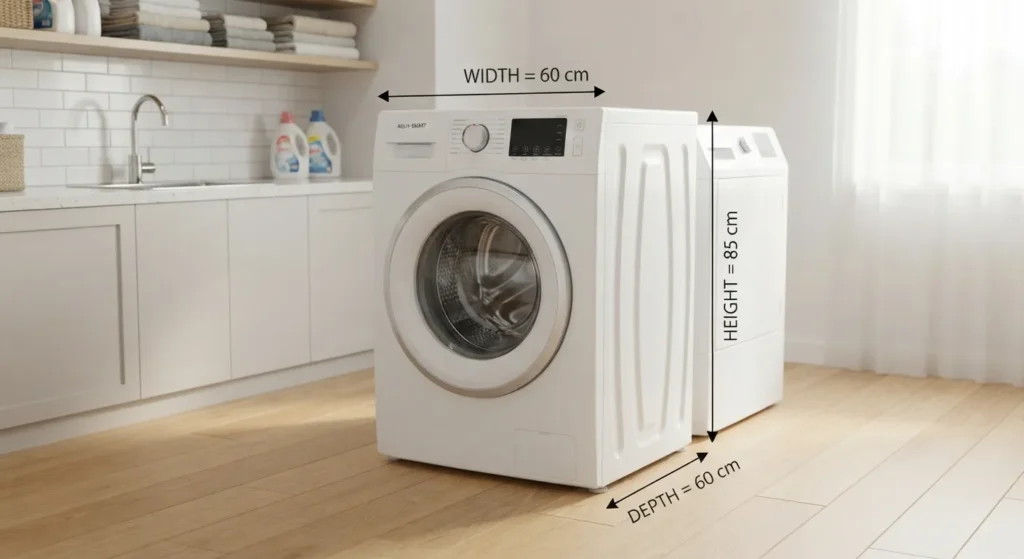
9. A Washing Machine: Width, Depth, and Height
A front-loading washing machine may be around 27 inches wide, 30 to 34 inches deep, and roughly 39 inches high, though the exact figures vary by model.
The width determines how much horizontal space the machine needs. Depth is particularly important because hoses and door clearance may require additional room behind or in front of the appliance.
Checking all three dimensions before buying helps prevent installation problems. The appliance’s listed depth may not account for every hose, plug, or open-door requirement.
Imagine the washer in a laundry alcove. Measure from side to side for width, from the front toward the wall for depth, and vertically from the floor to the top for height.
10. A Smartphone: Height, Width, and Thickness
A smartphone is often described using height, width, and thickness. For example, a device may be around 6 inches tall, 3 inches wide, and less than half an inch thick.
Height and width describe the front face of the phone. Thickness measures the distance between the front and back surfaces.
These dimensions matter when choosing a protective case, checking whether the phone fits in a pocket, or comparing devices. Screen size is a separate specification and is usually measured diagonally.
Hold a phone upright in your hand. The longest edge is its height, the shorter horizontal edge is its width, and the thin side profile shows its thickness.

11. A Book: Height, Width, and Spine Thickness
A paperback book might measure about 8 inches high, 5 inches wide, and around half an inch thick. Books vary by format, publisher, page count, and binding style.
Height and width describe the front cover, while thickness measures the spine from the front cover to the back cover when the book is closed. A large hardcover reference book may be much wider and thicker than a small paperback.
These dimensions can help when organizing shelves, packing books, or planning storage. Shelf depth matters as well, because a book may fit vertically but extend beyond the shelf’s front edge.
Picture a closed book lying flat. Its cover gives you the height and width, while the spine reveals the thickness.

12. A Laptop: Screen Size and Body Dimensions
A laptop may have a screen advertised as 15.6 inches, but its overall body dimensions include the keyboard deck and frame around the screen. The physical width is often around 14 inches, depending on the model.
The screen measurement is diagonal, while the laptop body’s width and depth describe the space it occupies on a desk. Thickness indicates how tall the closed laptop is when measured from its bottom to the top cover.
This difference matters when choosing a laptop sleeve or checking whether a computer fits into a bag. A sleeve needs to accommodate the body dimensions, not just the screen’s diagonal size.
Imagine the laptop closed on a desk. Measure the long side across the keyboard deck, the front-to-back distance, and the thickness from the desk to the top cover.

What Does L × W × H Mean on a Product?
When you see L × W × H, the letters usually stand for length × width × height. It is a common way to present the three dimensions of a box, storage container, piece of furniture, or other three-dimensional object.
For example, a box labeled 12 × 10 × 8 inches may be described as 12 inches long, 10 inches wide, and 8 inches high. But you should check the seller’s diagram or specification because the first two measurements can sometimes be ordered differently.
How do you read dimensions correctly?
- Length (L): Usually the longest horizontal side.
- Width (W): The horizontal measurement across the object.
- Height (H): The vertical measurement from bottom to top.
- Depth (D): Often the front-to-back measurement, particularly for furniture and appliances.
The labels are more important than guessing based on the order of the numbers. A manufacturer might list a refrigerator as width × depth × height, while a shipping company might use length × width × height.
What is the difference between dimensions, area, and volume?
Dimensions describe individual measurements. Area describes the amount of surface covered, while volume describes the amount of three-dimensional space an object occupies.
For a rectangular box, you can calculate volume by multiplying length × width × height. A 12 × 10 × 8-inch box has a geometric volume of 960 cubic inches, although its usable interior capacity will be lower if the walls have thickness.

How to Understand Dimensions Without a Tape Measure
You can often estimate an object’s size using familiar references, but estimates are not substitutes for exact measurements. These methods are useful for visualization and quick comparisons.
1. Use a standard sheet of paper
U.S. Letter paper measures 8.5 × 11 inches, while A4 paper measures approximately 8.27 × 11.69 inches. If you know which paper standard you have, it can help you estimate a nearby object’s dimensions.
2. Compare with a familiar door
Many U.S. interior doors are around 80 inches tall. A door gives you a useful reference when estimating the height of a cabinet, bookshelf, or other household object, although not all doors have the same dimensions.
3. Check a product specification
A desk, appliance, or screen may have its dimensions listed on the manufacturer’s website. This can be more reliable than estimating by sight, especially when you need to know whether an object will fit into a specific space.
4. Use a known furniture measurement
If you know that your mattress is a standard queen size, its 60 × 80-inch dimensions provide a reference for estimating the floor space taken up by nearby furniture.
5. Sketch the object as a rectangle
Draw the object and label each side. For a three-dimensional item, add a vertical line to represent height and a line extending toward the back to represent depth. This simple sketch helps you separate the measurements instead of treating them as one number.
If you’re buying furniture or appliances, confirm the actual dimensions before placing an order. A visual estimate can help you understand size, but a few inches can determine whether an item fits through a doorway or into an alcove.
Frequently Asked Questions
What does dimensions mean?
Dimensions are numerical measurements that describe the size of an object or space. They commonly include length, width, and height or depth.
What does 12 × 10 × 8 inches mean?
It means the object has three measurements of 12, 10, and 8 inches, often listed as length, width, and height. Check the manufacturer’s diagram to confirm the order.
What is the difference between dimensions and measurements?
A measurement is an individual value, such as 12 inches. Dimensions usually refer to multiple measurements that describe an object’s overall size.
What does L × W × H stand for?
L × W × H stands for length × width × height. It is a common format for describing boxes, furniture, and other three-dimensional products.
Are dimensions measured in inches or feet?
They can be measured in inches, feet, centimeters, millimeters, or meters. The unit depends on the product, industry, country, and level of detail needed.
What does depth mean in dimensions?
Depth usually measures how far an object extends from front to back. It is often used for cabinets, refrigerators, shelves, and other items that project into a room.
How do you calculate the area from dimensions?
For a rectangle, multiply its length by its width. If both measurements are in feet, the result is in square feet; if both are in meters, the result is in square meters.
How do you calculate volume from dimensions?
For a rectangular object, multiply length by width by height. Make sure all three measurements use the same unit before calculating the volume.
Where That Leaves You
The meaning of dimensions becomes much easier to understand when you connect the numbers with the object itself. Length, width, and height describe different directions, while depth often tells you how far an item extends from front to back.
A desk, for example, might be 48 inches long, 24 inches deep, and 30 inches high. Those three measurements tell you far more about where it will fit than simply calling it a large desk.
Whenever you see dimensions on a product page, identify the direction of each measurement, check the unit, and confirm the order used by the manufacturer. Once you do that, a string of numbers becomes a practical picture of the item’s real size.

Jack Harrison is a passionate writer who creates informative, engaging and easy-to-understand content for online readers. He enjoys researching new topics and sharing practical insights that help readers discover useful ideas and information.


