
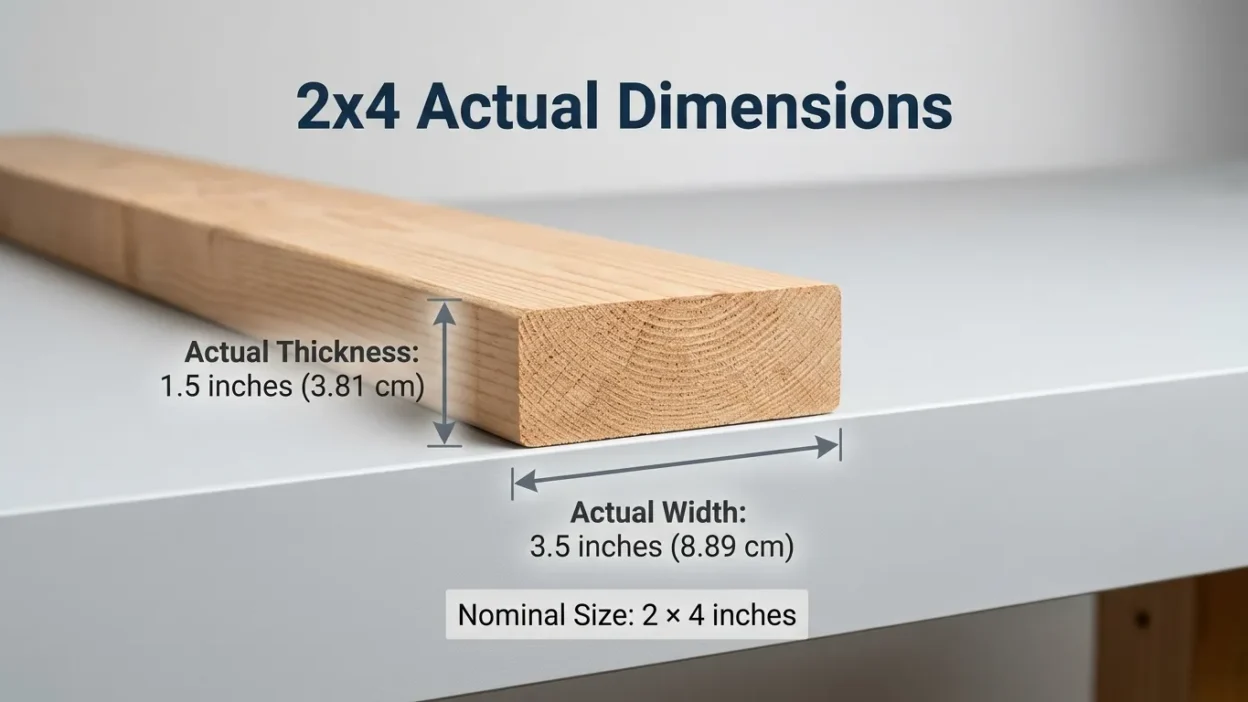
A piece of lumber labeled 2×4 sounds as though it should measure exactly 2 inches thick and 4 inches wide. Put a tape measure against a typical board, though, and you will find something different: its actual size is usually 1.5 inches thick and 3.5 inches wide.
That difference matters when you’re building a shelf, framing a wall, making a workbench, or figuring out whether several boards will fit together. Even a half-inch discrepancy can affect spacing, joints, and the finished dimensions of a project.
The reason is that a standard 2×4 is sold by its nominal size—the name assigned to the lumber—not its finished dimensions after processing. Once the wood has been dried and surfaced smooth, it becomes smaller than the original rough-cut measurement.
The 2×4 actual dimensions are typically 1.5 inches thick × 3.5 inches wide, equal to 0.125 feet × 0.2917 feet, 3.81 cm × 8.89 cm, 38.1 mm × 88.9 mm, and 0.0381 m × 0.0889 m. Its length is sold separately, commonly in options such as 8, 10, 12, and 16 feet.
This guide explains the actual measurement in inches, feet, centimeters, millimeters, and meters, compares a 2×4 with familiar objects, and shows why the difference between nominal and actual lumber size is important when planning a construction project.
Every Unit the Actual 2×4 Dimensions Convert To
A standard surfaced 2×4 board typically measures 1.5 inches by 3.5 inches across its cross-section. These two measurements describe the board’s thickness and width, not its length.
| Measurement | Nominal size | Actual size | Actual size in feet | Actual size in cm | Actual size in mm | Actual size in meters |
|---|---|---|---|---|---|---|
| Thickness | 2 in | 1.5 in | 0.125 ft | 3.81 cm | 38.1 mm | 0.0381 m |
| Width | 4 in | 3.5 in | 0.2917 ft | 8.89 cm | 88.9 mm | 0.0889 m |
These figures are typical for standard surfaced North American dimensional lumber. Specialty products, rough-sawn lumber, engineered wood, and lumber sold under different regional standards can have different dimensions.
How to convert 2×4 actual dimensions
The conversion formulas are straightforward:
- Inches ÷ 12 = feet
- Inches × 2.54 = centimeters
- Centimeters × 10 = millimeters
- Inches × 0.0254 = meters
For example, the actual 1.5-inch thickness converts to 1.5 ÷ 12 = 0.125 feet. Multiply 1.5 by 2.54 and you get 3.81 centimeters, or 38.1 millimeters.
The actual width of 3.5 inches converts to approximately 0.2917 feet, 8.89 cm, 88.9 mm, or 0.0889 meters.
What about the length of a 2×4?
The 2×4 label does not specify the board’s length. You can purchase lumber with the same cross-section in several lengths, depending on the store and product.
| Nominal board length | Length in inches | Length in feet | Length in meters |
|---|---|---|---|
| 8 ft | 96 in | 8 ft | 2.4384 m |
| 10 ft | 120 in | 10 ft | 3.048 m |
| 12 ft | 144 in | 12 ft | 3.6576 m |
| 16 ft | 192 in | 16 ft | 4.8768 m |
The listed length is a separate dimension from the board’s 1.5-by-3.5-inch cross-section. Actual usable length and end condition can vary, so check the product label and inspect the board before cutting.
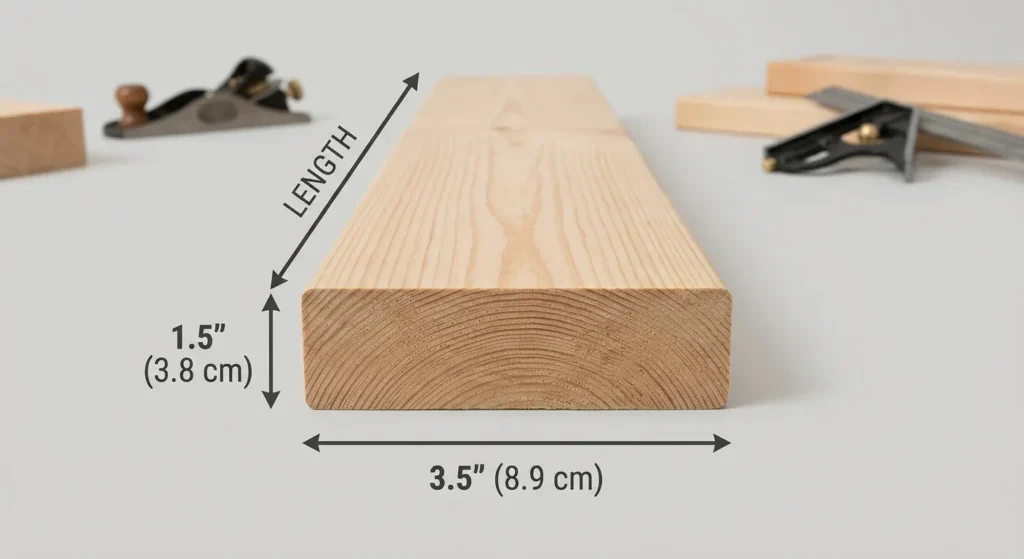
Why a 2×4 Is Smaller Than Its Name
The difference between nominal and actual lumber dimensions is one of the most important things to understand before starting a building project.
The name 2×4 refers to the board’s nominal dimensions. The board is initially cut from larger stock and then processed to create a more uniform, smooth surface. Drying and surfacing reduce its finished cross-section, leaving a standard surfaced board measuring approximately 1.5 inches by 3.5 inches.
This is not a mistake by the lumberyard. It is the established convention used for common dimensional lumber in North America.
Nominal size versus actual size
| Lumber label | Typical actual thickness | Typical actual width |
|---|---|---|
| 1×2 | 0.75 in | 1.5 in |
| 1×4 | 0.75 in | 3.5 in |
| 2×2 | 1.5 in | 1.5 in |
| 2×4 | 1.5 in | 3.5 in |
| 2×6 | 1.5 in | 5.5 in |
| 2×8 | 1.5 in | 7.25 in |
| 2×10 | 1.5 in | 9.25 in |
| 2×12 | 1.5 in | 11.25 in |
These are common actual sizes for surfaced dimensional lumber, but you should verify the product’s specifications. Not every wood product follows this exact pattern.
Notice that a board’s nominal thickness and width do not always shrink by the same amount. A nominal 2×4 becomes 1.5 × 3.5 inches, while a nominal 2×12 commonly becomes 1.5 × 11.25 inches.
Why the difference matters in construction
Suppose you are building a rectangular frame using 2×4 lumber. If you calculate the design using the nominal 2-inch thickness instead of the actual 1.5-inch thickness, the finished dimensions may be wrong.
The same issue arises when fitting shelves between supports, designing furniture joints, installing insulation, or estimating how much space a frame will occupy. For accurate work, use the actual measurements rather than the name printed on the lumber.

12 Things That Help You Visualize a 2×4
A 2×4 is not a particularly large piece of wood across its face, but its dimensions become easier to picture when you compare them with familiar objects. The following examples focus on its actual 1.5-inch thickness and 3.5-inch width.
These are visualization aids, not substitutes for measuring lumber. Some comparisons match one dimension more closely than another.
1. A Standard Deck of Playing Cards
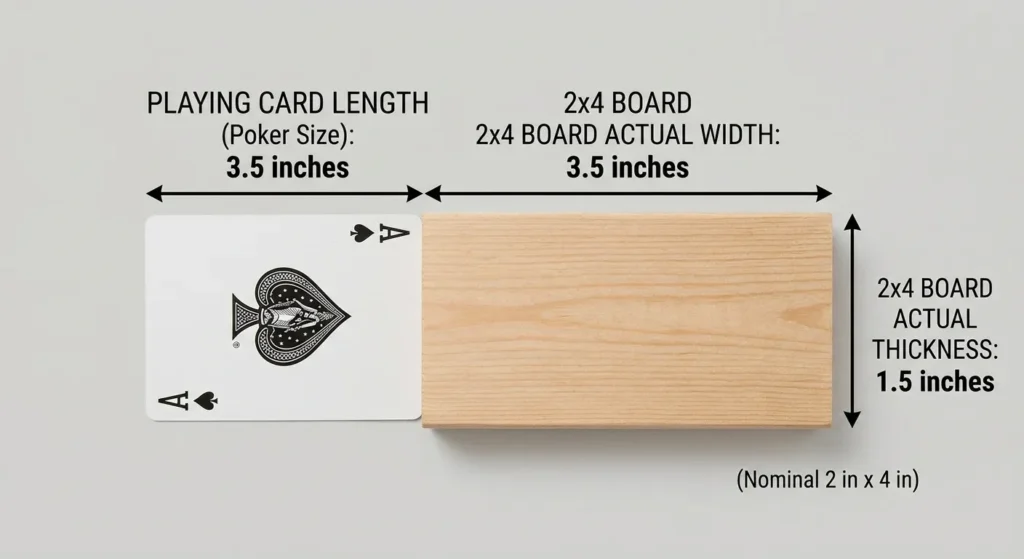
A typical poker-size playing card measures about 2.5 inches wide and 3.5 inches tall. That makes its 3.5-inch side close to the actual width of a 2×4 board.
The card is much thinner than the lumber, of course, so it only helps you picture one dimension. Imagine the short end of the board as being roughly as wide as the long side of a playing card.
Playing cards are made to standard formats, although dimensions can vary slightly by manufacturer and card style. Use the comparison to visualize the board’s face rather than its structural thickness.
2. A 3.5-Inch Computer Diskette
Older 3.5-inch floppy disks have a square outer casing measuring roughly 3.5 inches across. That is close to the actual width of a standard 2×4 board.
If you remember these storage disks, picture one placed against the broad face of the lumber. The disk’s side-to-side dimension gives you a familiar reference for the board’s width.
The comparison is especially useful because the disk’s name includes its size class. However, the measurement is approximate for visualization, and the casing’s exact external dimensions should not be treated as a woodworking reference.

3. A Small Sticky Note
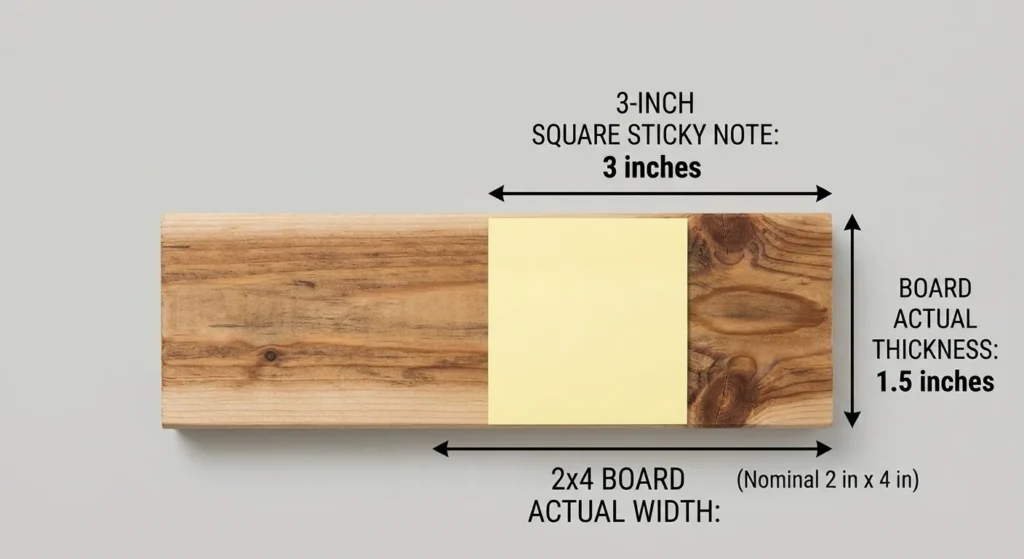
Some small square sticky notes measure around 3 × 3 inches, while other common formats are larger. A 3-inch note is slightly narrower than the 3.5-inch face of a 2×4.
That difference is only half an inch in total, so the note still offers a helpful mental picture. Imagine a small square of paper sitting on the board’s broad face, leaving a narrow strip of wood visible along one side.
Sticky-note sizes vary, so check the package if you want a closer comparison. This example is for visual scale, not for laying out a precise cut.
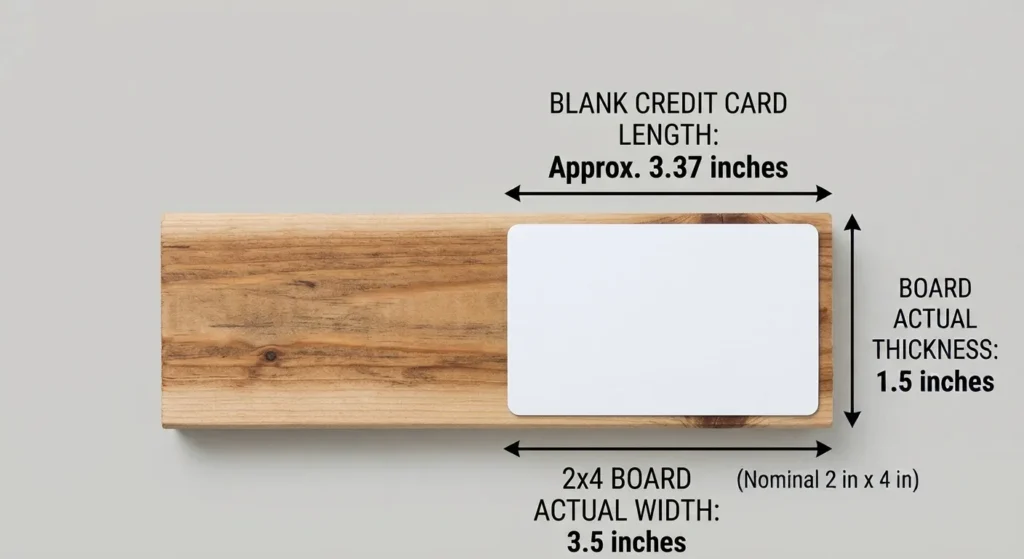
4. A Credit Card’s Short Side
A standard credit card is approximately 3.37 inches long and 2.125 inches wide. Its long edge is close to the 3.5-inch width of a 2×4, falling short by about 0.13 inch.
That makes a credit card a convenient everyday reference for the lumber’s broad face. Place the long edge of the card beside the board’s width and the difference is relatively small.
A payment card is far thinner than a board, so it does not help you estimate the lumber’s 1.5-inch thickness. It is best used as a quick width comparison.
5. A Smartphone’s Width
Smartphones vary substantially in size, but many modern models are around 2.5 to 3.2 inches wide. That puts their width in the general neighborhood of a 2×4’s actual 3.5-inch face.
A larger phone may come fairly close, while a compact model can leave a more noticeable gap. This is a useful comparison when you want to picture the lumber without reaching for a ruler.
Phone dimensions are model-specific, and protective cases can make devices wider. Use a phone as a rough reference only; it is not a dependable measuring tool for a construction project.

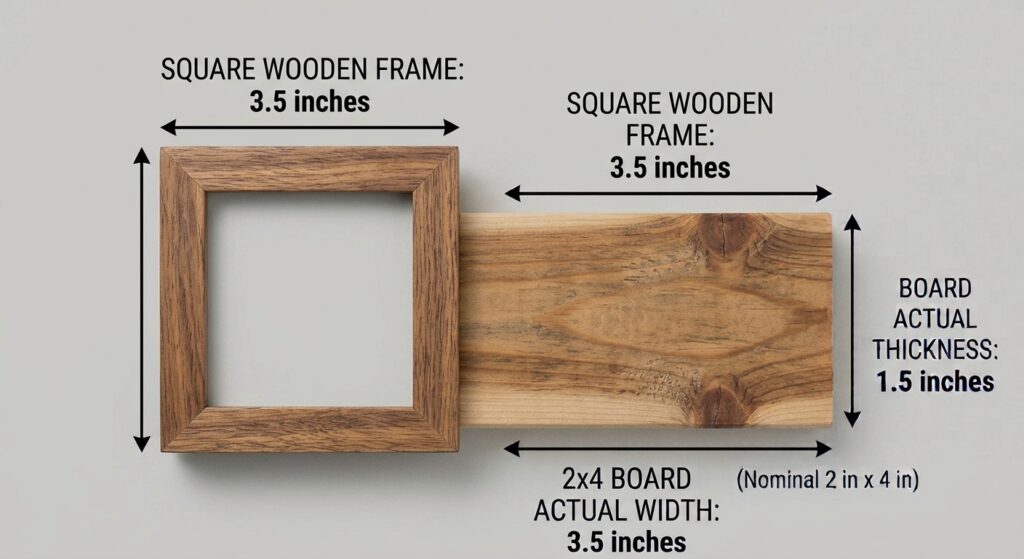
6. A Compact Wooden Picture Frame
A small picture frame with a 3.5-inch outside edge can provide a direct comparison for the board’s width. Compact frames come in many formats, so this example works best when you know the frame’s actual measurement.
The frame’s outside edge may be similar in width to the lumber’s broad face, even though its shape and thickness are very different. This helps you picture the space occupied by a 2×4 when viewed from the front.
For a project involving trim or framing, remember that frame sizes may refer to the photograph or artwork rather than the outer dimensions. Always distinguish the opening size from the frame’s total width.
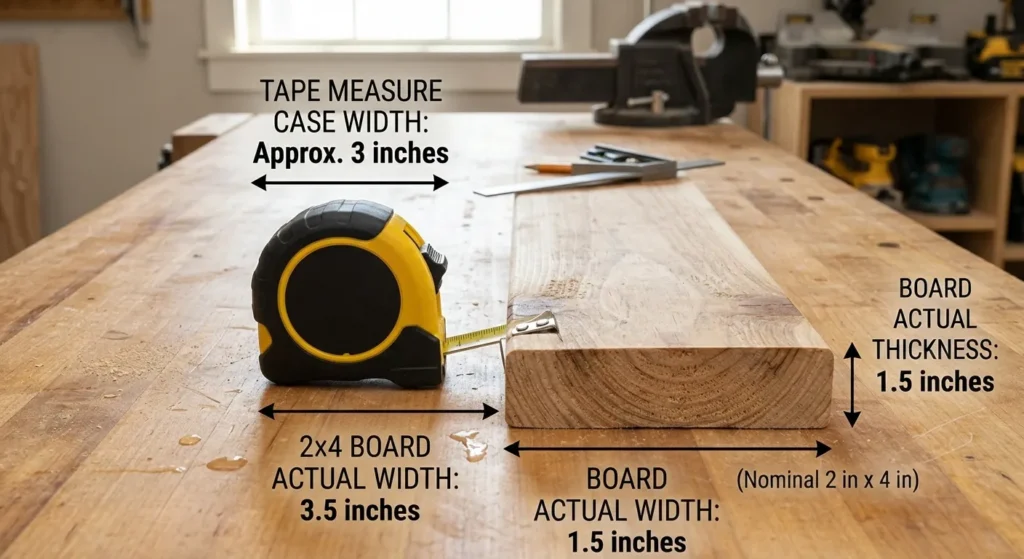
7. A Standard Tape Measure’s Case
Many tape-measure cases are around 2.5 to 3.5 inches across, depending on the model. A larger case may be close to the 3.5-inch width of a 2×4.
This comparison is particularly convenient on a worksite because you may already have a tape measure in your hand. The case gives you a rough reference for the board’s broad face, while the extended tape provides the actual measurement.
Not all tape measures have the same case dimensions. If accuracy matters, use the tape itself rather than assuming the case is a specific width.
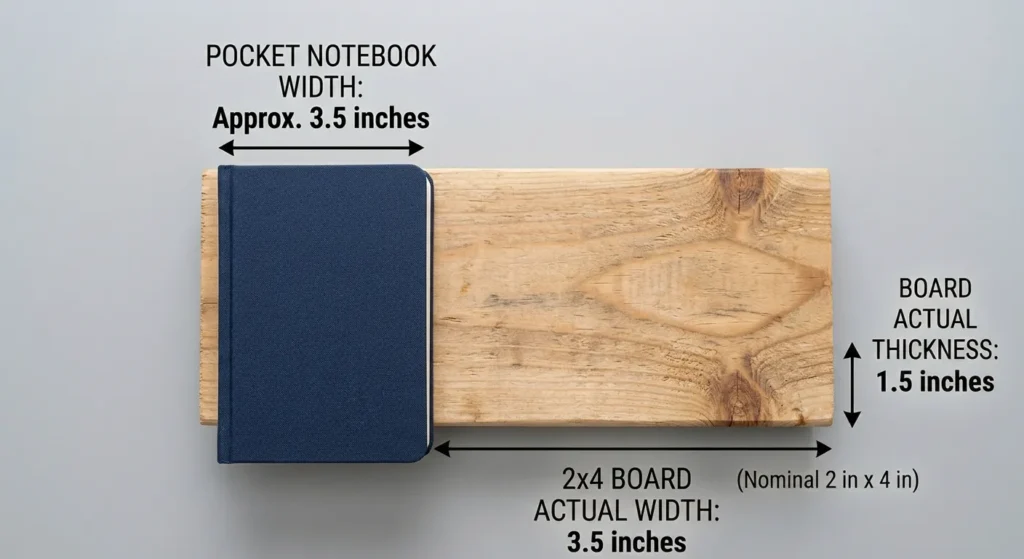
8. A Small Hardcover Notebook
Compact notebooks often measure around 3 to 4 inches across their shorter side. A notebook near 3.5 inches wide can be close to the broad face of a 2×4.
This is a practical comparison for people who keep a small notebook in a pocket or toolbox. Imagine the notebook’s width against the board to get a feel for how broad the timber is.
Notebook dimensions differ by format and manufacturer, so not every pocket notebook will match. The comparison is intended to make the measurement easier to imagine, not to replace an actual measurement.
9. A 1.5-Inch Stack of Wooden Blocks
The thickness of a typical surfaced 2×4 is 1.5 inches. A stack of wooden blocks that measures 1.5 inches high can therefore represent that dimension directly.
For example, three half-inch-thick pieces stacked together would reach 1.5 inches, provided each piece is actually that thick. This makes the thickness easier to visualize than trying to estimate it from the board’s much wider face.
The accuracy of the comparison depends on the blocks themselves. If you are using scrap wood, measure the pieces first, because their labeled or intended thickness may not match their actual dimensions.

10. A Standard Brick’s Shorter Dimension
Bricks are manufactured in several sizes, and their dimensions depend on the type and regional standard. Some common bricks have a width or depth in the general range of 3.5 to 4 inches.
That can make a brick’s shorter dimension a rough reference for the 3.5-inch width of a 2×4. Place the two side by side and you can see whether their widths are close, though the result depends on the particular brick.
Do not use brick dimensions as a universal standard. If your project requires a precise clearance, measure the actual brick and the actual lumber rather than relying on a general comparison.

11. A Small Cutting Board
Some compact kitchen cutting boards are around 8 to 10 inches wide, so they are considerably wider than a 2×4’s 3.5-inch face. They are not an exact match, but a small board can help you understand the scale of a lumber piece when viewed alongside it.
For example, the broad face of a 2×4 is a little under half the width of an 8-inch cutting board. This is useful when imagining the lumber as a narrow structural member rather than a large tabletop surface.
Cutting-board sizes vary widely, so the comparison is meaningful only if you know the board’s dimensions. Choose a smaller reference object when you want a closer match to the 3.5-inch width.

12. Two 2×4 Boards Placed Side by Side
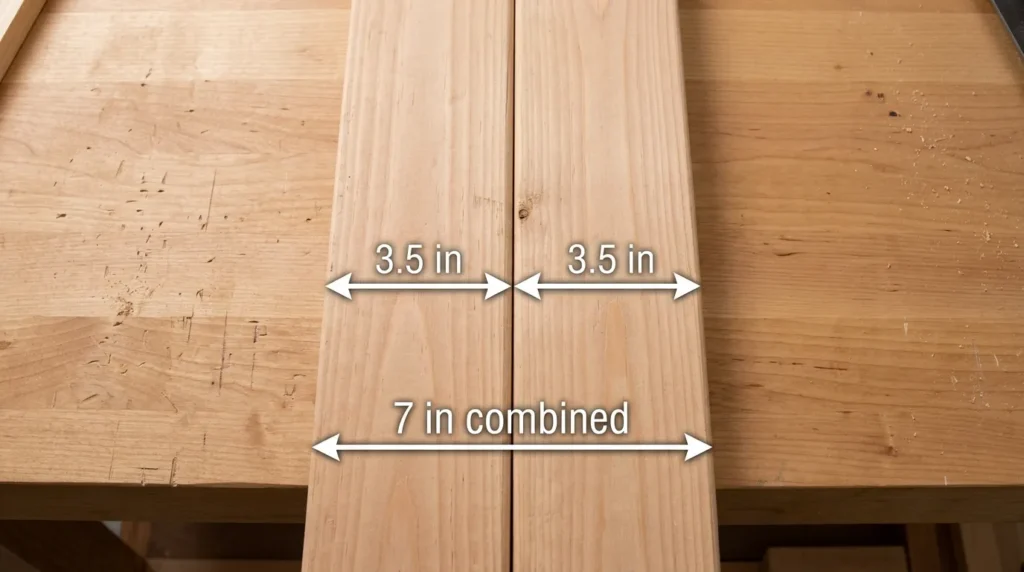
One of the clearest comparisons uses the lumber itself. Two standard 2×4 boards placed side by side along their widths cover about 7 inches in total, assuming their edges meet without gaps.
This makes it easy to see how the actual 3.5-inch width combines in a real construction layout. The nominal labels might suggest a combined width of 8 inches, but the actual combined measurement is closer to 7 inches.
The same principle matters when building frames, tables, and wall assemblies. Always base the final layout on the actual dimensions and the way the pieces are positioned.
The Nominal Lumber Size Question Builders Actually Ask
One of the most common questions about 2×4 actual dimensions is whether the board really measures 2 inches by 4 inches. For standard surfaced North American lumber, the answer is no: the usual finished cross-section is 1.5 inches by 3.5 inches.
The nominal label remains useful because it identifies a familiar lumber category, but it should not be used as the final measurement when planning a build.
Why are 2×4 boards called 2×4 if they are smaller?
The name refers to the nominal dimensions associated with the lumber category, while the actual size reflects the finished board after drying and surfacing. The convention allows builders and retailers to refer to a common product type using a familiar name.
It is similar to how a product name can identify a standard category without describing every final physical measurement. For a project drawing, however, the actual cross-section is the dimension that determines the space the board occupies.
What is the actual size of a 2×4 in a wall?
A standard 2×4 wall stud typically has an actual cross-section of 1.5 × 3.5 inches. When installed with its 3.5-inch dimension across the wall’s depth, it contributes to a nominal 2×4 framing wall.
The finished wall is usually thicker than the stud alone because drywall, sheathing, siding, or other layers may be added. The final wall thickness therefore depends on the complete assembly, not just the lumber.
Does the actual measurement change with board length?
The typical cross-section remains 1.5 × 3.5 inches for standard surfaced 2×4 lumber, whether the board is sold in an 8-foot or 16-foot length. Longer boards are not automatically thicker or wider.
However, different products, treatment processes, rough-sawn lumber, or specialty dimensions can depart from standard sizes. Verify the product label if your build depends on a precise fit.

Estimating 2×4 Dimensions Without a Tape Measure
If you just want a quick mental picture, several everyday references can help you estimate a board’s dimensions. They are useful for rough planning, but they are not accurate enough for cutting wood or fitting structural parts.
- Use a playing card: A poker-size card’s 3.5-inch side is close to the actual width of a 2×4.
- Picture a credit card: Its long edge is about 3.37 inches, just a little shorter than the board’s 3.5-inch width.
- Use a stack of measured blocks: Three half-inch blocks add up to 1.5 inches, matching the board’s typical thickness.
- Compare two boards: Two 2×4s placed side by side across their widths measure about 7 inches altogether.
- Check a tape-measure case only as a rough guide: Some cases are close to 3.5 inches across, but the dimensions vary by model.
For a real woodworking or construction task, use a ruler, caliper, or tape measure. Measuring the board itself is the reliable way to confirm its actual size, especially if the lumber is rough-sawn, weathered, treated, or intended for a close-fitting joint.
FAQs
What are the actual dimensions of a 2×4?
A standard surfaced 2×4 typically measures 1.5 inches thick and 3.5 inches wide. The length is separate and may be sold in several options, such as 8, 10, 12, or 16 feet.
How many feet is a 2×4 actual size?
The actual thickness is 0.125 feet, and the actual width is about 0.2917 feet. These conversions describe the board’s cross-section, not its length.
What are 2×4 actual dimensions in cm?
A typical 2×4 measures 3.81 cm thick and 8.89 cm wide. These values convert the standard actual dimensions of 1.5 × 3.5 inches.
What are 2×4 actual dimensions in mm?
The typical actual cross-section is 38.1 mm × 88.9 mm. The first value is the thickness, and the second is the width.
How many meters is a 2×4?
The actual thickness is 0.0381 meters, and the width is 0.0889 meters. If the board is 8 feet long, its nominal length converts to 2.4384 meters.
Why is a 2×4 not actually 2 inches by 4 inches?
The 2×4 name is its nominal lumber size. Drying and surfacing reduce the original dimensions, so standard finished lumber commonly measures 1.5 × 3.5 inches.
Is every 2×4 exactly 1.5 × 3.5 inches?
That is the typical actual size for standard surfaced North American dimensional lumber, but not every wood product is identical. Rough-sawn boards, specialty lumber, and products made to different standards may have other dimensions.
What can I use to visualize the width of a 2×4?
A standard poker-size playing card has a side measuring about 3.5 inches, close to the board’s actual width. A credit card’s long edge is another useful reference, at approximately 3.37 inches.
Where That Leaves You
The key measurement to remember is simple: a standard 2×4 is typically 1.5 inches thick by 3.5 inches wide, not 2 inches by 4 inches. That equals 3.81 × 8.89 centimeters, or 38.1 × 88.9 millimeters.
For an easy visual reference, compare the board’s width with the long side of a playing card or credit card. For construction, furniture making, and accurate cuts, always use the actual dimensions rather than relying on the nominal label.
That half-inch difference is not just a technical detail. It can determine whether a frame fits, a shelf lines up, or a joint comes together properly. Measure the lumber you have, plan around its finished size, and your project will start with more accurate numbers.

Jack Harrison is a passionate writer who creates informative, engaging and easy-to-understand content for online readers. He enjoys researching new topics and sharing practical insights that help readers discover useful ideas and information.


