

You can measure the length of a table, the height of a door, and the width of a room using inches or feet. But there is a bigger question hiding behind those everyday measurements: how many dimensions are needed to describe the world around us?
The answer depends on what you’re talking about. In everyday life, we experience three spatial dimensions: length, width, and height. Modern physics also treats time as a fourth dimension in spacetime, while mathematics allows us to describe spaces with many more dimensions.
This question comes up in geometry, school science, video games, astronomy, and discussions about the universe. A flat drawing, a solid object, and a moving object through time each require different ways of describing their position.
So, how many dimensions are there? There are three familiar spatial dimensions and four dimensions in the standard spacetime description used by relativity: three of space plus one of time. Higher-dimensional mathematical models also exist, and some theories in physics propose additional dimensions that have not been experimentally confirmed.
The Main Types of Dimensions Explained
A dimension describes an independent direction or coordinate needed to identify a position within a particular space. The more dimensions a model has, the more coordinates may be needed to specify where something is.
The word is used slightly differently in geometry, physics, and ordinary measurement. That’s why answers to “how many dimensions are there?” can vary without necessarily contradicting one another.
Dimensions at a Glance
| Type | What It Describes | Example |
|---|---|---|
| 0D | A point with no spatial extent | A mathematical point |
| 1D | One spatial direction | A straight line |
| 2D | Two spatial directions | A flat rectangle |
| 3D | Three spatial directions | A box or bedroom |
| 4D spacetime | Three spatial coordinates plus time | An event occurring at a place and time |
| Higher dimensions | Additional independent coordinates in a mathematical model | A point described by five or more coordinates |
A point is called zero-dimensional because it has no length, width, or height. A line needs one coordinate to locate a point along it. A flat surface needs two, while a point inside an ordinary room needs three.
The fourth dimension requires a little more care. In relativity, time is combined with the three spatial dimensions to describe events in spacetime. Time is not simply another direction you can walk toward in the same way you move left or right.
What Are the Three Spatial Dimensions?
The three spatial dimensions are the directions used to describe ordinary physical space.
- Length: How far something extends from one end to another.
- Width: How broad something is from side to side.
- Height: How tall something is from bottom to top.
For example, a rectangular box might measure 12 inches long, 8 inches wide, and 6 inches high. These three measurements describe its external size.
In feet, that box would measure 1 foot long, 8 inches wide, and 6 inches high. In centimeters, its dimensions would be 30.48 × 20.32 × 15.24 cm.
You can use inches, feet, centimeters, or meters to measure these dimensions. Changing the unit changes the number, but it doesn’t change how many spatial dimensions the object has.
Where Dimensions Appear in Everyday Life
Dimensions are not just abstract ideas from physics textbooks. They are part of almost every measurement you make at home, at school, or at work.
A one-dimensional measurement describes a distance along a line. A two-dimensional measurement describes a flat area. A three-dimensional measurement describes an object’s size in space.
| Measurement Type | Typical Units | What You Measure |
|---|---|---|
| Length | Inches, feet, cm, meters | A line or distance |
| Area | Square inches, square feet, cm², m² | A floor, wall, or sheet |
| Volume | Cubic inches, cubic feet, cm³, m³ | Space occupied by a solid or container |
| Spacetime coordinates | Spatial units and time units | An event’s location and time |
Consider a bedroom floor. Its length and width are used to calculate the floor area. If the room is 12 feet long and 10 feet wide, its area is 120 square feet.
To describe the room’s volume, you also need its height. If the ceiling is 8 feet high, the simple rectangular room volume is 960 cubic feet.
Notice the difference between the units: feet measure length, square feet measure area, and cubic feet measure volume. The number of dimensions in the measurement helps determine which unit makes sense.
12 Examples That Make Dimensions Easier to Understand
These examples show how dimensions move from simple geometry into real-world objects. Each one focuses on what information is needed to describe a shape or event.
1. A Mathematical Point: Zero Dimensions

A mathematical point has zero dimensions. It identifies a location, but it has no measurable length, width, or height.
Points are used as building blocks in geometry. For example, the corners of a rectangle can be represented by points, and lines can connect those points.
A drawn dot on paper does have a physical size because ink covers an area. The ideal mathematical point, however, is treated as having no size at all.
Imagine identifying the exact corner of a desk. You can point to its location without needing to describe a tiny object’s width or height.
2. A Straight Line: One Dimension
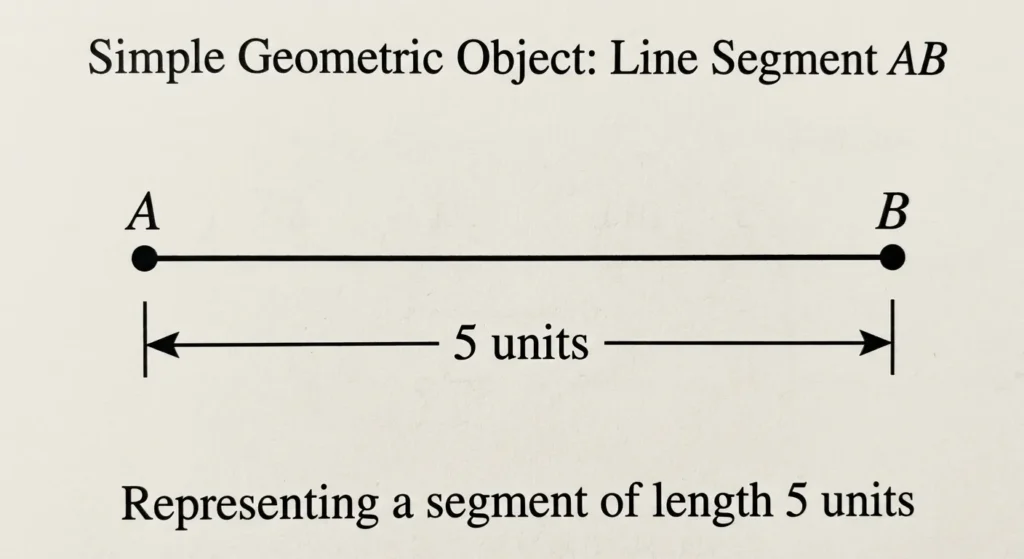
A straight line is a familiar example of one-dimensional geometry. To identify a position along it, you need only one coordinate.
In real life, a drawn line has thickness, but the mathematical model ignores that thickness. The line represents a distance or path rather than a solid object.
A line segment can be measured in inches, feet, centimeters, or meters. For example, a line segment measuring 12 inches is one foot long.
Imagine moving a marker along a straight ruler. You only need to know how far along the ruler the marker sits to describe its position.
3. A Flat Sheet of Paper: Two Dimensions

A flat sheet of paper can be described using two spatial dimensions: length and width. Its surface has area, even though a simple geometric model may treat its thickness as negligible.
A common U.S. Letter sheet measures 8.5 × 11 inches. Multiplying those measurements gives an area of 93.5 square inches.
Paper has physical thickness, of course. If you’re measuring the actual material as a solid object, thickness adds a third spatial dimension.
Picture a sheet lying flat on a desk. You can describe its outline using two measurements, while ignoring the very small distance from its top surface to its bottom surface.
4. A Rectangular Box: Three Dimensions

A rectangular box is an easy way to see three spatial dimensions at once. You need its length, width, and height to describe its overall size.
A box measuring 12 × 8 × 6 inches has a volume of 576 cubic inches. That figure comes from multiplying length by width by height.
Shipping companies often use these three dimensions to calculate package size, while some carriers also consider weight. The external measurements can matter when a parcel must fit into a vehicle or storage area.
Look at a box sitting on the floor. Its base extends in two directions, and its sides rise vertically, making the third direction visible.
5. A Bedroom: Three Dimensions in a Familiar Space

A bedroom has three spatial dimensions: length, width, and height. You need all three to describe its overall rectangular shape.
A room measuring 12 feet by 10 feet with an 8-foot ceiling has a floor area of 120 square feet and a simple volume of 960 cubic feet.
These figures help with different tasks. Floor area is useful when choosing flooring, while room volume can be relevant to some heating, cooling, and ventilation calculations.
Imagine standing in the center of the room. You can walk forward and sideways, then look up toward the ceiling. Those are three different spatial directions.
6. A Basketball: A Three-Dimensional Object

A basketball occupies three-dimensional space, even though its basic shape is a sphere. Its size is commonly described using its diameter or circumference rather than separate length, width, and height measurements.
A regulation-size basketball is roughly 9.4 inches in diameter, with exact specifications varying by category and governing rules. Its rounded shape has approximately the same diameter in any direction through its center.
A sphere also has a surface area and volume. These quantities describe its outer surface and the space enclosed inside it.
Picture a basketball resting on the floor. It has a measurable width, height, and depth, even though it doesn’t have the corners of a box.
7. A Floor Plan: Two Dimensions Used for Planning
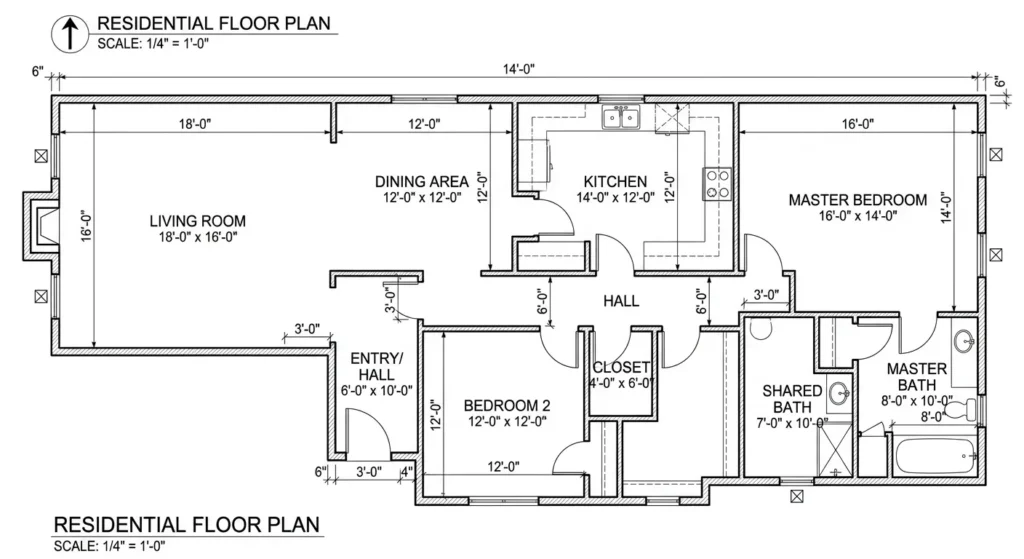
A floor plan is usually drawn as a two-dimensional representation of a building. It shows the arrangement of rooms and their horizontal dimensions, often using feet or meters.
Architects and homeowners use floor plans to plan furniture placement, door openings, and walking paths. A plan might show a room as 12 feet by 10 feet without depicting its ceiling height.
A floor plan is not the same thing as the actual building. The drawing represents selected information about a three-dimensional structure on a flat surface.
Imagine looking straight down at your home from above. You would see room outlines and furniture positions, but you wouldn’t directly see how high the walls are.
8. A Photograph: A Two-Dimensional Image of a Three-Dimensional Scene

A standard photograph is represented as a two-dimensional image. It has width and height, but a single flat image does not directly preserve the full depth information of the original scene.
Photographers create an impression of depth through perspective, shadows, overlapping objects, and differences in apparent size. Those visual cues help the viewer interpret the scene.
A digital image may be 1,920 pixels wide and 1,080 pixels tall. Those are two dimensions of the image grid; the pixel count doesn’t by itself describe the physical size of a printed photograph.
Think of a picture of a long road. It may look as though the road extends far into the distance, but the image itself is still a flat rectangle.
9. A Television Screen: Width and Height

A television screen is a two-dimensional surface, usually described by its width and height. Retailers also advertise screen size using the diagonal measurement from one corner to the opposite corner.
For example, a 55-inch television is measured diagonally, not 55 inches across its width. A widescreen model with a 16:9 aspect ratio has an approximate screen width of 47.9 inches and height of 27 inches, excluding the bezel.
The diagonal, width, and height describe different properties of the same rectangular screen. Knowing which one a specification refers to helps prevent mistakes when planning a wall mount or TV stand.
Imagine drawing a rectangle around the visible screen. Its width and height describe the two-dimensional surface, while the television’s depth adds another dimension to the physical device.
10. A Map: Two Dimensions for Representing Places
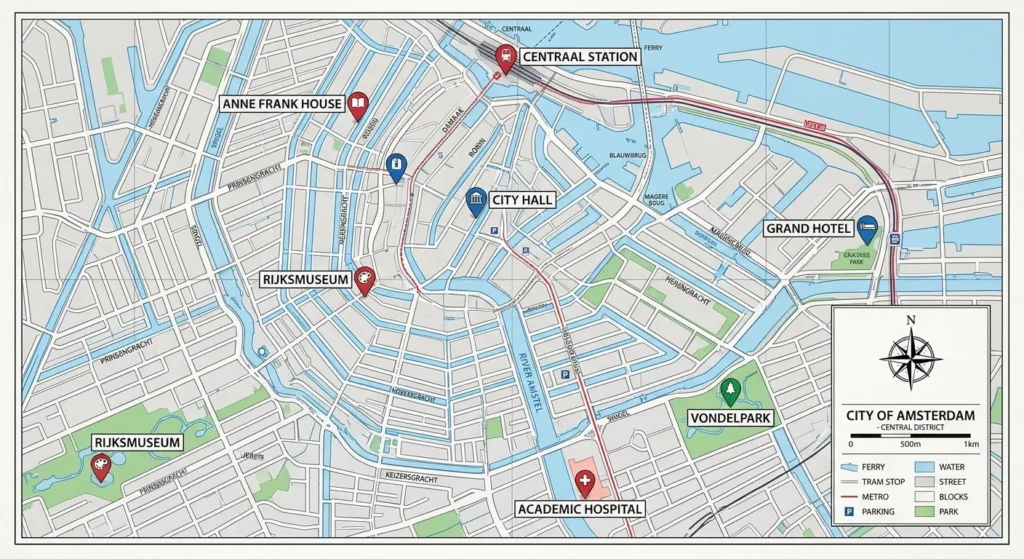
A conventional flat map represents locations using two coordinates, often related to latitude and longitude. This makes it possible to show large areas on a sheet or screen.
The real surface of Earth is curved, so turning it into a flat map requires a projection. Different map projections preserve different properties, such as local shapes, directions, or areas, and distort others.
A map can also use symbols to represent features that have height or depth, such as mountains and ocean trenches. Those symbols provide information without making the map itself a three-dimensional object.
Picture a road map spread across a table. It shows where places are relative to one another, but the sheet has only two dimensions in its ordinary physical form when thickness is ignored.
11. A Timeline: One Dimension of Time

A timeline arranges events along a single direction representing time. Its horizontal position indicates when something happened relative to other events.
Timelines are useful in history, project planning, and science because they make order and duration easier to compare. The spacing on a timeline may be proportional to time, or it may simply organize events visually.
A timeline drawn on paper is physically two-dimensional as an image, but the information it represents may be one-dimensional: a sequence ordered by time.
Imagine three events marked on a line: yesterday, today, and tomorrow. Their positions help you understand their order without needing a map of physical space.
12. Spacetime: Three Spatial Dimensions Plus Time

In relativity, an event is described by three spatial coordinates and one time coordinate. Together, these form four-dimensional spacetime.
An event could be a flash of light occurring at a particular location at a particular time. Knowing only where it happened isn’t enough to distinguish it from another flash at the same location but at a different time.
Time behaves differently from spatial directions in the equations of relativity. It is part of spacetime, but you cannot freely move back and forth through time in the same way you can move left or right through a room.
Imagine tracking a moving bicycle. A map can show its location in space, but adding timestamps tells you where the bicycle was at each moment. That combined description illustrates why time matters as well as space.
Is the Fourth Dimension Time or Another Direction?
This is one of the most common follow-up questions about dimensions. The answer depends on whether you’re discussing physics or a mathematical model.
In Physics, the Fourth Dimension Usually Means Time
In Einstein’s theory of relativity, space and time are described together as spacetime. An event requires three spatial coordinates and a time coordinate.
Time is important because observers can disagree about certain measurements of space and time, especially when they move relative to one another or experience different gravitational conditions. Relativity provides a framework for relating those measurements consistently.
That does not mean physicists have demonstrated an ordinary fourth spatial direction that people can walk through. The fourth coordinate in standard spacetime is temporal.
Can There Be More Than Four Dimensions?
Yes, mathematical models can contain five, ten, or many more dimensions. In mathematics, a dimension simply represents an independent coordinate needed to describe a point in the space being studied.
Some theoretical physics frameworks, including certain versions of string theory, propose additional spatial dimensions. These proposals are not the same as confirmed observations of extra directions in everyday space.
The important distinction is between a model that is mathematically possible, a theory that makes physical predictions, and a feature of nature that has been experimentally verified.
Are Dimensions the Same as Parallel Universes?
No. Dimensions and parallel universes are different ideas. A dimension is a way to describe independent coordinates in a space or model; a parallel universe is a hypothetical separate universe or reality in certain speculative frameworks.
Popular science fiction often combines these ideas, but the existence of additional dimensions does not automatically prove that parallel universes exist.
Understanding Dimensions Without Complicated Math
You can build a useful intuition for dimensions without advanced equations. Start with simple shapes and add one kind of information at a time.
- Use a line. A point moving along a line needs one coordinate to identify its position.
- Draw a rectangle. Now you need two coordinates, such as horizontal and vertical position.
- Add height. Imagine lifting the rectangle off the page to create a box. You now need three spatial coordinates.
- Track an event through time. Record where the object is and when it is there. In a spacetime description, that adds a time coordinate.
- Separate the model from reality. Mathematics can describe higher-dimensional spaces, but a mathematical description alone does not establish that those dimensions physically exist.
For practical measurements, the distinction between dimensions and units is particularly useful. A table may have three spatial dimensions, while its length can be expressed in inches, feet, or centimeters. The units tell you how much; the dimensions tell you which independent measurements are needed.
Frequently Asked Questions
How many dimensions are there in everyday space?
We experience three spatial dimensions: length, width, and height. These describe positions and shapes in ordinary physical space.
Are there three or four dimensions?
Both answers can be correct, depending on context. Ordinary space has three spatial dimensions, while relativity describes physical events using four spacetime coordinates: three for space and one for time.
What is the fifth dimension?
In mathematics, a fifth dimension can be an additional independent coordinate beyond four others. In some theoretical physics models, extra dimensions have specific proposed properties, but there is no confirmed evidence that an accessible fifth spatial direction exists in everyday space.
Can humans see the fourth dimension?
Humans directly experience three spatial dimensions and the passage of time. We can use diagrams, mathematical models, and computer visualizations to explore higher-dimensional ideas, but those representations are not direct views of an extra spatial direction.
What is a zero-dimensional object?
A mathematical point is zero-dimensional because it has no length, width, or height. A dot drawn on paper has physical size, so it is only a visual representation of an ideal point.
What is the difference between two-dimensional and three-dimensional objects?
A two-dimensional shape is described by two spatial coordinates, such as length and width. A three-dimensional object also has depth or height, allowing its volume to be measured.
Are inches and feet dimensions?
No. Inches and feet are units used to measure length. Length is a spatial dimension, while inches and feet are different ways to express its numerical value.
Do scientists know whether extra dimensions exist?
Extra dimensions appear in some theoretical models, but their physical existence has not been conclusively demonstrated. Scientists investigate such ideas through mathematical consistency and experimental tests.
Where That Leaves You
The clearest answer to “how many dimensions are there?” is that ordinary space has three spatial dimensions, and modern relativity describes events in four-dimensional spacetime by adding time. Mathematics can describe spaces with more dimensions, while extra physical dimensions remain a theoretical possibility rather than an established fact.
A room gives you a practical starting point: measure its length, width, and height in feet or meters. A timeline then adds another kind of information—when something happens—showing why location and time are both important.
Remember the distinction: dimensions describe the directions or coordinates needed; inches, feet, centimeters, and meters are units used to measure length. Once you separate those two ideas, the subject becomes much easier to understand.

Jack Harrison is a passionate writer who creates informative, engaging and easy-to-understand content for online readers. He enjoys researching new topics and sharing practical insights that help readers discover useful ideas and information.


