

A crib mattress can look small in a nursery, but a difference of even an inch can matter when you’re checking whether it fits a crib safely. Unlike an adult mattress, where a little extra room may be manageable, a crib mattress needs to fit its frame closely, without dangerous gaps around the edges.
The standard full-size US crib mattress measures approximately 52 inches long by 28 inches wide. That gives you a useful starting point when shopping for a mattress, checking nursery space, or comparing crib dimensions with familiar household objects.
In feet, the standard size is about 4 feet 4 inches long by 2 feet 4 inches wide. In metric measurements, that’s 132.08 cm by 71.12 cm, or 1,320.8 mm by 711.2 mm.
This guide explains standard crib mattress dimensions, converts them into everyday units, and uses practical comparisons to help you picture the size without pulling out a tape measure. It also covers mattress thickness, mini crib differences, and the fit checks that matter when choosing one for a baby.
Every Crib Mattress Measurement Converted
A standard full-size crib mattress is commonly designed around a length of 52 inches and a width of 28 inches. Actual products can vary slightly, so use these figures as a reference rather than a substitute for the mattress and crib manufacturer’s specifications.
| Measurement | Length | Width |
|---|---|---|
| Inches | 52 in | 28 in |
| Feet and inches | 4 ft 4 in | 2 ft 4 in |
| Decimal feet | 4.33 ft | 2.33 ft |
| Centimeters | 132.08 cm | 71.12 cm |
| Millimeters | 1,320.8 mm | 711.2 mm |
| Meters | 1.3208 m | 0.7112 m |
| Yards | 1.44 yd | 0.78 yd |
These conversions describe the mattress’s length and width, not its thickness. Thickness depends on the individual model, and it should be checked separately.
How the conversion math works
The calculations are straightforward:
- Inches to feet: Divide the inches by 12. For example, 52 ÷ 12 = 4.33 feet.
- Inches to centimeters: Multiply by 2.54. For example, 52 × 2.54 = 132.08 cm.
- Inches to millimeters: Multiply by 25.4. For example, 28 × 25.4 = 711.2 mm.
- Inches to meters: Multiply by 0.0254. For example, 52 × 0.0254 = 1.3208 meters.
- Inches to yards: Divide by 36. For example, 52 ÷ 36 ≈ 1.44 yards.
So, when someone searches for crib mattress dimensions in feet, the easiest way to remember the standard reference size is roughly 4 feet 4 inches by 2 feet 4 inches.
Where Standard Crib Mattress Dimensions Fit on a Size Chart
A full-size crib mattress is a compact sleeping surface designed to fit a full-size crib. Its rectangular footprint is about 10.1 square feet, which is considerably smaller than the surface of a twin mattress.
The US Consumer Product Safety Commission (CPSC) defines a full-size crib mattress as having a minimum dimension of 27¼ inches wide by 51⅝ inches long, with a maximum thickness of 6 inches. Those are regulatory size limits, not a promise that every mattress will have identical measurements. Always confirm that the specific mattress is suitable for the crib.
Here’s how common mattress types compare:
| Mattress type | Approximate length | Approximate width |
|---|---|---|
| Standard full-size crib mattress | 52 in | 28 in |
| Mini crib mattress | Varies by model; often around 38 in | Varies by model; often around 24 in |
| Twin mattress | 75 in | 38 in |
| Full/double mattress | 75 in | 54 in |
| Queen mattress | 80 in | 60 in |
The mini crib figures are common examples, not a universal standard. Mini cribs can use different mattress sizes, so check the product manual before buying.
One more measurement matters: thickness. A mattress may have the correct length and width but still be unsuitable if it is too thick for the crib’s design or exceeds the manufacturer’s limit. The crib and mattress should be used according to their instructions, with no added padding or improvised layers.
12 Things That Help You Visualize Crib Mattress Dimensions
The easiest way to picture a crib mattress is to compare its length and width separately. A 52-by-28-inch rectangle is a little over four feet long and just over two feet wide, so several everyday objects can help you estimate its footprint.
These comparisons are for visualization only. They are not substitutes for measuring a mattress or checking whether it fits a crib.
1. A Bath Towel Measuring About 52 × 28 Inches
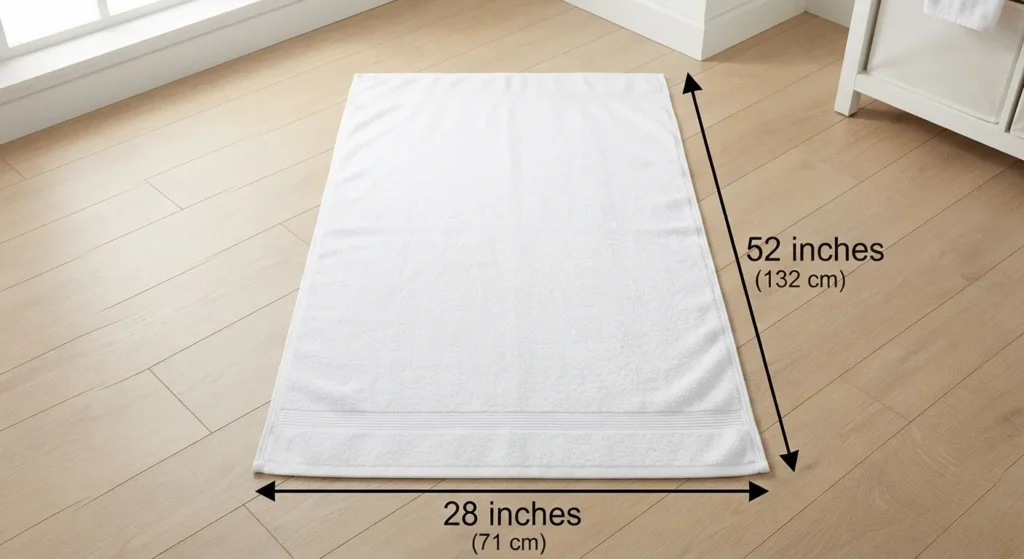
Some large bath towels measure around 52 inches long and 27–30 inches wide. That makes one a useful visual comparison for the overall length and width of a standard crib mattress.
Towel dimensions vary by brand and style. Bath sheets, oversized towels, and compact towels can all have different measurements, so check the label if you want to use a particular towel as a reference.
A towel is also soft and flexible, unlike a mattress with a defined rectangular shape. It may wrinkle or stretch slightly when laid down.
For a quick mental picture, imagine a large bath towel spread flat on the floor. Its outline can give you a rough sense of how much space a crib mattress covers.
2. A Four-Foot Folding Table

A common four-foot folding table is about 48 inches long. That’s only 4 inches shorter than the 52-inch length of a standard crib mattress.
These tables are designed for compact spaces, small gatherings, craft projects, or extra serving space. Their length makes them a useful reference for imagining a crib mattress’s longer side.
The table may be much wider than the mattress, depending on its design. Compare the length rather than assuming its entire surface matches the mattress footprint.
Picture the mattress extending roughly 2 inches beyond each end of a 48-inch table. That small difference helps make the 52-inch measurement easier to visualize.
3. A Standard Twin Mattress

A standard US twin mattress measures about 75 inches long by 38 inches wide. Compared with a 52-by-28-inch crib mattress, it is 23 inches longer and 10 inches wider.
That difference is noticeable because a twin mattress is designed for an older child, teenager, or adult, while a crib mattress fits a much smaller sleeping space.
Twin mattresses are useful for comparing the scale of different bed sizes, but they cannot replace a crib mattress. Their dimensions and construction are intended for a different type of bed.
If you have a twin mattress at home, imagine removing nearly two feet from its length and about ten inches from its width. The remaining rectangle would be close to the standard crib mattress footprint.
4. A 24 × 48-Inch Area Rug

A small rug measuring 24 by 48 inches is close to the crib mattress’s overall proportions, although it is 4 inches narrower and 4 inches shorter.
Compact rugs are often used beside a bed, in an entryway, or under a small piece of furniture. Their rectangular shape makes them helpful for imagining how much floor space a crib mattress occupies.
Rugs come in many sizes, and some are labeled in feet rather than inches. A 2-by-4-foot rug, for example, measures 24 by 48 inches.
Think of the crib mattress as a rectangle slightly longer and wider than this rug. This comparison is particularly useful when planning a nursery layout.
5. A 4-Foot-4-Inch Length of Measuring Tape

A tape measure set to 52 inches gives you the exact reference length of a standard crib mattress. The shorter side is 28 inches, making it easy to mark out the full rectangular footprint.
This is less a household-object comparison and more a direct way to recreate the dimensions without needing the actual mattress in the room. Use masking tape to mark each side on the floor.
Marking the corners is especially helpful when deciding where a crib might fit. You can also leave extra space around the outline for access, bedding changes, and moving around the nursery.
Unlike estimating from a towel or table, this method can be quite accurate if you read the tape carefully. Still, the manufacturer’s measurements should guide the final fit.
6. A Standard Interior Door’s Width

Many interior doors are around 28 to 32 inches wide. A 28-inch-wide crib mattress is therefore similar to the width of a narrower standard interior door.
Door widths differ by home, country, and building standards. Some doors are wider, and the door slab’s size is not necessarily the same as the clear opening when the door is open.
This comparison works best for visualizing the mattress’s shorter side. It does not mean a crib mattress will pass through every doorway easily, especially if it is thick, flexible, or wrapped in packaging.
If you’re moving a mattress into a nursery, measure the doorway and any tight turns along the route. The mattress footprint alone does not tell you whether it will be easy to carry through the space.
7. A Large Suitcase Laid Flat

Large checked suitcases can be roughly 28 to 32 inches tall on their longest side, though their exact dimensions vary. That makes a suitcase a possible reference for the shorter side of a crib mattress, rather than its full footprint.
Suitcases are designed to maximize packing capacity while staying manageable for travel. Wheels and handles may add to the outside dimensions, so the advertised size may not match the main body alone.
A suitcase is usually much narrower than a crib mattress is long. It is useful for thinking about the scale of a 28-inch measurement, but not as a precise length-and-width comparison.
Imagine placing a suitcase on the floor and extending the space beside it until the rectangle reaches 52 inches long. This helps build a sense of the mattress’s overall proportions.
8. A Small Desk Surface

Some compact desk surfaces measure around 48 to 50 inches long and 20 to 24 inches deep. That puts them fairly close to a crib mattress in length, although they may be narrower.
A desk’s usable surface depends on its design. A writing desk may have a shallow top, while a computer desk can be deeper to accommodate a monitor, keyboard, and other equipment.
This comparison is useful if you’re planning where a crib could go in a room that already has furniture. A desk can help you estimate the length, while the crib mattress outline helps you account for the additional width.
Remember that a crib also has a frame, legs, and sometimes a larger outer footprint than its mattress. Leave room for the whole crib, not just the sleeping surface.
9. A Large Serving Tray

Most serving trays are much smaller than a crib mattress, but an unusually large rectangular catering tray can help you picture part of the width or length. This is a weaker comparison than a towel or table because tray sizes vary widely.
Trays are generally designed to be carried comfortably, so they are usually much smaller than a 52-by-28-inch rectangle. Do not assume a typical kitchen tray is close to crib mattress size.
The useful idea is to imagine several tray-sized sections laid side by side until they cover a rectangle of the mattress’s dimensions. That makes the footprint easier to picture even if you don’t own a large tray.
For a more dependable estimate, use a tape measure or a known-size object such as a four-foot folding table instead.
10. A Small Children’s Play Mat

Some compact children’s play mats have dimensions close to a crib mattress, while others are much larger or square. Always check the product label before using one as a reference.
Play mats are made to create a comfortable floor area for play, crawling, or activities. Their size can be a helpful visual cue when you’re planning a baby-friendly room, but their purpose and construction are different from those of a crib mattress.
If you have a mat around 50 inches long and 28 inches wide, its outline will be fairly close to the standard mattress footprint. A larger square mat will cover a different area even if one side seems similar.
Lay the mat flat and compare both sides rather than judging from its appearance when folded or rolled up. The shape matters as much as the length.
11. A Standard Pillow Beside the Mattress Outline
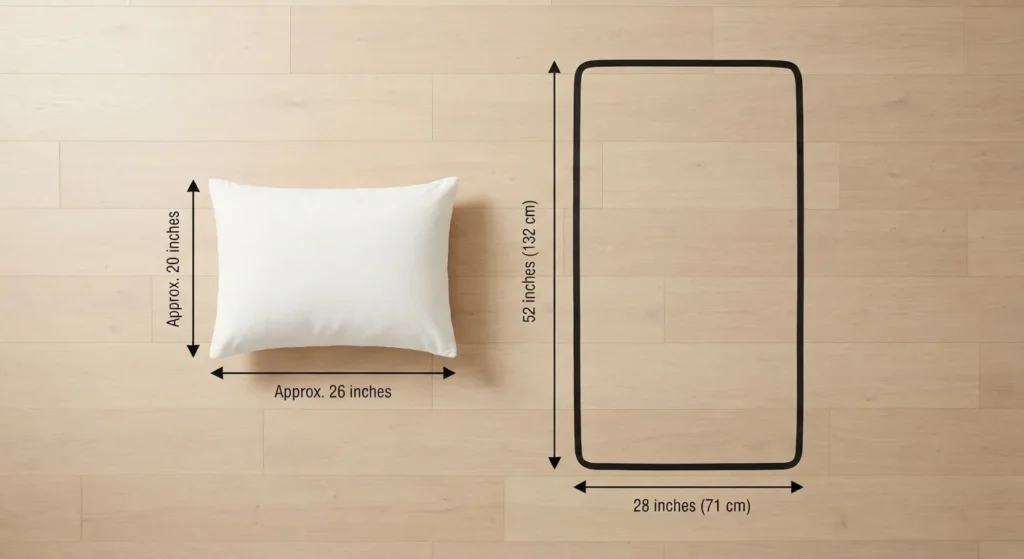
A standard US bed pillow is often about 20 by 26 inches. That makes it somewhat close to the crib mattress’s 28-inch width, but much shorter than the mattress’s 52-inch length.
Pillows are commonly sized to fit adult beds, and their dimensions vary by style and fill. They compress when handled, so their apparent size may change depending on how they are placed.
This comparison works best for the width: imagine a 26-inch pillow with another 2 inches added across its shorter side. That gets you close to 28 inches.
A pillow is not a safe substitute for measuring a crib mattress or a guide to what should be placed in a baby’s sleep space. It is only a visual reference for adults planning dimensions.
12. Two Feet Plus Two More Feet and Four Inches
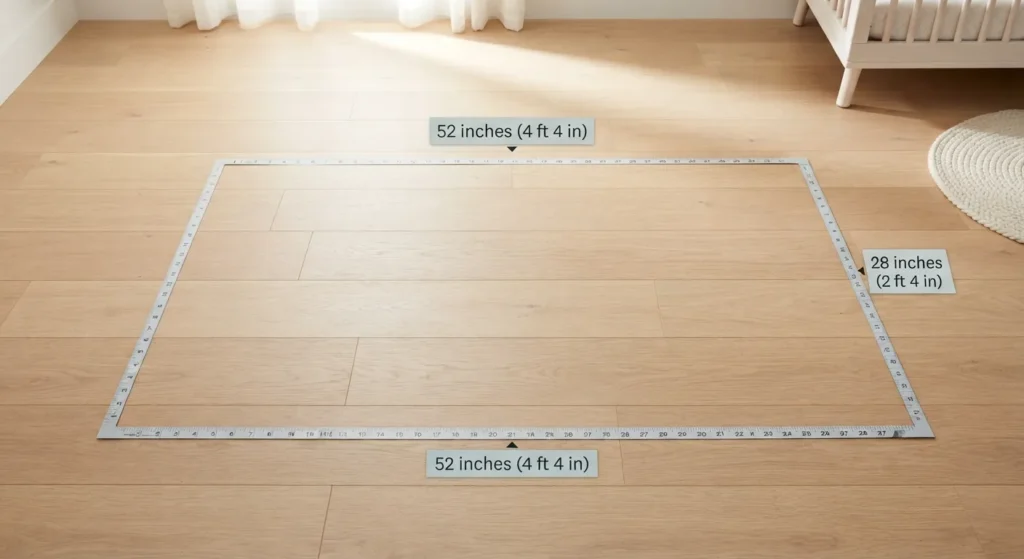
Sometimes the easiest comparison is to break the measurement into smaller lengths. The 52-inch side equals four feet plus four inches, while the 28-inch side equals two feet plus four inches.
You can estimate those lengths using a standard 12-inch ruler, a tape measure, or floor marks. Four feet is 48 inches, so adding another 4 inches gives you the full mattress length.
For the width, two feet equals 24 inches. Add 4 more inches to reach 28 inches. This repeated four-inch addition makes the dimensions easier to remember.
If you’re trying to plan a nursery corner, mark a 48-inch line on the floor and extend it by 4 inches. Then mark the shorter side at 28 inches and connect the corners to create a rough rectangle.
The Crib Mattress Fit Question Parents Actually Need Answered
Knowing the standard size is useful, but the more important question is whether the mattress fits your particular crib.
A mattress that measures approximately 52 × 28 inches may fit many full-size cribs, but the crib manufacturer’s instructions and the mattress’s stated compatibility should determine the final choice. Never assume that a mattress fits simply because its measurements are close.
What does a proper crib mattress fit look like?
A properly fitted crib mattress should sit flat and snugly inside the crib, without hazardous gaps between the mattress and the sides. A gap can create an entrapment risk for an infant.
The CPSC’s full-size crib mattress dimensions specify a minimum width of 27¼ inches and a minimum length of 51⅝ inches, with a maximum thickness of 6 inches. These regulatory measurements are not a universal guarantee of compatibility with every crib.
Before purchasing, check three things:
- Length and width: Compare the mattress specifications with the crib’s instructions.
- Thickness: Confirm that the mattress stays within the manufacturer’s permitted thickness and works with the crib’s mattress-support settings.
- Fit and condition: Make sure the mattress lies flat, fits snugly, and is not damaged or excessively soft.
For infant sleep, use a firm, flat mattress designed for the crib with a fitted sheet. Avoid adding toppers, extra padding, or improvised gap fillers.
Are mini crib mattress dimensions the same?
No. Mini cribs are smaller than full-size cribs, and their mattress sizes are not all identical. Some are designed for mattresses around 38 × 24 inches, but that is only a common example.
A mattress advertised as a mini crib mattress should not be selected by its label alone. Check the exact model requirements, because even two mini cribs can have different mattress specifications.
Getting to Crib Mattress Dimensions Without a Tape Measure
You can estimate a standard crib mattress footprint using a few everyday references. These methods are useful for planning a room, but they are not accurate enough to confirm a safe mattress fit.
1. Start with a four-foot reference
Four feet equals 48 inches. A standard crib mattress is about 52 inches long, so imagine extending that length by another 4 inches.
If you’re marking a floor area, the extra 4 inches is a little more than the width of an average adult hand. Hand sizes vary, though, so treat this as a rough estimate.
2. Estimate the width in two-foot sections
Two feet is 24 inches. Add another 4 inches to reach the standard 28-inch mattress width.
This is easy to picture because the width is only slightly greater than two feet. You can mark the distance with floor-safe masking tape if you want to see the rectangle more clearly.
3. Use a large bath towel as a visual guide
A large bath towel measuring approximately 52 × 28 inches can resemble the footprint of a standard crib mattress. Check the towel’s actual dimensions if you need a closer estimate.
The towel comparison is helpful for visualizing the space, but towels are flexible and may stretch or wrinkle. Don’t rely on one to check mattress compatibility.
4. Mark the rectangle on the floor
If you have a ruler or measuring tape available, mark a 52-inch line and a perpendicular 28-inch line. Connect the corners to create a rectangle.
This is one of the most useful ways to plan where the mattress-sized area would sit in a nursery. Remember that the crib frame will normally occupy more space than the mattress alone.
5. Compare it with a twin mattress
A twin mattress is about 75 × 38 inches. The crib mattress is shorter by 23 inches and narrower by 10 inches.
If you have a twin bed in the room, imagine a smaller rectangle within its footprint. This is useful for understanding the general scale, although it cannot tell you whether a crib will fit through a doorway or into a particular corner.
FAQs
How many feet are crib mattress dimensions?
A standard full-size crib mattress is approximately 4 feet 4 inches long and 2 feet 4 inches wide. In decimal feet, that’s about 4.33 × 2.33 feet.
How many centimeters is a standard crib mattress?
A 52 × 28-inch crib mattress converts to approximately 132.08 × 71.12 cm. Actual mattress dimensions can vary, so check the manufacturer’s specifications.
How many millimeters is a crib mattress?
Using the standard reference size, the length is 1,320.8 mm and the width is 711.2 mm. These are mathematical conversions of 52 and 28 inches.
How many meters is a crib mattress?
A standard crib mattress is approximately 1.3208 meters long and 0.7112 meters wide. For everyday room planning, you can round those values to about 1.32 × 0.71 meters.
How thick is a standard crib mattress?
Thickness varies by product. The CPSC specifies a maximum thickness of 6 inches for a full-size crib mattress, but you must also follow the crib and mattress manufacturer’s instructions.
Are all crib mattresses the same size?
No. Full-size crib mattresses follow defined dimensional requirements, but individual products may vary within applicable limits. Mini crib mattresses use different sizes, so check the exact crib model before buying.
Can I use a twin mattress in a crib?
No. A standard twin mattress is much larger than a crib mattress and is not designed to fit a crib frame. Use a mattress specifically made for your crib.
How can I check whether a crib mattress fits safely?
Follow the crib manufacturer’s instructions and use a mattress confirmed as compatible with that model. It should lie flat and fit snugly, with no hazardous gaps around the edges.
Where That Leaves You
The standard full-size crib mattress measures approximately 52 inches long by 28 inches wide. That’s about 4 feet 4 inches by 2 feet 4 inches, or 132.08 × 71.12 cm.
A four-foot folding table gives you a helpful reference for the mattress’s length, while a large bath towel can help you picture its overall rectangular footprint. Both are useful for estimating space, not for confirming a safe fit.
If you’re buying a mattress, measure the crib and check the manufacturer’s specifications before making a decision. The key takeaway is simple: the numbers help you visualize the size, but a snug, compatible fit is what matters most.

Jack Harrison is a passionate writer who creates informative, engaging and easy-to-understand content for online readers. He enjoys researching new topics and sharing practical insights that help readers discover useful ideas and information.