

When someone asks, “What are the dimensions?”, they usually want more than a single number. They want to know how much space an object actually takes up—how long it is, how wide it is, and, when relevant, how tall or deep it is.
That sounds simple, but dimensions can become confusing because measurements are often written in different orders. A box might be listed as 12 × 8 × 4 inches, while a television is commonly described by its screen diagonal, and a sheet of paper may be identified by its width and height.
Understanding dimensions is useful when you’re buying furniture, checking whether something will fit in a room, comparing products, measuring packages, or simply trying to visualize an object’s size. This guide explains what dimensions mean, how they are written, how to convert them, and how to visualize them without a measuring tape.
Dimensions describe an object’s measurable size, most commonly its length, width, and height or depth.
What Do Dimensions Mean?
The word dimensions refers to the measurable characteristics that describe the size of something.
For a simple rectangular object, the three most common dimensions are:
- Length — how long the object is
- Width — how wide it is from side to side
- Height — how tall it is from bottom to top
Depending on the object, depth may be used instead of height or alongside it. For example, a cabinet might be described as 30 inches wide, 18 inches deep, and 72 inches tall.
The order is important. If a product is listed as 30 × 18 × 72 inches, you should check the manufacturer’s stated order before assuming which number represents which side.
Dimensions vs. Size
These words are often used interchangeably, but there is a subtle difference.
Size is a general description of how large something is. Dimensions provide the specific measurements that describe that size.
For example, saying a desk is “large” doesn’t tell you whether it will fit against your wall. Saying it is 60 inches wide × 30 inches deep × 29 inches high gives you useful information for planning the space.
Why Dimensions Matter
Dimensions become especially important when an object needs to fit somewhere specific.
A sofa might fit comfortably in a large living room but fail to pass through a doorway. A refrigerator may fit between two cabinets but not have enough clearance to open its doors.
That is why product dimensions are often more useful than general descriptions such as small, medium, or large.

How Dimensions Are Written and Measured
Dimensions can be expressed using several measurement systems.
In the United States, inches and feet are common for household products, furniture, rooms, and construction. Metric measurements such as centimeters and meters are widely used internationally.
Common Dimension Conversions
| Measurement | Equivalent |
|---|---|
| 1 inch | 2.54 cm |
| 1 foot | 12 inches |
| 1 foot | 30.48 cm |
| 1 yard | 3 feet |
| 1 meter | 100 cm |
| 1 meter | 39.37 inches |
| 1 centimeter | 10 mm |
The basic conversion formulas are straightforward:
- inches × 2.54 = centimeters
- centimeters ÷ 2.54 = inches
- feet × 12 = inches
- inches ÷ 12 = feet
- meters × 100 = centimeters
- centimeters ÷ 100 = meters
For example, an object measuring 24 inches long is 2 feet long or 60.96 cm.
What Does 12 × 8 × 4 Inches Mean?
Suppose a package is listed as:
12 × 8 × 4 inches
If the manufacturer uses the conventional length × width × height order, that means:
- Length: 12 inches
- Width: 8 inches
- Height: 4 inches
The package therefore occupies a rectangular space measuring 12 inches in one direction, 8 inches in another, and 4 inches vertically.

Dimensions Can Be Written Differently
Not every product follows the same convention.
A picture frame might be listed as 18 × 24 inches, meaning width × height. A mattress might be described as 60 × 80 inches, meaning width × length. A television is usually marketed according to its screen diagonal, rather than its width and height.
So whenever exact fit matters, look for the manufacturer’s explanation of the measurement order.
12 Everyday Objects and Their Typical Dimensions
The easiest way to understand dimensions is to connect measurements with objects you already recognize. The examples below are approximate because products vary by manufacturer and model.
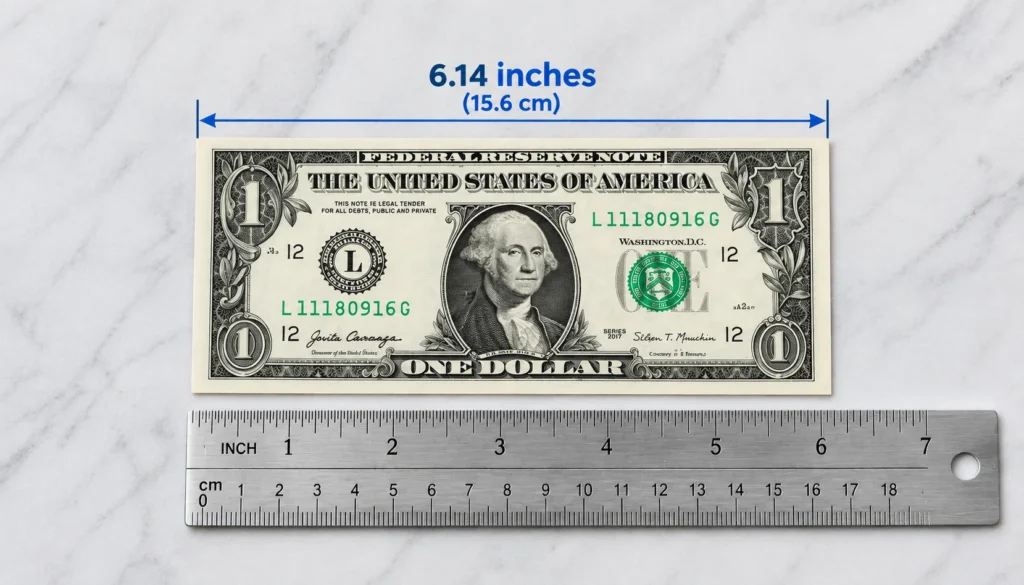
A U.S. Dollar Bill
A U.S. one-dollar bill measures approximately 6.14 inches long × 2.61 inches wide.
That makes a dollar bill a surprisingly useful reference when visualizing a length of roughly six inches. It is flat, familiar, and has a standardized size.
It is particularly useful for estimating short horizontal measurements, although it should be treated as a reference rather than a substitute for an accurate measuring tool.
A Letter-Size Sheet of Paper
A standard U.S. Letter sheet measures 8.5 × 11 inches.
That gives you two useful reference dimensions: 8.5 inches across the short side and 11 inches along the long side.
If someone says an object is about 8.5 inches wide, placing it against the short edge of Letter paper gives you an immediate visual reference.

A Paperback Book
Paperback books come in many sizes, but compact editions are often around 7 to 8 inches tall.
That makes a typical compact paperback useful for visualizing a length close to seven inches. The exact dimensions depend heavily on the publisher and edition.
If you are comparing a book with another object, measure the particular edition rather than assuming every paperback has identical dimensions.

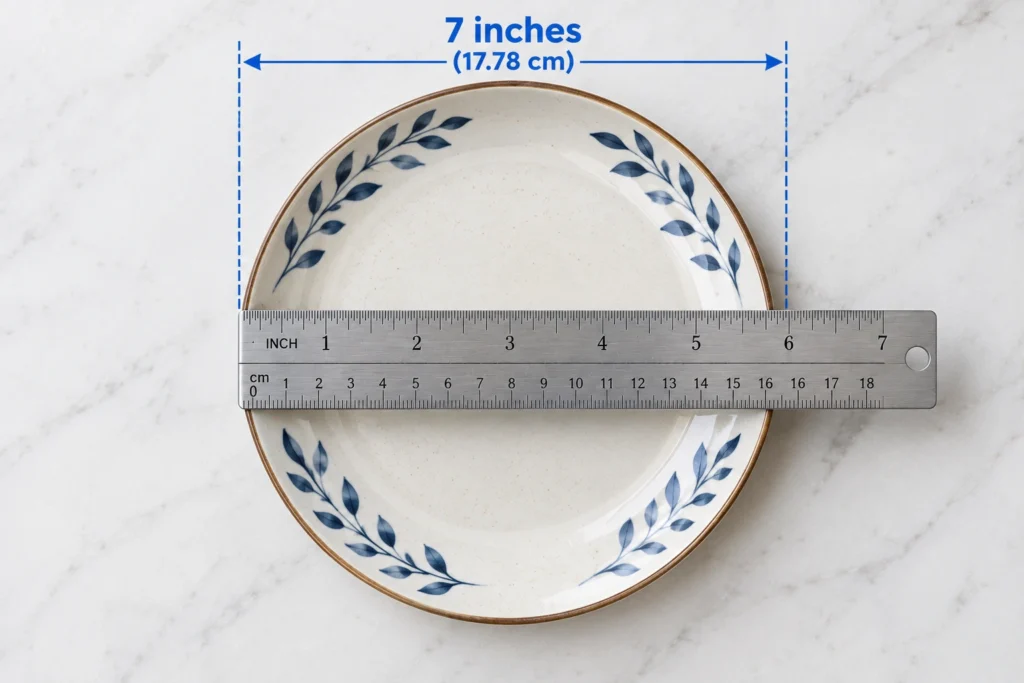
A Side Plate
Small side plates commonly measure around 6 to 8 inches in diameter.
A plate is especially useful for visualizing diameter because the measurement runs straight across the circular object through its center.
A 7-inch side plate, for example, gives you a clear physical reference for what seven inches looks like.
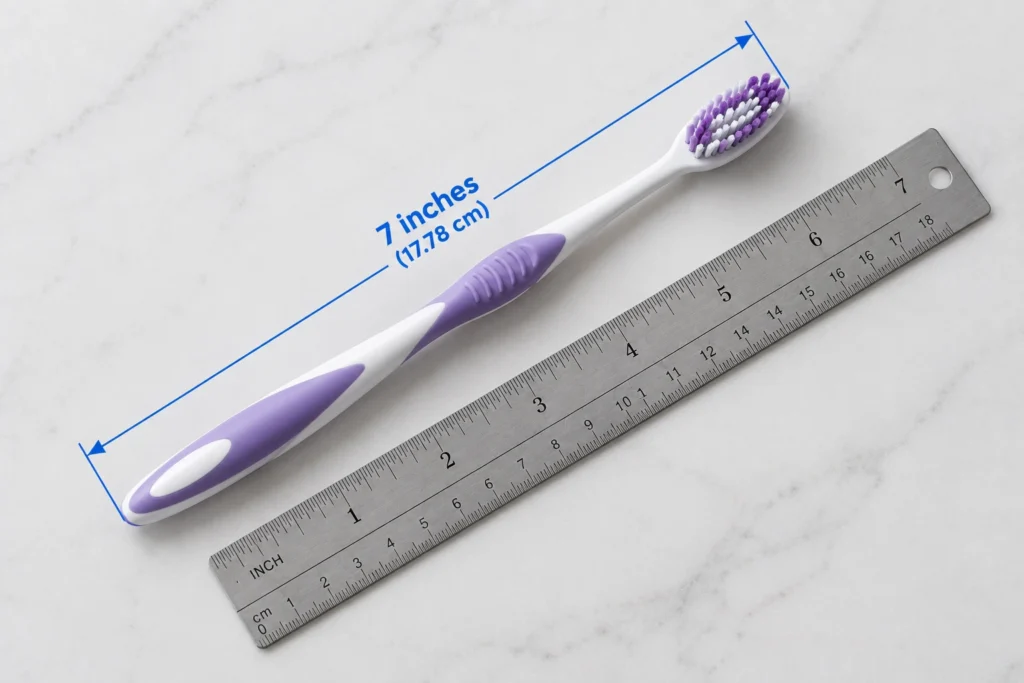
A Standard Adult Toothbrush
A full-size adult toothbrush is commonly around 7 inches long, although exact lengths vary by design.
The handle, neck, and brush head all contribute to its total length. Some toothbrushes are slightly shorter or longer, so it is better to describe this as an approximate comparison.
A toothbrush is one of the more convenient household references for visualizing a length around seven inches.
A Compact Tablet
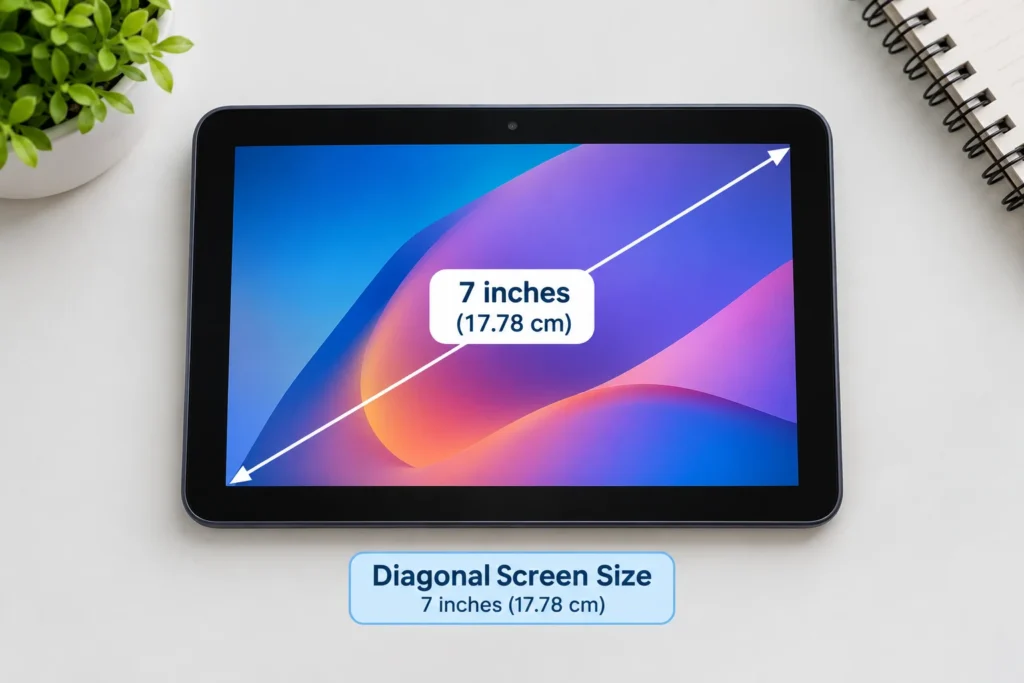
Small tablets can have screens around 7 inches diagonally, although the tablet’s overall body is larger than the screen.
This distinction matters. A “7-inch tablet” normally refers to the diagonal measurement of the display, not the tablet’s width or height.
As a result, a seven-inch tablet screen cannot be assumed to be seven inches wide.

A Smartphone
Modern smartphones vary considerably in physical dimensions, but many have body heights in the neighborhood of 6 inches or more.
This makes a phone useful for rough visual comparisons, particularly when thinking about lengths between five and seven inches.
However, phone dimensions should always be checked for the exact model because screen size, body size, and aspect ratio differ.

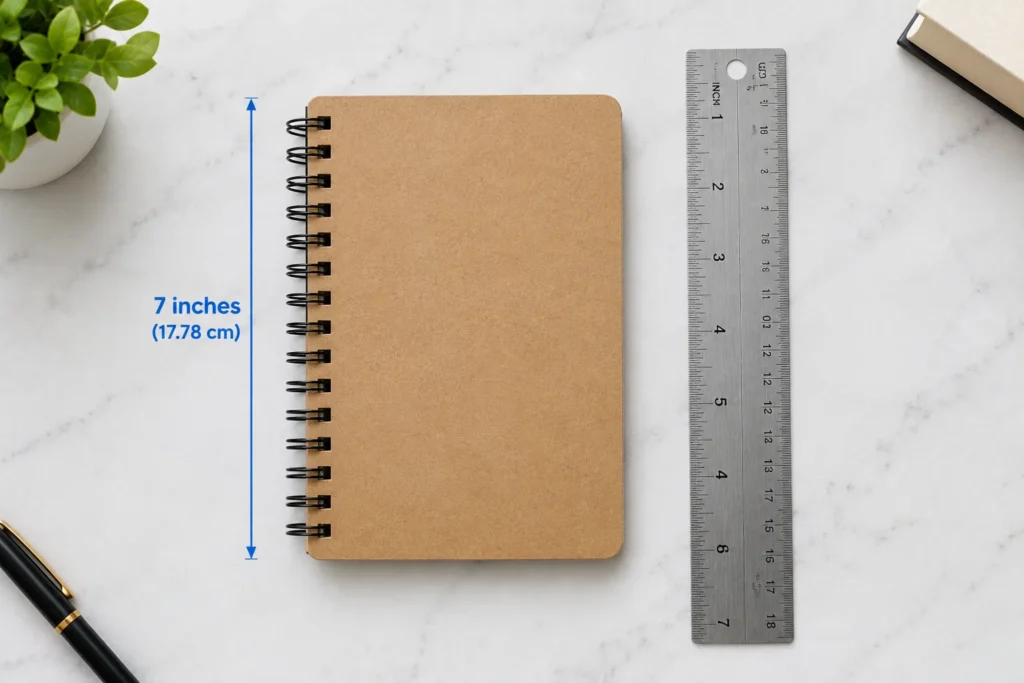
A Small Notebook
Small notebooks often measure roughly 7 to 9 inches along their longer side.
The exact size depends on the notebook format, but a compact notebook can give you a useful visual reference for several inches of length.
Unlike a flexible object such as a cable, a notebook has rigid edges, making its dimensions easier to compare visually.
A Kitchen Cutting Board
Small cutting boards may measure approximately 12 inches or more along their longest side.
This makes them useful for visualizing measurements around one foot rather than short lengths such as seven inches.
The thickness is another dimension that can be overlooked. A board might have a large surface area while remaining relatively thin.

A Standard Door
A typical residential interior door is much taller than most everyday objects, often around 80 inches high in the United States.
This provides a useful reference when thinking about measurements in feet rather than inches.
A door also demonstrates why dimensions need context: its height, width, and thickness are all separate measurements.

A Dining Table
A common dining table may be roughly 60 to 72 inches long, depending on the design and seating capacity.
The table’s dimensions are normally given as length × width × height. A six-foot-long table, for example, provides a useful reference for understanding measurements in the five-to-six-foot range.
Its actual dimensions can vary substantially between four-person, six-person, and larger tables.

A Twin Mattress
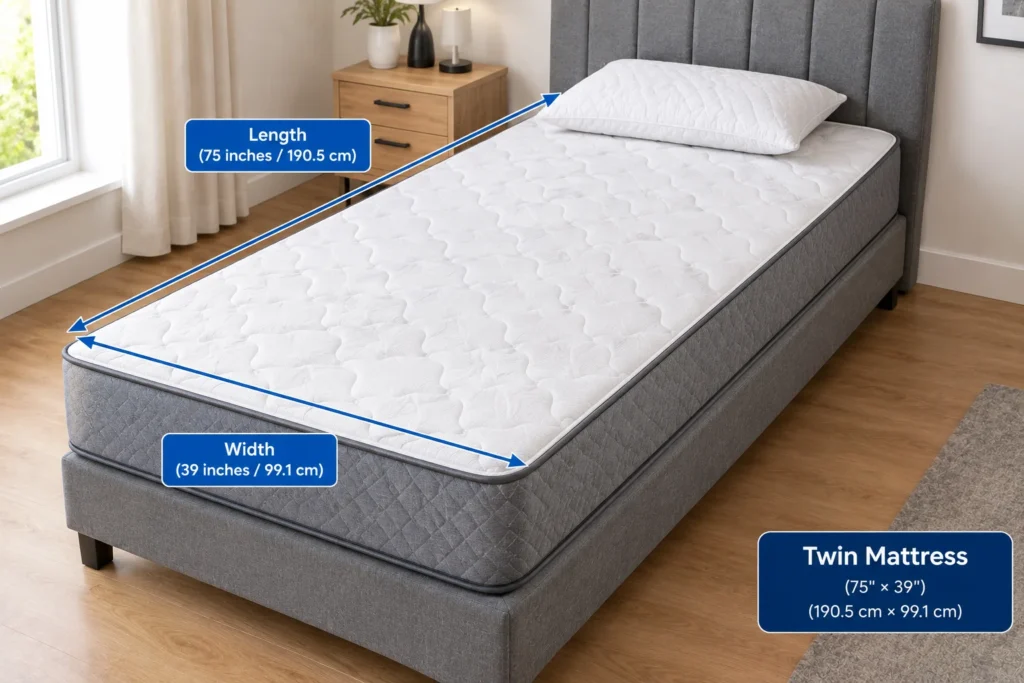
A standard U.S. twin mattress is approximately 38 inches wide × 75 inches long.
This is a good example of why the order of dimensions matters. The 75-inch figure describes the mattress’s length, while 38 inches describes its width.
Mattress dimensions are particularly important because even a relatively small difference can affect whether a mattress fits a bed frame.
The Product Size Question People Actually Mean
When someone searches “what are the dimensions?”, they may actually be asking a more specific question:
“How big is this product in the real world?”
That distinction matters because different products use different measurement conventions.
A television, for example, is normally described by its screen diagonal. A seven-inch tablet generally refers to a seven-inch diagonal display. A piece of furniture, on the other hand, is usually described using width, depth, and height.
Screen Dimensions Are Different
Suppose a tablet has a 7-inch screen.
That does not mean the tablet is seven inches wide. The seven-inch measurement runs diagonally from one corner of the display to the opposite corner.
Likewise, a 55-inch television does not measure 55 inches across from left to right. Its advertised screen size refers to the diagonal of the display.
Furniture Dimensions Are Usually More Direct
Furniture is generally easier to interpret because manufacturers commonly provide multiple dimensions.
A sofa might be listed as:
84 W × 36 D × 34 H inches
Here:
- W = width
- D = depth
- H = height
Those numbers tell you much more than simply calling the sofa “large.”
When buying furniture online, compare all three dimensions with your available space, and remember to account for doors, hallways, stairs, and other obstacles.
How to Visualize Dimensions Without a Tape Measure
You can estimate many dimensions using familiar objects, but there is an important difference between visual estimation and accurate measurement.
If precision matters, use a ruler, tape measure, or another appropriate measuring tool.
Use a Dollar Bill for Short Lengths
A U.S. dollar bill is approximately 6.14 inches long.
That makes it a useful reference for imagining a length of around six inches. It can also help you estimate whether something is noticeably longer or shorter than six inches.
[INTERNAL LINK: how long is 7 inches]
Use Letter Paper for Larger Measurements
U.S. Letter paper measures 8.5 × 11 inches.
Its short side gives you an 8.5-inch reference, while its long side provides an 11-inch reference. If an object is around seven inches long, it will be visibly shorter than the paper’s 8.5-inch width.
Use Your Own Body Measurements Carefully
Your hand, forearm, or foot can provide a rough reference, but body dimensions vary considerably between people.
For example, your foot might be close to a familiar length, but it should not be treated as a standardized measuring device.
Body-based comparisons are useful for visualization, not precision.
Compare Against a Known Product
If you own an object with documented dimensions, it can become a useful reference.
For example, if you have a seven-inch plate, you can place another object next to it and visually compare their lengths or widths.
Just remember that the comparison is only as accurate as the known object’s dimensions.
Check the Measurement Direction
One of the easiest mistakes is measuring the wrong direction.
Before comparing an object, ask:
Am I measuring its length, width, height, depth, diameter, or diagonal?
That single question can prevent a surprisingly large number of measurement errors.
FAQs About Dimensions
What are the dimensions of an object?
The dimensions describe the object’s measurable size, usually using length, width, and height or depth. The exact measurements depend on the object and the measurement system being used.
What does 12 × 8 × 4 inches mean?
It normally means the object has three dimensions measuring 12 inches, 8 inches, and 4 inches. The exact order—such as length × width × height—should be confirmed from the manufacturer’s specifications.
How do you convert dimensions from inches to centimeters?
Multiply each inch measurement by 2.54. For example, 10 inches equals 25.4 centimeters.
How do you convert dimensions from feet to inches?
Multiply the number of feet by 12. For example, 5 feet equals 60 inches.
What is the difference between dimensions and size?
Size is a general description of how large something is, while dimensions provide specific measurements. Saying a table is “large” is less useful than giving its exact width, depth, and height.
What does W × D × H mean?
It usually means width × depth × height. This format is common when describing furniture, appliances, cabinets, and other three-dimensional products.
Are screen dimensions measured the same way as furniture?
No. Screens such as televisions and tablets are commonly described by their diagonal screen measurement, while furniture is generally described using width, depth, and height.
Can I estimate dimensions without a measuring tape?
Yes, for a rough comparison. Familiar objects such as U.S. currency, Letter paper, books, and standardized products can help you visualize a measurement, but they should not replace a measuring tool when accuracy is important.
Conclusion
So, what are the dimensions? In practical terms, dimensions are the numbers that tell you how much physical space an object occupies. For most rectangular objects, that means looking at length, width, and height or depth.
The most important thing is to identify what direction each measurement represents. A seven-inch diagonal screen, a seven-inch-wide plate, and a seven-inch-long toothbrush are all seven-inch measurements, but they describe very different physical dimensions.
For everyday visualization, start with something familiar: a U.S. dollar bill is about 6.14 inches long, Letter paper is 8.5 × 11 inches, and a compact paperback can be around 7 inches tall. These references make abstract numbers much easier to picture—and when exact size matters, confirm the comparison with a real measuring tool.

Jack Harrison is a passionate writer who creates informative, engaging and easy-to-understand content for online readers. He enjoys researching new topics and sharing practical insights that help readers discover useful ideas and information.


ioxejsxhfvpmxksmtuksvoxzgfwdof