

A blanket can look large when it is folded on a shelf but surprisingly small when you spread it across a bed. The difference becomes obvious when you try to cover a full-size mattress, tuck the edges around the sides, or share the blanket with someone else.
Full-size blankets do not all come in one exact measurement. Some are designed to cover the top of a mattress, while others include extra fabric for draping over the sides and foot of the bed. That is why checking the dimensions before buying matters.
A typical full-size blanket measures around 80 × 90 inches, although many products are smaller or larger depending on the brand, material, and intended use. If you are comparing blankets online, the listed measurements are more useful than the product label alone.
A blanket measuring 80 × 90 inches equals 6 feet 8 inches × 7 feet 6 inches, 203.2 × 228.6 centimeters, 2,032 × 2,286 millimeters, and 2.032 × 2.286 meters. Below, you will learn how these dimensions compare with a full-size mattress, other bedding sizes, and familiar household objects.
Every Unit of Full Size Blanket Dimensions Converts To
A full-size blanket is usually described using two measurements: width and length. For this guide, we will use 80 inches wide by 90 inches long as a practical example, not a universal standard.
Here is how those dimensions convert into other units.
| Unit | Width | Length |
|---|---|---|
| Inches | 80 in | 90 in |
| Feet | 6 ft 8 in | 7 ft 6 in |
| Decimal feet | 6.67 ft | 7.5 ft |
| Centimeters | 203.2 cm | 228.6 cm |
| Millimeters | 2,032 mm | 2,286 mm |
| Meters | 2.032 m | 2.286 m |
| Yards | 2.22 yd | 2.5 yd |
These conversions help when a retailer lists a blanket in centimeters instead of inches or when you want to compare products sold in different countries.
How the conversion works
The math is straightforward:
- Inches to feet: Divide the inches by 12.
- Inches to centimeters: Multiply the inches by 2.54.
- Inches to millimeters: Multiply the inches by 25.4.
- Inches to meters: Multiply the inches by 0.0254.
- Inches to yards: Divide the inches by 36.
For example, an 80-inch blanket width divided by 12 gives approximately 6.67 feet. Multiplying 80 by 2.54 gives 203.2 centimeters.
When shopping, remember to read the measurements in the correct order. An 80 × 90-inch blanket is 80 inches across and 90 inches from top to bottom when laid flat. Rotating it changes which side is the width, but it does not change the amount of fabric.
Where Full-Size Blankets Fit on a Bedding Size Chart
A full-size mattress in the United States typically measures 54 inches wide by 75 inches long. That is smaller than our example blanket, which measures 80 × 90 inches.
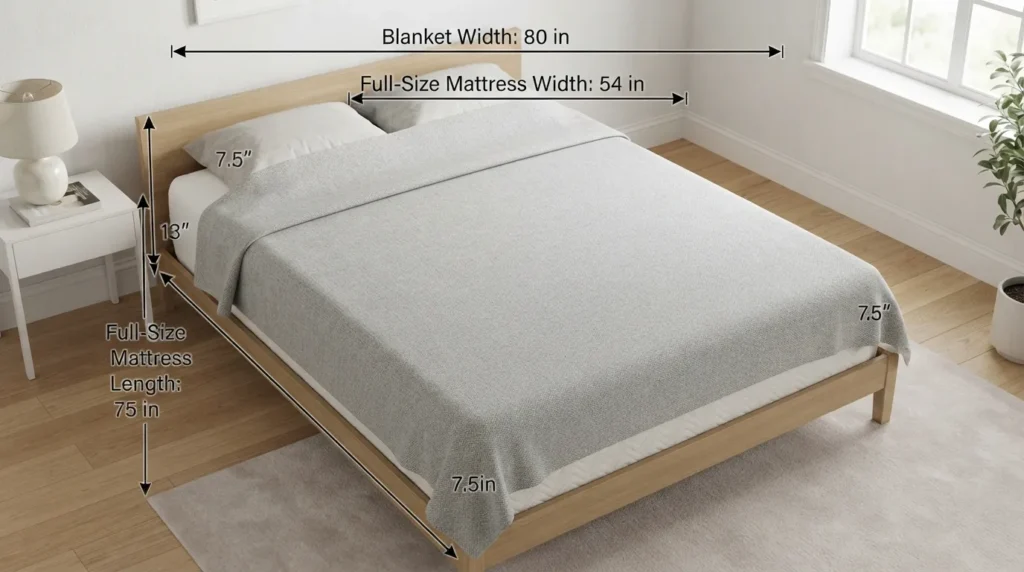
The difference between mattress and blanket dimensions is important. The mattress measurement tells you the size of the sleeping surface. The blanket measurement includes the fabric that can hang over the edges.
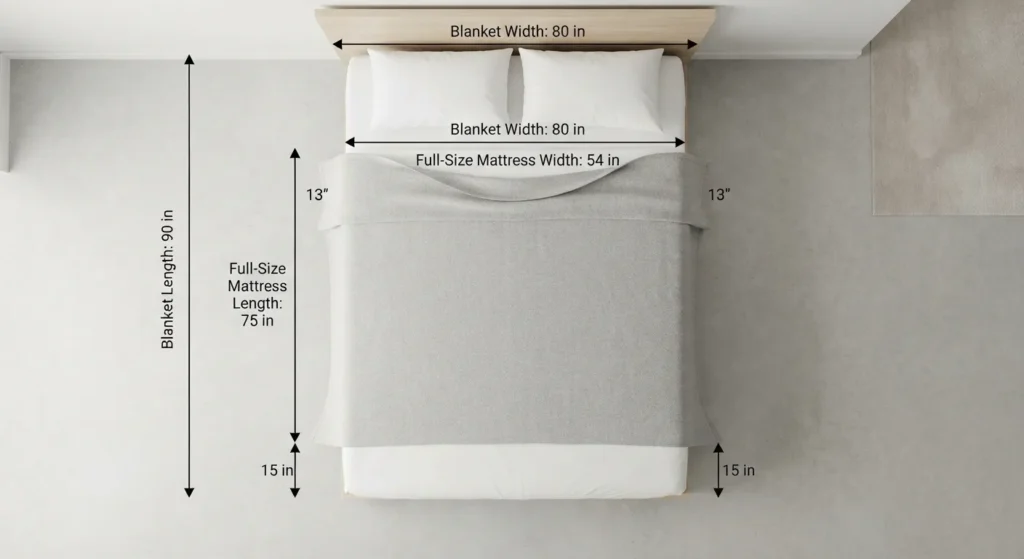
Using the example above, an 80-inch blanket placed across a 54-inch-wide mattress provides 26 inches of extra width. If centered, that works out to approximately 13 inches of overhang on each side.
Along the length, a 90-inch blanket on a 75-inch mattress leaves 15 inches of extra fabric. If centered evenly, that is around 7.5 inches at each end. In real use, you may pull more of the blanket toward the pillows or the foot of the bed.
Typical blanket dimensions by bed size
The figures below are general examples rather than fixed industry standards. Actual blanket sizes vary by manufacturer and style.
| Bed size | Typical mattress dimensions | Example blanket dimensions |
|---|---|---|
| Twin | 38 × 75 in | About 65 × 90 in |
| Twin XL | 38 × 80 in | About 65 × 90–100 in |
| Full/Double | 54 × 75 in | About 80 × 90 in |
| Queen | 60 × 80 in | About 90 × 90–100 in |
| King | 76 × 80 in | About 108 × 90–100 in |
A full-size blanket is often a practical choice for a full or double bed, but the best fit depends on how much overhang you want. A thicker mattress, pillow-top design, or preference for tucking the blanket underneath can affect the size you need.
Also, do not assume that every product labeled “full/queen” has the same measurements. Some manufacturers combine sizes, while others sell separate full and queen blankets.
12 Things That Help You Visualize Full Size Blanket Dimensions
Numbers on a product page are useful, but they can still be difficult to picture. These 12 comparisons give you a better sense of how wide 80 inches and how long 90 inches really are.
1. A Full-Size Mattress
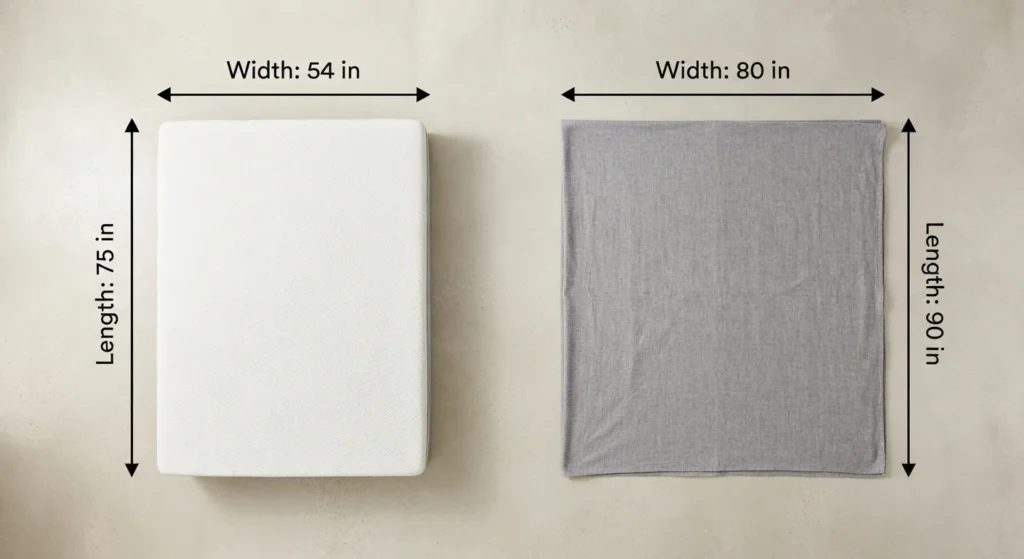
A full mattress is one of the most useful references because it shows what the blanket is intended to cover. A standard US full mattress is about 54 inches wide and 75 inches long.
Compared with an 80 × 90-inch blanket, the mattress is 26 inches narrower and 15 inches shorter. That extra fabric allows the blanket to extend beyond the mattress edges.
Picture the blanket spread over the bed with fabric hanging down both sides. The exact drop depends on how the blanket is positioned, but the mattress provides an easy starting point for judging the fit.
2. A Queen-Size Mattress

A standard US queen mattress measures about 60 inches wide by 80 inches long. That makes it six inches wider and five inches longer than a full mattress.
An 80 × 90-inch blanket can cover a queen mattress, but it will provide less overhang than it would on a full bed. This may be enough for someone who prefers a lighter drape, though it may not suit everyone.
The comparison is especially helpful if you are deciding between a full-size blanket and a full/queen product. Check the actual product dimensions rather than assuming a shared label means a perfect fit.
3. A Standard Interior Door

Many standard US interior doors are around 80 inches tall. That is the same as the example blanket’s width, which measures 6 feet 8 inches.
Imagine measuring from the floor to the top of a typical door. You would get a distance close to the blanket’s width when it is spread out.
The blanket’s 90-inch length is another 10 inches longer than that door height. Door dimensions vary, so use this comparison as a visual reference rather than a substitute for measuring your actual space.
4. Two and a Half Yards of Fabric

The 90-inch length of the example blanket equals 2.5 yards. That is a useful reference for anyone familiar with buying fabric for sewing or home projects.
A yard is 36 inches, so two full yards make 72 inches. Another half yard adds 18 inches, bringing the total to 90 inches.
Think of a fabric counter measuring out two and a half yards in one continuous length. It gives you a sense of the blanket’s length, although a blanket is much wider than a narrow strip of fabric.
5. A Six-Foot-Four-Inch Person

A person who is 6 feet 4 inches tall measures 76 inches. The example blanket’s 90-inch length is 14 inches longer.
This comparison helps explain why a 90-inch blanket can cover most adults comfortably when laid lengthwise. It also leaves some fabric for positioning around the shoulders or feet.
Of course, the fit depends on how the person sleeps and whether they like to tuck the blanket under their feet. The measurement is a visual aid, not a guarantee that every sleeper will feel equally covered.
6. A Seven-and-a-Half-Foot Section of Wall
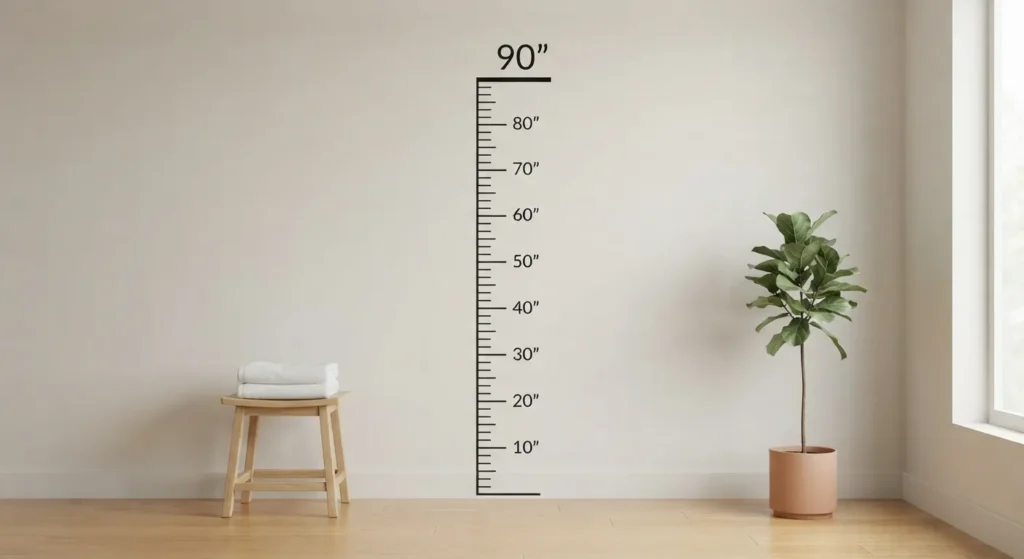
The length of an 80 × 90-inch blanket is 7 feet 6 inches. You can imagine that distance vertically along a wall to understand the measurement.
A wall reference is useful because you can often see a long stretch of uninterrupted space more easily than you can picture a number on a screen. Marking the distance with removable tape can make the comparison even clearer.
Remember that the blanket’s 90 inches represent its length when laid flat. The wall comparison illustrates the distance, not the blanket’s shape or thickness.
7. A Large Area Rug

An 80 × 90-inch blanket covers a little over 6.2 square yards of flat surface. That is a useful way to think about its overall footprint rather than only its longest side.
For context, an 8 × 10-foot rug is 96 × 120 inches, making it substantially larger than the blanket. A full-size blanket covers a smaller rectangular area, although it can still feel generous when draped across a bed.
This comparison is most useful when you want to imagine the blanket’s footprint on a floor or table. Keep in mind that a rug and a blanket serve different purposes and may have different thicknesses and edge finishes.
8. A Six-Foot Folding Table
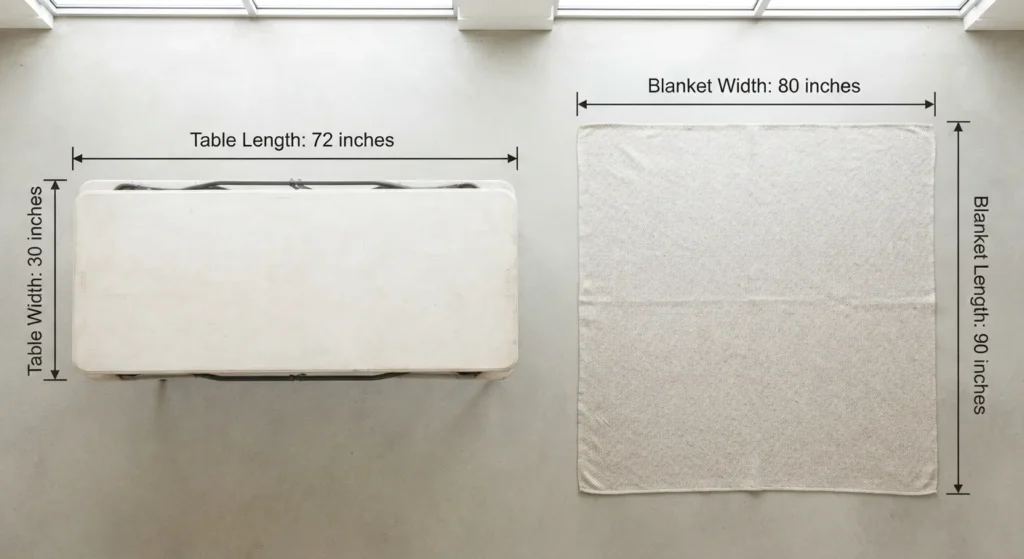
A common six-foot folding table measures around 72 inches long. The example blanket’s 90-inch length is 18 inches longer than the table.
That is a useful comparison if you have ever set up a table for a family gathering or outdoor event. You can imagine the blanket extending beyond both ends if you tried to lay it lengthwise over the tabletop.
Table sizes vary, but a six-foot folding table is a familiar reference for many households. It helps make the blanket’s length feel less abstract.
9. A Standard US Dollar Bill
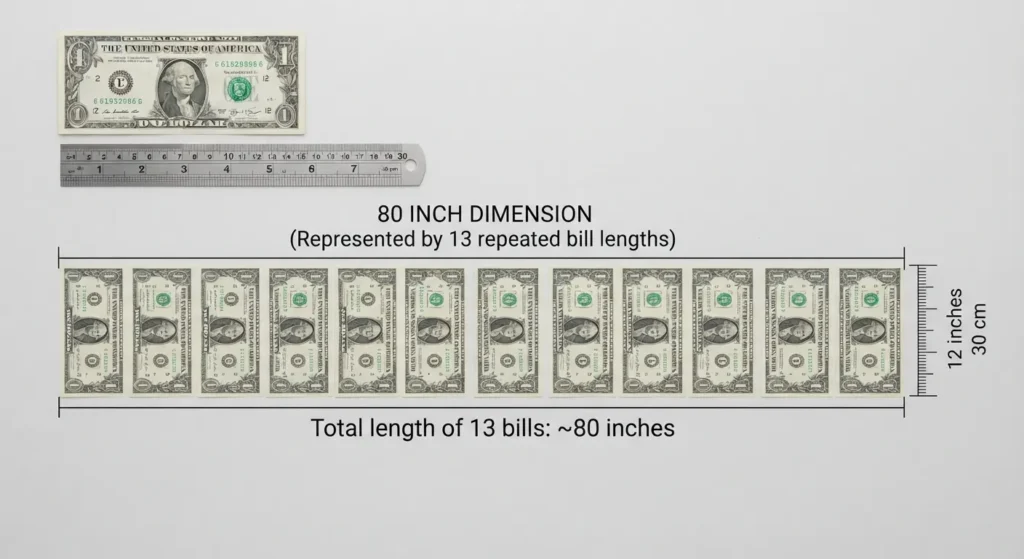
A US dollar bill measures approximately 6.14 inches long. It would take about 13 bill lengths placed end to end to span 80 inches, although the final distance would be slightly over 80 inches.
This comparison is handy because a dollar bill has a consistent size and is easy to recognize. It also gives you a way to estimate a long measurement if you do not have a ruler nearby.
Do not use a single bill as if it were a full-size measuring tool. The repeated-bill idea is only a visual guide, and carefully lining up many bills would be less convenient than using a tape measure.
10. A Standard Pillow

A typical US standard bed pillow is around 20 × 26 inches, although pillow sizes vary. Compared with the blanket, the pillow is much smaller in both directions.
You could place several standard pillows across the blanket’s width to get a rough visual sense of the scale. Four pillow widths would total 80 inches, but the arrangement would be wider than most people need on a single full bed.
This is a familiar comparison for anyone shopping for bedding. Just remember that pillows are usually measured by their fabric dimensions and can look smaller or larger depending on how full they are.
11. A Typical Yoga Mat

Many standard yoga mats are around 24 inches wide and 68 inches long. An 80-inch blanket width is more than three times the mat’s width, while the blanket’s 90-inch length is 22 inches longer than the mat.
The comparison is useful because yoga mats are long rectangular objects that people often see laid flat. You can picture the mat’s shape and then imagine a much broader rectangle beside it.
Yoga mats come in longer and wider versions, so this comparison refers to a common size rather than every model. It is a way to visualize the blanket, not an exact measurement substitute.
12. A Small Dining Table

A compact dining table might measure around 48 inches long and 30 inches wide. The example blanket is longer and wider than the tabletop, giving you a sense of how much surface area it covers.
If you imagine placing the blanket flat on the floor beside such a table, the blanket would extend noticeably beyond every edge. That makes it easier to understand why an 80 × 90-inch blanket can provide substantial coverage on a full mattress.
Dining tables vary considerably in size, so use this as a general visual comparison. If your own table is available, measuring it can give you a more personal reference.
The Full Bed Question People Actually Mean
When someone searches for full size blanket dimensions, they are often trying to answer a more practical question: Will this blanket fit my full bed?
The answer depends on the blanket’s actual dimensions and how you want it to sit on the mattress. A full mattress is typically 54 × 75 inches, while a commonly used example for a full-size blanket is 80 × 90 inches.
How much overhang should a full blanket have?
If you center an 80-inch-wide blanket on a 54-inch-wide mattress, the extra width is 26 inches. Divided evenly, that gives you about 13 inches of fabric hanging over each side.
The 90-inch length leaves 15 inches beyond a 75-inch mattress. If centered, that would mean about 7.5 inches at the head and foot. In practice, many people position the blanket farther toward the foot of the bed or tuck it under the pillows.
Is an 80 × 90-inch blanket big enough for two people?
It may be, but comfort depends on how much coverage each person prefers. Two sleepers who move around a lot may prefer a wider blanket, while someone sleeping alone on a full bed may find this size generous.
Should you buy a larger blanket?
Consider a larger size if you have a deep mattress, want a dramatic drape, share the blanket, or prefer to tuck fabric beneath the mattress. A smaller blanket may work if you want lightweight coverage without much overhang.
The most reliable approach is to measure your mattress and compare those dimensions with the product’s listed width and length. Do not rely on the words “full size” alone, especially when shopping across brands or countries.
Getting to These Dimensions Without a Tape Measure
You can get a rough sense of an 80 × 90-inch blanket without measuring every inch, but estimates will not be as reliable as a proper tape measure.
Use your mattress as the starting point
If you have a standard full mattress, you already know it is about 54 × 75 inches. An 80 × 90-inch blanket should extend beyond it by roughly 13 inches on each side and 7.5 inches at each end when centered evenly.
Compare it with a six-foot table
A common six-foot folding table is about 72 inches long. The blanket’s 90-inch length is 18 inches longer, so picture adding about a foot and a half to the table’s length.
Use a standard sheet of paper for a smaller reference
US Letter paper measures 8.5 × 11 inches. It is far smaller than a blanket, but its known dimensions can help you visualize a foot or so at a time. Several sheets laid end to end can demonstrate the distance, though this is awkward for checking a full blanket.
Mark the dimensions on the floor
If you have a clear floor area, use removable tape or string to mark an 80-inch side and a 90-inch side. The rectangle will give you a direct sense of the blanket’s footprint before you buy one.
Check the product label carefully
If you are estimating because you do not have a tape measure, check the manufacturer’s listed dimensions and whether the order is width × length. Some listings round measurements or describe a range, particularly for knitted, fleece, or stretchy blankets.
For a better understanding of related bedding sizes, see [INTERNAL LINK: Full Size Mattress Dimensions] or [INTERNAL LINK: Queen Size Blanket Dimensions].
FAQs About Full Size Blanket Dimensions
What are the standard full size blanket dimensions?
A common example is approximately 80 × 90 inches, but there is no single measurement used by every manufacturer. Always check the product’s actual dimensions before purchasing.
How many feet is an 80 × 90-inch blanket?
It measures 6 feet 8 inches wide by 7 feet 6 inches long. In decimal feet, that is approximately 6.67 × 7.5 feet.
How many centimeters is a full-size blanket?
An 80 × 90-inch blanket measures 203.2 × 228.6 centimeters. These conversions apply to the example dimensions; other full-size blankets may be different.
How many meters is an 80 × 90-inch blanket?
It measures approximately 2.032 × 2.286 meters. That is just over two meters wide and nearly 2.3 meters long.
Is a full-size blanket the same size as a full mattress?
No. A typical US full mattress is about 54 × 75 inches, while a blanket is usually larger so it can cover the mattress and hang over its edges.
Will a full-size blanket fit a queen bed?
It can cover a queen mattress, but the overhang will be smaller. A standard US queen mattress is about 60 × 80 inches, so check whether the blanket provides enough coverage for your preferences.
Is a full-size blanket big enough for two people?
It can work for two people, but it may feel narrow if both sleepers move around or prefer plenty of individual coverage. A wider blanket may be more comfortable for couples.
How can I measure a blanket without a tape measure?
Use the mattress as a reference, compare it with a known-size table, or mark an 80 × 90-inch rectangle on the floor. These methods help you visualize the dimensions, but use a ruler or tape measure when accuracy matters.
Where That Leaves You
A typical full-size blanket measuring 80 × 90 inches is about 6 feet 8 inches wide and 7 feet 6 inches long. It is larger than a standard full mattress, giving it room to drape over the sides and ends.
The easiest comparison is the mattress itself: a 54 × 75-inch full bed leaves a noticeable amount of extra fabric beneath an 80 × 90-inch blanket. That overhang is what turns a flat measurement into useful coverage.
Before buying, compare the blanket’s listed dimensions with your mattress and think about how much fabric you want hanging over the edges. Once you picture that extra space, choosing the right blanket size becomes much easier.

Jack Harrison is a passionate writer who creates informative, engaging and easy-to-understand content for online readers. He enjoys researching new topics and sharing practical insights that help readers discover useful ideas and information.