

A Mahjongg puzzle can fill your screen with dozens of tiles, but the amount of space it occupies depends on more than the number of tiles you see. Tile size, overlapping layers, screen resolution, and the game’s layout all affect how large the board looks.
If you’re searching for Mahjongg Dark dimensions, the first thing to know is that the phrase may refer to a particular online Mahjongg game rather than a physical object with one fixed measurement. Different versions and websites can display different board layouts, so there isn’t one reliable width in inches or feet that applies to every version.
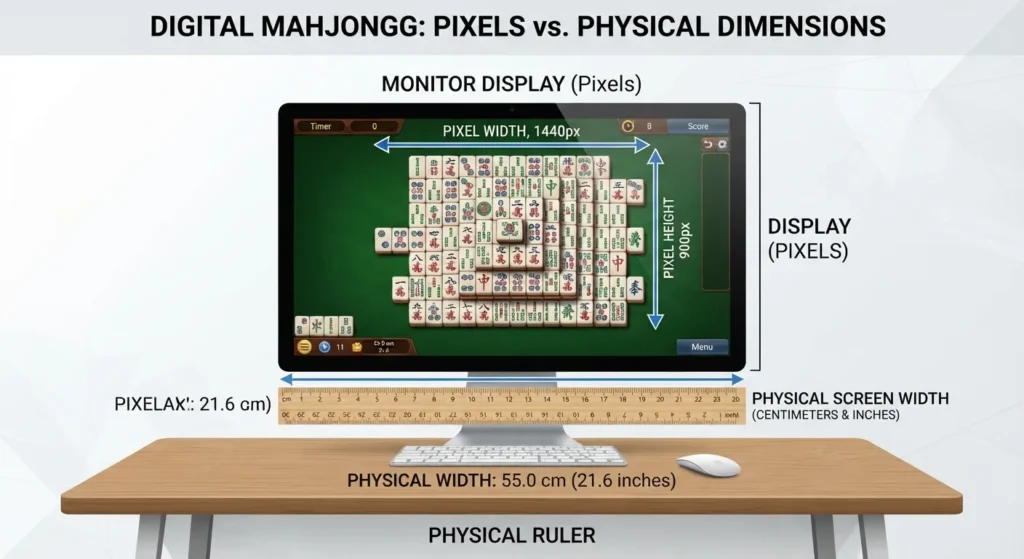
For a digital game, dimensions are usually more useful when described in pixels, screen proportions, and the number of tiles across and down. Inches, centimeters, and feet only become meaningful if you’re measuring a physical display.
This guide explains how to understand Mahjongg Dark’s board dimensions, how to estimate its on-screen size, what familiar screens and objects can help you visualize it, and how to distinguish the game board’s size from the size of the device you’re playing on.
Important note: Without a specific game link or screenshot, the exact board dimensions of the version you mean cannot be confirmed. The examples below explain how to measure and visualize the layout without inventing an official size.
Every Unit Used to Describe Mahjongg Dark Dimensions
Unlike a garage or a mattress, a digital Mahjongg board doesn’t have a universal physical width and height. Its dimensions depend on the version of the game, the browser or app window, and the device’s display settings.
Here are the most useful units for understanding its size.
| Unit | What it tells you |
|---|---|
| Pixels (px) | The board’s width and height on the screen or in an image |
| Inches | The physical width or height of the displayed board |
| Centimeters (cm) | The metric equivalent of its physical size |
| Millimeters (mm) | A smaller metric measurement for precise comparisons |
| Feet (ft) | Useful for a large display or projected game |
| Meters (m) | Mainly relevant to a very large display or projection |
To convert a physical measurement, use these simple formulas:
- Inches to centimeters: multiply by 2.54.
- Inches to millimeters: multiply by 25.4.
- Inches to feet: divide by 12.
- Inches to meters: multiply by 0.0254.
For example, if the visible game board measures 10 inches wide on your monitor, that equals 25.4 cm, 254 mm, or about 0.83 feet.
Pixels cannot be converted directly into inches without knowing the display’s pixel density or the actual physical size of the image on screen. A board that’s 900 pixels wide might look different on a laptop and a large desktop monitor.
How the Game Board’s Size Works
The size of a Mahjongg Dark board is different from the size of a physical Mahjongg set. The digital board is made up of illustrated tiles arranged in a particular pattern, often with some tiles overlapping others.
Three measurements matter most when you’re trying to understand the board:
- Board width: The horizontal distance from the leftmost tile to the rightmost tile.
- Board height: The vertical distance from the topmost tile to the bottommost tile.
- Tile dimensions: The width and height of an individual tile as displayed on screen.
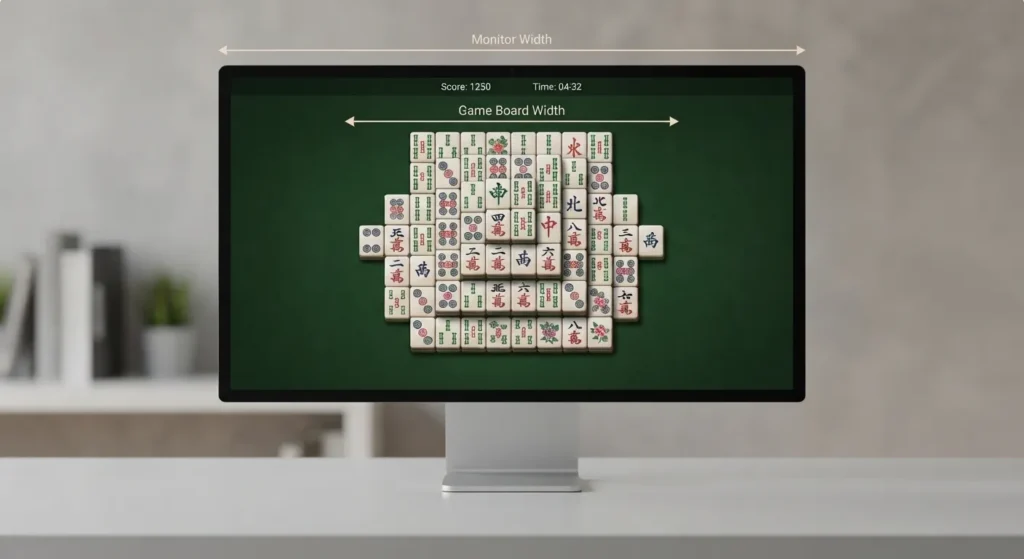
The number of tiles alone does not tell you the board’s dimensions. A layout with many small tiles may take up less screen space than one with fewer, larger tiles.
Screen scaling also matters. If a game fills the browser window, the board may expand to use the available space. If the game has a fixed-size play area, it may leave empty margins around the tiles instead.

10 Familiar Things That Help You Visualize the Board
Since Mahjongg Dark is a digital game, the most useful comparisons are familiar screens and everyday objects that help you estimate the display area. These examples are visual references, not claims about the game’s official dimensions.
1. A Laptop Screen
A laptop is one of the most natural ways to play a browser-based Mahjongg game. Many laptops have screens around 13–16 inches diagonally, although the actual width and height vary with the screen’s aspect ratio.
The diagonal measurement is not the same as the width of the screen. For example, a 15.6-inch display is measured from one corner to the opposite corner, not horizontally across the screen.
If the game board fills most of the laptop display, its apparent size will depend on how much space the browser controls and game menus occupy. A board surrounded by menus can have a much smaller playable area.
Imagine opening the game on your laptop and looking at the tiles between the browser’s edges. That visible tile area—not the entire laptop—is the measurement you want to compare.

2. A Desktop Monitor
A desktop monitor provides a larger viewing area than many laptop screens. Common monitor sizes include 24 and 27 inches, measured diagonally, but the board’s actual width depends on the monitor’s proportions and the game’s layout.
A 27-inch monitor doesn’t mean the Mahjongg board is 27 inches wide. The board may occupy only the central portion of the display, especially if the game uses a fixed play area or leaves room for controls.
A larger monitor can make tiles appear more spacious and easier to distinguish. However, the game may simply scale up its existing layout rather than display more tiles.
Picture the board centered on a desktop monitor with empty space on either side. The tile arrangement may stay the same even if the monitor gets larger.
3. A Smartphone Screen
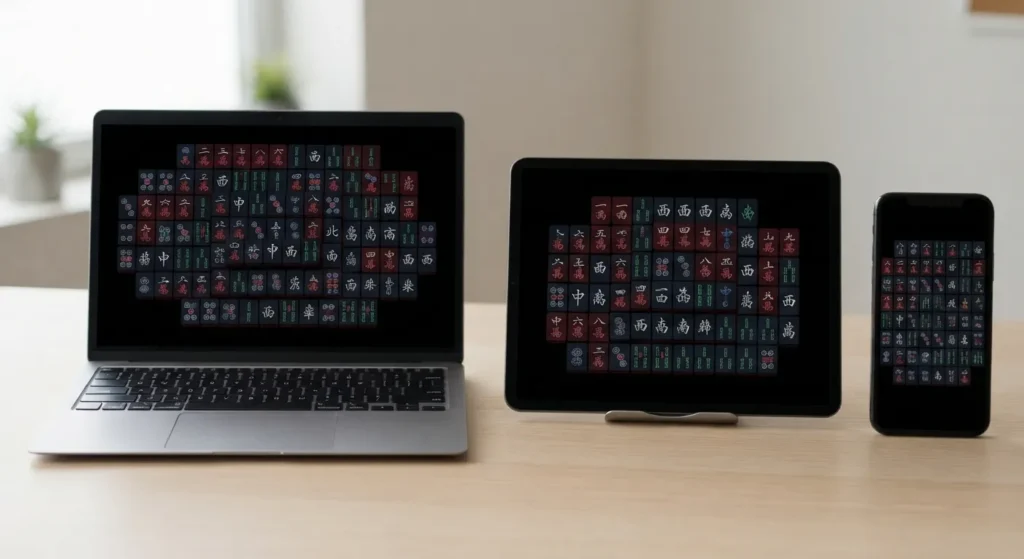
A smartphone has a much smaller physical display than a laptop or desktop monitor, so a Mahjongg game may need to scale down or rearrange its interface to fit.
Phones are often described by their diagonal screen size. That figure doesn’t reveal how wide the game board will appear, since screen proportions and interface scaling vary from device to device.
Small tiles can become harder to select on a phone, especially when the board contains overlapping rows. Some versions may use a responsive layout, while others may be designed primarily for larger screens.
Imagine the same puzzle displayed on a phone instead of a monitor. The underlying game may be similar, but each tile occupies a smaller physical area.

4. A Tablet
A tablet sits between a smartphone and a laptop in terms of portability and viewing area. Its wider screen can make tile-based games more comfortable to view than they are on a small phone.
Tablet screens come in different sizes and proportions, so the exact space available for a Mahjongg board will vary. Some displays are relatively wide, while others are closer to a square shape.
A board that feels crowded on a phone may be easier to inspect on a tablet because the tiles have more room. This is especially helpful when several tiles overlap and you need to identify which ones are available to select.
Think of a tablet as a portable game board. It gives you a larger viewing surface without requiring a full desktop setup.

5. A Standard Sheet of US Letter Paper
A sheet of US Letter paper measures 8.5 × 11 inches, or approximately 21.6 × 27.9 cm. It offers a familiar physical reference for estimating the width or height of a game board displayed on a screen.
If the visible board appears roughly as wide as a sheet of paper’s 11-inch side, you can use that as a rough comparison. This only works if you compare the board’s physical display size with the paper itself—not the number of pixels in a screenshot.
The comparison becomes less reliable when you view the game at different zoom levels or on another monitor. A screenshot can be resized without changing the original arrangement of the tiles.
Imagine holding a sheet of paper beside your monitor and estimating how much screen width the tile board occupies. It gives you a quick physical reference without needing to know the game’s pixel dimensions.

6. A 24-Inch Monitor Compared With a 27-Inch Monitor
A 24-inch and a 27-inch monitor are both common desktop display sizes. The difference between them is measured diagonally, so the larger screen is not simply three inches wider.
If both monitors use the same aspect ratio, the 27-inch model will have a larger width and height. The game board may therefore appear physically larger if it scales proportionally with the display.
The exact difference also depends on resolution and browser scaling. Two monitors can show the same number of pixels across the game board but display them at different physical sizes.
Picture the same Mahjongg layout on two monitors side by side. The tile pattern can remain unchanged even though the physical board looks larger on one screen.

7. A Computer Keyboard
A full-size computer keyboard is often around 17–18 inches wide, although compact and ergonomic models can be much narrower or wider. It provides a useful reference for estimating the physical width of a desktop display area.
If the Mahjongg board appears about as wide as a full-size keyboard when you hold the keyboard up to the screen for comparison, you can use that as a rough estimate of the board’s displayed width.
This comparison is only meaningful when the keyboard and the board are viewed in the same physical context. A keyboard sitting on the desk is not directly comparable to an on-screen object unless you account for perspective.
Imagine a keyboard placed directly below the game window. Comparing their widths gives you a familiar reference for how much screen space the board occupies.

8. A Television Screen
A television can display a browser-based game if the device supports it or if you connect a computer. TVs are commonly sold in sizes such as 32, 43, 50, and 55 inches, with the size measured diagonally.
The large screen doesn’t guarantee a larger board in every version. A game designed around a fixed-size window may occupy only part of the television, leaving substantial empty space around the tiles.
If the game scales to fill the available area, individual tiles may appear much larger than they would on a laptop. Viewing distance also changes how large the board feels to the player.
Picture a Mahjongg board displayed in the center of a television. It may look enormous from across the room, even though its logical layout and number of tiles remain unchanged.

9. A Printed Mahjongg Tile
Physical Mahjongg tiles are small rectangular pieces, but their dimensions vary by set and manufacturer. They can help you understand the shape and proportions of the digital tiles, though they cannot establish the exact on-screen size.
A digital tile may look wider, taller, or more three-dimensional depending on its artwork and the game’s visual style. Shadows and overlapping layers can also make tiles appear larger than their clickable area.
If you own a physical set, place one tile beside your monitor and compare it visually with a tile shown on screen. This provides a rough sense of scale, but the result depends on your viewing angle and display settings.
The important distinction is between the artwork you see and the interactive tile area. A tile graphic may include a shadow or border that makes it appear slightly larger than the space used for selection.

10. A Browser Window
The browser window itself is another helpful reference because the game board must fit within the space left by the browser’s interface. Tabs, the address bar, menus, and the operating system’s taskbar can all reduce the visible area.
For example, maximizing a browser window may give the game more room than opening it in a smaller window. Hiding certain browser controls or changing zoom settings can also affect how the board appears, depending on the game.
This is why two people can open what appears to be the same game and see different board sizes. They may be using different screens, window dimensions, zoom levels, or versions of the game.
Imagine drawing a rectangle around the tile area inside your browser. That rectangle is the most useful boundary to measure when you’re trying to describe the dimensions of the Mahjongg Dark board.

What Screen Size Do You Need to Play Mahjongg Dark?
There is no single screen size that can be recommended for every version of Mahjongg Dark without knowing which game you mean. A browser-based version may resize automatically, while another version may be optimized for a particular screen layout.
For a comfortable experience, consider these factors:
- Screen size: A larger screen generally makes it easier to view individual tiles.
- Resolution: Higher resolution can provide a sharper image, but it doesn’t automatically make the game board physically larger.
- Aspect ratio: A wider display may leave more horizontal room, while a different aspect ratio may change how the board fits.
- Browser zoom: Zooming in can enlarge tiles but may hide part of the board or require scrolling.
- Tile arrangement: Layered layouts may need more visible space than simpler arrangements.
The best way to confirm the actual dimensions is to open the exact game and measure the visible board area. If you need its pixel dimensions, use a screenshot with a known image size and identify the board’s outermost edges. If you need its physical size in inches or centimeters, measure the displayed board on your screen.
Estimating the Board Size Without a Measuring Tool
You can get a reasonable estimate of the game’s displayed size using references you already have.
1. Compare It With Your Keyboard
On a desktop computer, compare the width of the visible game board with the keyboard below the monitor. A full-size keyboard is often around 17–18 inches wide, but compact keyboards differ.
2. Use a Sheet of Paper
Hold a standard US Letter sheet near the screen and compare its 11-inch long edge with the board’s visible width. Keep the paper and display in a position that makes the comparison easy, and treat the result as an estimate.
3. Check the Screen’s Diagonal Size
If you know your monitor’s diagonal measurement, you can estimate its physical width if you also know its aspect ratio. The game board will usually occupy only a portion of that width, so measure or estimate its share of the screen separately.
4. Take a Screenshot
A screenshot is useful when you want to describe the board in pixels. The screenshot’s total width and height are not automatically the game’s dimensions; identify the exact rectangle containing the tile layout.
5. Count Tiles Across the Board
Count the number of tile positions across a row and estimate the displayed width of one tile. Multiplying the two can provide a rough estimate, but overlapping tiles, gaps, and perspective effects can make the result less precise.
For a more exact result, use the actual game link or a screenshot showing the entire board. That makes it possible to distinguish the board’s visible dimensions from the overall screen size.
Frequently Asked Questions
What are the exact Mahjongg Dark dimensions?
The exact dimensions cannot be confirmed from the name alone because different online versions may use different layouts and scaling. A specific game link or screenshot is needed to identify and measure the correct board.
How big is Mahjongg Dark in pixels?
Its pixel dimensions depend on the version and the size of the game area in your browser or app. To obtain an accurate figure, measure the board’s visible edges in a screenshot rather than using the entire screenshot dimensions.
Can Mahjongg Dark dimensions be measured in inches?
Yes, if you’re referring to the physical size of the board as displayed on a monitor, tablet, or phone. The measurement will vary with the device and scaling settings, so there is no universal number of inches.
How many feet is the Mahjongg Dark board?
There is no fixed number of feet for a digital board. If you measure its displayed width in inches, divide that number by 12 to convert it into feet.
How many centimeters is the Mahjongg Dark board?
You need the board’s physical width or height first. Multiply a measurement in inches by 2.54 to convert it to centimeters; for a pixel measurement, you also need the display scaling or pixel density.
Does Mahjongg Dark have a standard board size?
Not one that can be confirmed for every game using that name. The layout and screen area may vary by publisher, website, device, and game version.
Can I play Mahjongg Dark on a phone or tablet?
That depends on the particular version and whether its website or app supports your device. If the board looks crowded on a phone, a tablet or desktop monitor may provide a more comfortable viewing area.
How can I find the dimensions of my Mahjongg Dark game?
Open the exact game, take a screenshot, and identify the outer edges of the tile layout. For physical dimensions, measure the displayed board on your screen; for pixel dimensions, measure its boundary within the screenshot.
Where That Leaves You
The key point is that Mahjongg Dark dimensions describe a digital board whose displayed size depends on the game version and your screen, not a standard physical object with a fixed width and height. Pixels are the most useful starting point for measuring the layout, while inches, centimeters, and feet describe how large it appears on a particular display.
A laptop, monitor, tablet, or even a sheet of paper can help you visualize the board’s size. Just remember that these are comparisons rather than official measurements.
If you share the exact Mahjongg Dark game link or a screenshot of its full board, the actual pixel dimensions—and, with screen-size information, an approximate physical measurement—can be worked out much more accurately.

Jack Harrison is a passionate writer who creates informative, engaging and easy-to-understand content for online readers. He enjoys researching new topics and sharing practical insights that help readers discover useful ideas and information.


