
A bed can look small in a furniture showroom and suddenly take over a bedroom when you bring it home. The difference often comes down to a few inches of width, the length of the mattress, and how much space remains for everything else.
A standard U.S. full-size mattress measures 54 inches wide by 75 inches long. It’s a common choice for solo sleepers, teenagers, guest rooms, and smaller bedrooms where a queen mattress may feel too wide.
The tricky part is imagining those numbers in a real room. Knowing that a mattress is 54 inches wide doesn’t immediately tell you whether it will fit beside your dresser or leave enough space to walk around the bed.
Full size mattress dimensions equal 4 feet 6 inches wide by 6 feet 3 inches long, 137.16 cm by 190.5 cm, 1,371.6 mm by 1,905 mm, and 1.3716 m by 1.905 m. Below, we’ll compare this mattress with familiar furniture, household objects, and other bed sizes so you can picture its footprint before buying one.
Full Size Mattress Dimensions in Every Unit
The standard U.S. full mattress has two main measurements: 54 inches across and 75 inches from head to foot. You’ll sometimes hear this size called a double mattress, particularly in the United States.
| Unit | Width | Length |
|---|---|---|
| Inches | 54 in | 75 in |
| Feet and inches | 4 ft 6 in | 6 ft 3 in |
| Decimal feet | 4.5 ft | 6.25 ft |
| Centimeters | 137.16 cm | 190.5 cm |
| Millimeters | 1,371.6 mm | 1,905 mm |
| Meters | 1.3716 m | 1.905 m |
| Yards | 1.5 yd | 2.08 yd |
The math is easy to check. Divide inches by 12 to get feet, or multiply inches by 2.54 to convert to centimeters. To convert centimeters to millimeters, multiply by 10; to convert centimeters to meters, divide by 100.
For example, 54 inches divided by 12 equals 4.5 feet, or 4 feet 6 inches. The 75-inch length converts to 6.25 feet, which is 6 feet 3 inches.
A full mattress has a surface area of approximately 28.1 square feet. That’s the mattress footprint alone, not the full space occupied by a bed frame, headboard, or nearby furniture.
These are standard U.S. dimensions. Products may vary slightly by manufacturer, and full-size mattresses in other markets may follow different sizing conventions.
Where a Full Mattress Fits on the Bed Size Chart
A full mattress is wider than a twin but narrower than a queen. It can offer a comfortable amount of space for one person while leaving more room in the bedroom for a desk, wardrobe, or other furniture.
| Mattress Size | Typical Width | Typical Length | General Use |
|---|---|---|---|
| Twin | 38 in | 75 in | Compact single bed |
| Twin XL | 38 in | 80 in | Single bed with extra length |
| Full | 54 in | 75 in | Solo sleepers and guest rooms |
| Queen | 60 in | 80 in | Couples and larger bedrooms |
| King | 76 in | 80 in | Couples wanting more width |
| California King | 72 in | 84 in | Extra length for taller sleepers |
Compared with a twin, a full mattress adds 16 inches of width while keeping the same typical 75-inch length. That additional space can make sleeping and turning over more comfortable for one person.
A queen mattress is 6 inches wider and 5 inches longer than a full. Those differences may sound modest, but they provide extra room for couples and taller sleepers. A full can accommodate two adults in some situations, although each person gets only about 27 inches of width if the mattress is split evenly.
Also remember that mattress thickness is a separate measurement. Full mattresses can be thin or quite tall depending on their construction, and the bed frame can extend beyond the mattress on every side.
12 Things That Help You Visualize Full Size Mattress Dimensions
Comparisons are useful because most people can picture a desk or doorway more easily than a measurement written in inches. The examples below help you imagine a 54-by-75-inch rectangle. Exact sizes vary by product, so treat approximate comparisons as visual guides rather than measuring standards.
1. A Standard Twin Mattress
A standard U.S. twin mattress is typically 38 inches wide by 75 inches long. It shares the full mattress’s length, but the full is 16 inches wider.
That extra width makes a full feel less narrow, particularly for someone who changes sleeping positions during the night. It can also be useful for a growing teenager who wants more room without moving up to a queen.
Picture a twin mattress and imagine adding an 8-inch strip to each side. The resulting width is 54 inches, while the length stays at 75 inches.

2. A Queen Mattress
A standard queen mattress measures 60 inches wide by 80 inches long. Compared with a full mattress, it adds 6 inches of width and 5 inches of length.
The difference is especially noticeable when two people share the bed. A full gives each person approximately 27 inches of width, while a queen gives each around 30 inches when divided evenly.
Imagine placing a 6-inch-wide strip along one side of a full mattress and extending the foot by another 5 inches. That extra area represents the queen’s larger footprint.

3. A Compact Sofa About 54 Inches Wide
Some compact sofas or loveseats measure around 54 inches from one armrest to the other. That is approximately the same as the width of a full mattress.
Sofa dimensions depend heavily on the design, so not every loveseat will match this measurement. Still, if you have a small two-seat sofa, its width can be a useful way to picture the mattress span.
Imagine the sofa’s width stretched into a flat rectangle that extends 75 inches in the other direction. That is the basic shape of a full mattress, without the backrest or cushions.

4. A Six-Foot-Tall Adult
A person who stands 6 feet tall measures 72 inches. A full mattress is 75 inches long, leaving a difference of only 3 inches.
This comparison helps explain why a full mattress can feel short for some taller sleepers. A pillow takes up some space at the head, and a person may not sleep perfectly straight, so the extra length can feel limited.
Imagine lying on a full mattress with your head near the top edge. The mattress is only slightly longer than a 6-foot person, which is why taller sleepers may prefer a longer option such as a twin XL or queen.

5. A Standard Interior Door
Many U.S. interior door slabs are around 30 or 32 inches wide. A full mattress’s 54-inch width is wider than a single door slab, although mattresses can sometimes be angled or flexed to pass through tight openings.
Getting a mattress through a doorway depends on more than the width printed on the label. Hallway turns, staircases, ceiling clearance, mattress firmness, and the way it can safely bend all matter.
For a quick mental picture, imagine a 30-inch doorway and then add another 24 inches. The combined span is 54 inches, which approximates the width of a full mattress.

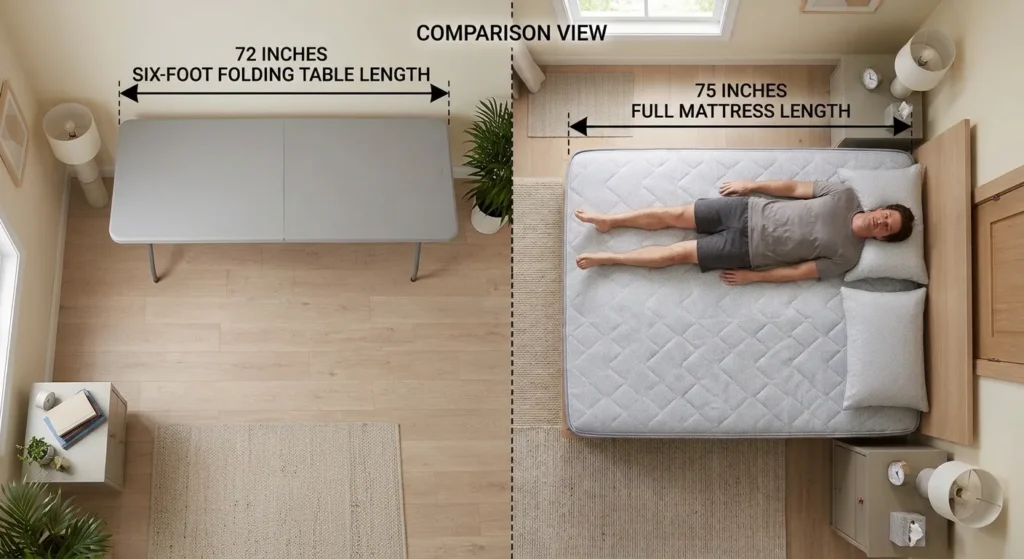
6. A Standard Six-Foot Folding Table
A common folding table measures about 72 inches long, although models differ. A full mattress is 75 inches long, so it extends about 3 inches beyond a 72-inch table.
This is a handy comparison because folding tables are often used at family gatherings, markets, and events. Many people already have a rough sense of how much space one occupies.
Imagine a six-foot table placed beside the mattress lengthwise. The mattress is just a little longer, while its 54-inch width is much broader than the table’s usual depth.
7. A Four-by-Eight-Foot Plywood Sheet
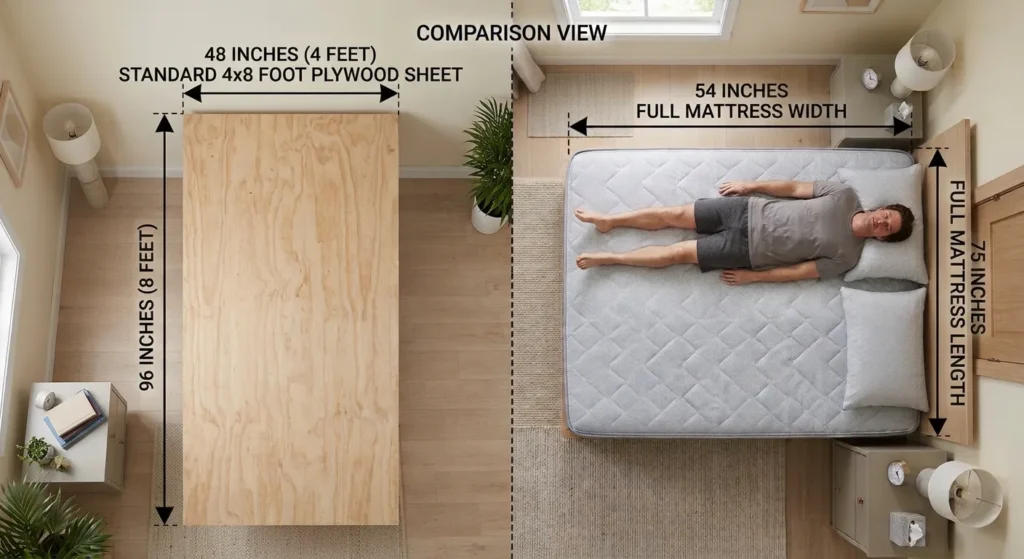
A standard construction plywood sheet is commonly sold in a nominal 4-by-8-foot size, equivalent to 48 by 96 inches. A full mattress is 6 inches wider and 21 inches shorter.
This comparison gives you a familiar large rectangle, particularly if you’ve visited a hardware store or worked on a home project. The plywood sheet is narrower but much longer than the mattress.
Picture the plywood sheet lying flat, then imagine adding a 6-inch strip along one side and shortening its length by 21 inches. You would end up with a rectangle close to the full mattress footprint.
8. A Five-Foot Desk
A desk that measures 60 inches wide is 6 inches wider than a full mattress. The comparison is useful because 5-foot desks are common in home offices and study spaces.
Desk depth varies, and many desks are far shorter from front to back than a mattress is from head to foot. This means the desk is a helpful reference for width but not a complete match for the mattress’s overall shape.
Imagine reducing a 60-inch desk width by 6 inches. That leaves the full mattress’s 54-inch width, with a separate 75-inch length extending away from it.

9. A Six-by-Eight-Foot Area Rug
A 6-by-8-foot rug measures 72 by 96 inches. A full mattress measures 54 by 75 inches, so the rug is larger in both directions.
This is a useful bedroom-planning comparison because rugs are often sold in standard rectangular sizes. A 6-by-8 rug can extend beyond the mattress, although the amount of visible rug depends on how it is placed beneath or beside the bed.
Picture the mattress centered on the rug. There would be extra rug area on the sides and at the ends, but the bed frame and furniture could change the final arrangement.

10. A 75-Inch Television Screen
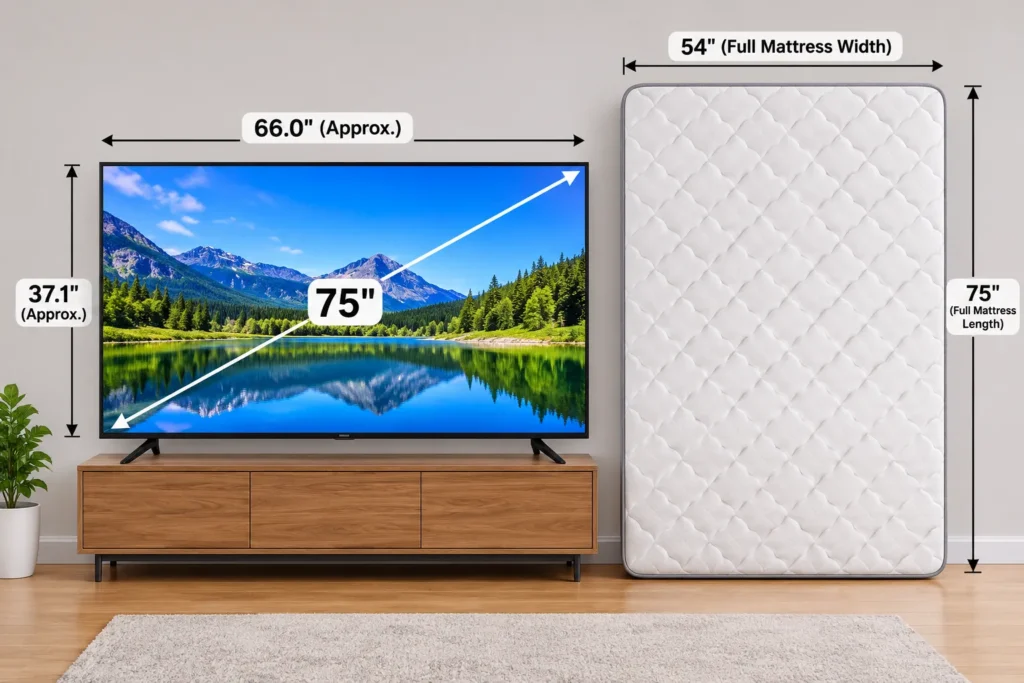
A television advertised as 75 inches is measured diagonally across its screen, not horizontally. A typical 16:9 screen of that size is approximately 65.4 inches wide and 36.8 inches tall, excluding the bezel and stand.
That makes the screen wider than a full mattress’s 54-inch width, but the screen height is much shorter than the mattress’s 75-inch length. It’s a useful reminder that diagonal screen sizes cannot be compared directly with a mattress’s width or length.
Imagine placing a 75-inch TV screen across the mattress width. It would extend beyond both sides if centered, while the screen’s height would cover less than half the mattress length.
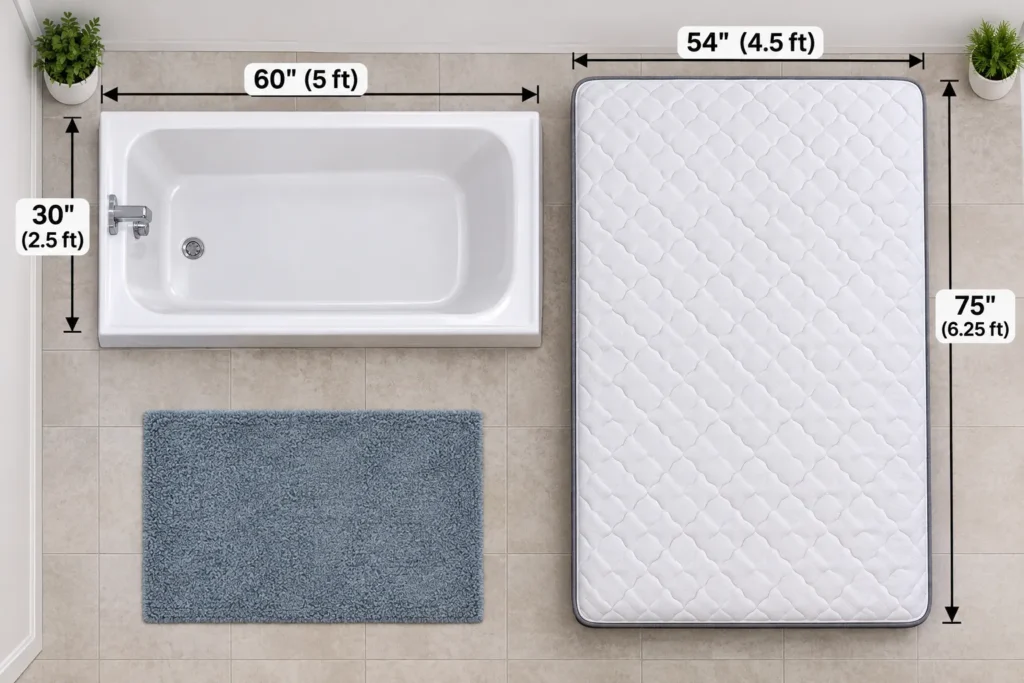
11. A Standard Bathtub
Many standard alcove bathtubs are around 60 inches long and roughly 30 inches wide, though sizes vary by design. A full mattress is longer at 75 inches and wider at 54 inches.
The comparison can help you understand the mattress’s footprint using an object familiar from most homes. A bathtub is a smaller rectangle, especially in width, while the mattress provides a much larger flat surface.
Imagine extending a 60-by-30-inch rectangle to 75 inches long and 54 inches wide. The resulting surface is significantly larger than the typical bathtub footprint.
12. Two Standard Pillow-Length References
Many standard bed pillows are around 20 inches long and 26 inches wide, although pillow dimensions vary by brand. Three 26-inch pillow widths placed end to end would total 78 inches, close to the 75-inch length of a full mattress.
This comparison works best as a mental estimate, not as an exact measuring method. Pillows can compress, and their stated sizes may not match their actual dimensions perfectly.
Imagine laying three standard pillows end to end along the mattress length. The combined span would be just a little longer than the mattress, helping you picture how much space 75 inches covers.

What Size Room Works for a Full Mattress?
A full mattress measures 54 by 75 inches, but the bedroom must accommodate more than the mattress itself. You’ll need space for the bed frame, walking paths, drawers, a closet, and any bedside furniture you want to keep.
A room around 9 by 10 feet can sometimes accommodate a full bed, but whether the layout feels comfortable depends on the door position, wardrobe, windows, and the bed frame’s outer dimensions. A room with fewer obstacles may work better than a larger room with awkward corners.
Before choosing a mattress, measure the room and consider where the bed will sit. Leave enough clearance to get in and out comfortably, open drawers, and reach closet doors. Don’t forget to check the path from the front door to the bedroom, especially if there are narrow hallways or stair turns.
The mattress’s dimensions also differ from the complete bed’s dimensions. A headboard, footboard, or projecting rails can add several inches to the width or length. If space is tight, check the frame manufacturer’s overall measurements rather than relying only on the mattress size.
Getting to Full Mattress Dimensions Without a Tape Measure
You can make a reasonable estimate of a full mattress’s size without a tape measure, provided you use references with known dimensions. These approaches are useful for visualizing a room, but they are not substitutes for precise measurements when buying furniture.
- Use the four-and-a-half-foot width. A full mattress is 54 inches wide, equal to 4 feet 6 inches. If you know the width of a nearby piece of furniture, compare it with that span.
- Picture a six-foot folding table. A common six-foot table is 72 inches long, just 3 inches shorter than the mattress’s 75-inch length. This offers a useful rough comparison.
- Compare it with a twin mattress. A standard twin shares the full mattress’s 75-inch length but is 16 inches narrower. This works only if the twin’s size is known.
- Use floor tiles with known dimensions. Count the tiles across the intended space and multiply by their actual size. Avoid assuming every tile is 12 inches square, since tile sizes vary.
- Check the product label or listing. If you already own the mattress, the manufacturer’s label or original product listing may confirm its dimensions. This is more reliable than estimating by sight.
For a purchase or tight bedroom layout, measure the mattress and the frame separately. A rough estimate can help you picture the size, but a few inches can determine whether furniture fits comfortably.
FAQs
How many feet are full size mattress dimensions?
A standard full mattress is 4 feet 6 inches wide and 6 feet 3 inches long. In decimal feet, the dimensions are 4.5 by 6.25 feet.
How many centimeters is a full mattress?
A standard U.S. full mattress measures 137.16 cm wide by 190.5 cm long. These measurements are the metric equivalents of 54 by 75 inches.
How many millimeters is a full mattress?
A full mattress is typically 1,371.6 mm wide and 1,905 mm long. Those values convert the standard U.S. dimensions into millimeters.
How many meters is a full mattress?
A standard full mattress measures 1.3716 meters wide and 1.905 meters long. Rounded for everyday planning, that’s about 1.37 by 1.91 meters.
Is a full mattress the same as a double mattress?
In standard U.S. mattress sizing, “full” and “double” usually refer to the same 54-by-75-inch size. Names and dimensions can differ in other countries, so check the product measurements before ordering.
Is a full mattress big enough for two adults?
Two adults can share a full mattress, but each person gets only about 27 inches of width if the sleeping surface is divided evenly. It may feel narrow for couples who move around a lot or prefer more personal space.
Will a full mattress fit in a small bedroom?
A full mattress can work well in a compact bedroom, but the available room for other furniture depends on the room layout and bed-frame size. Measure walking paths, door swings, and drawer clearance before choosing the final placement.
Is a full mattress longer than a twin?
No. A standard full and a standard twin are both typically 75 inches long. The full is wider: 54 inches compared with the twin’s 38 inches.
Where That Leaves You
A standard full mattress measures 54 inches wide by 75 inches long—or 4 feet 6 inches by 6 feet 3 inches, equal to 137.16 by 190.5 cm. It provides more width than a twin while taking up less space than a queen.
One of the easiest ways to picture it is to think of a six-foot folding table: the mattress is about 3 inches longer, but much wider from side to side. That comparison gives you a useful starting point when planning your bedroom.
Before you buy, check both the mattress and the bed frame dimensions. The mattress may fit on paper, but the extra space needed for the frame and everyday movement is what makes the layout practical.

Jack Harrison is a passionate writer who creates informative, engaging and easy-to-understand content for online readers. He enjoys researching new topics and sharing practical insights that help readers discover useful ideas and information.