A tennis court looks deceptively simple from the stands: a rectangle, a net, and a few white lines. Step onto one, though, and the distance from the baseline to the net feels much longer than it looks on television.
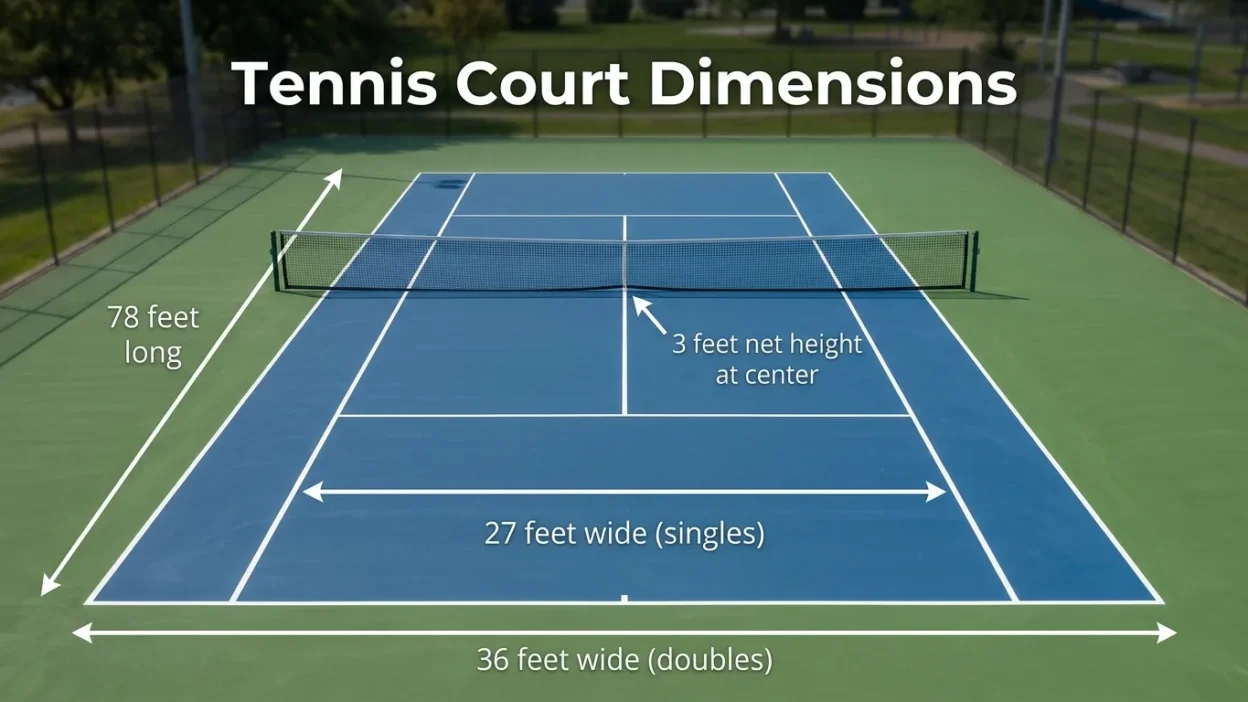
The official playing area is 78 feet long, but its width changes depending on whether the match is singles or doubles. A singles court is 27 feet wide, while a doubles court uses the full 36-foot width. These are the standard dimensions set out by the International Tennis Federation (ITF).
Standard tennis court dimensions are 78 × 27 feet for singles and 78 × 36 feet for doubles. In metric units, that is approximately 23.77 × 8.23 meters for singles and 23.77 × 10.97 meters for doubles. The doubles layout includes an extra 4 feet 6 inches of width on each side.
Whether you are planning a backyard court, checking a sports facility, coaching players, or simply curious about the measurements, this guide explains the official dimensions, line markings, surrounding space, and everyday comparisons that make the size easier to picture.
Every Unit Tennis Court Dimensions Convert To
The first thing to remember is that the painted playing area and the entire space needed for a court are not the same. The official court measurements describe the boundaries used during play. Players also need room beyond those lines to run for shots safely.
Official tennis court measurements
| Measurement | Singles court | Doubles court |
|---|---|---|
| Length | 78 ft | 78 ft |
| Width | 27 ft | 36 ft |
| Length in inches | 936 in | 936 in |
| Width in inches | 324 in | 432 in |
| Length in centimeters | 2,377 cm | 2,377 cm |
| Width in centimeters | 823 cm | 1,097 cm |
| Length in millimeters | 23,770 mm | 23,770 mm |
| Width in millimeters | 8,230 mm | 10,970 mm |
| Length in meters | 23.77 m | 23.77 m |
| Width in meters | 8.23 m | 10.97 m |
| Playing area | 2,106 sq ft | 2,808 sq ft |
| Playing area in square meters | 195.65 m² | 260.87 m² |
Metric figures are rounded for practical use. Official rules give the length as 23.77 meters, the singles width as 8.23 meters, and the doubles width as 10.97 meters.
How to convert tennis court dimensions
The calculations use the same familiar conversion rules as other measurements:
- Feet to inches: multiply by 12.
- Feet to centimeters: multiply by 30.48.
- Feet to millimeters: multiply by 304.8.
- Feet to meters: multiply by 0.3048.
- Square feet to square meters: multiply by approximately 0.0929.
For example, a 78-foot court length is 78 × 12 = 936 inches. Multiplying 78 by 0.3048 gives 23.7744 meters, which is commonly rounded to 23.77 meters in tennis specifications.
The width is where singles and doubles differ. Both use the same 78-foot length, but the doubles boundaries extend 4 feet 6 inches farther out on each side than the singles sidelines.
Net height and other important measurements
The court is not only about length and width. The net and service lines also have fixed positions.
| Court feature | Standard measurement |
|---|---|
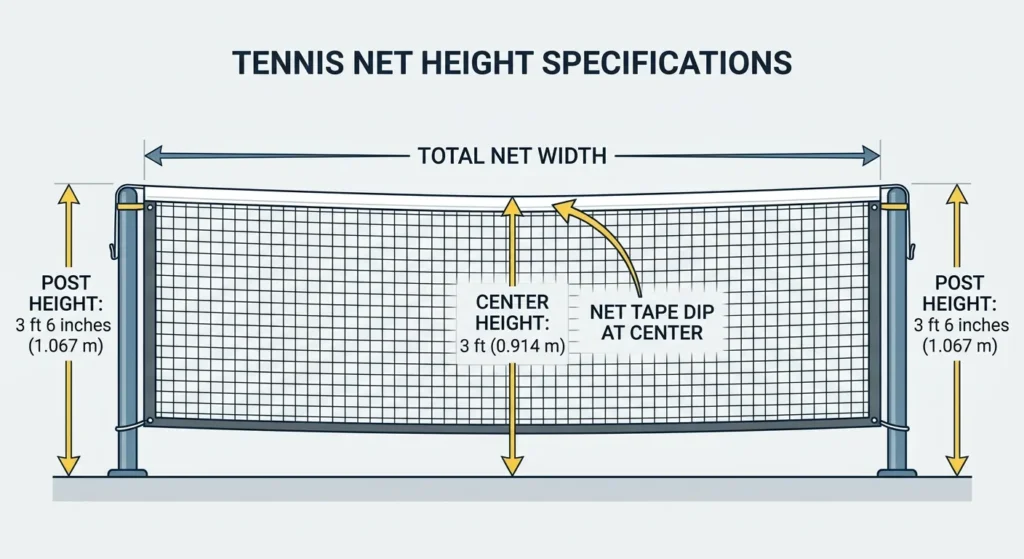
| Net height at center | 3 ft (36 in / 0.914 m) |
| Net height at posts | 3 ft 6 in (42 in / 1.07 m) |
| Net to each service line | 21 ft (252 in / 6.40 m) |
| Width of each doubles alley | 4 ft 6 in (54 in / 1.37 m) |
| Net to each baseline | 39 ft (468 in / 11.89 m) |
These measurements follow the standard court layout described by the ITF.

How a Tennis Court Fits Into a Real Space
A tennis court’s playing rectangle is only the starting point when you are assessing land or designing a facility. Players need room to move beyond the baselines and sidelines without running straight into a fence, wall, or spectator area.
Singles and doubles use the same court length
The baseline-to-baseline distance remains 78 feet for both formats. The difference is the width used during rallies: singles uses the inner sidelines, while doubles uses the outer sidelines.
Many courts have both sets of lines painted on the surface. That means a court can be used for either format without changing its physical size.
The doubles alleys add useful width
Each doubles alley measures 4 feet 6 inches wide. There is one on either side of the singles court, adding a combined 9 feet to the playing width.
That explains the difference between a 27-foot singles court and a 36-foot doubles court. The extra space is part of the doubles playing area, not additional space outside the court.
Service boxes divide the court into smaller targets
Each service line sits 21 feet from the net. Together with the net, center service line, and singles sidelines, these markings create the service boxes used during a serve.
This is why the court can feel like several smaller spaces inside one large rectangle. Players are aiming for particular areas, rather than simply hitting the ball anywhere inside the outer boundary.

12 Real-World Comparisons That Make Court Size Easier to Visualize
A 78-foot length is difficult to judge from a photograph, so it helps to compare the court with other familiar spaces. The following examples use real sports dimensions or clearly labeled estimates. They are visual references, not substitutes for official court measurements.
1. A Full-Size Basketball Court
An NBA basketball court measures 94 feet long by 50 feet wide. That makes it 16 feet longer than a tennis court and considerably wider than even the tennis doubles layout.
Basketball and tennis courts are both long rectangles, but their proportions differ. A tennis court is much narrower, which makes the net and sidelines feel closer together.
Imagine walking from one baseline to the other on a tennis court, then adding another 16 feet. That extra distance brings you to the length of an NBA court.

2. A Volleyball Court
A standard indoor volleyball court measures 59 feet long by about 29 feet 6 inches wide. It is 19 feet shorter than a tennis court, while its width sits between the singles and doubles tennis widths.
This comparison is useful because both sports have a net across the middle. The volleyball court is shorter, and its side boundaries are closer together than those of a tennis doubles court.
Picture a volleyball court with an extra 19 feet added to its length. You would then be close to the 78-foot tennis court length.

3. A Pickleball Court
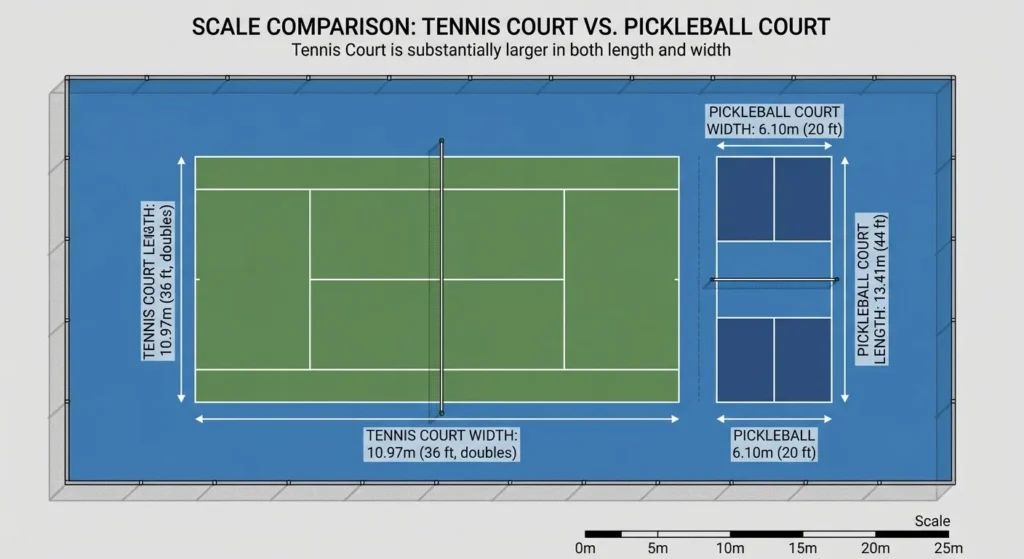
A standard pickleball court measures 44 feet long by 20 feet wide. Compared with tennis, it is 34 feet shorter and 7 feet narrower than a singles court.
Both sports use a net and marked service areas, but the court sizes are different. A tennis court is substantially longer, leaving more ground to cover during rallies.
Imagine placing a 44-foot pickleball court lengthwise inside the tennis court. The tennis court would extend another 34 feet beyond it.
4. A Badminton Doubles Court
A standard badminton doubles court is about 44 feet long and 20 feet wide. Its length is the same as a pickleball court and 34 feet less than a tennis court.
The difference can be surprising because badminton rallies can involve quick movement across the full court. However, badminton players cover a smaller floor area than tennis players.
Use the badminton court as a smaller rectangle in your mind, then extend its length by 34 feet to visualize the tennis court.

5. A Tennis Court’s Own Half-Length
The net divides the 78-foot court into two equal halves. From the net to either baseline is 39 feet, or 468 inches.
That distance is especially useful when estimating the court while standing on it. Instead of trying to imagine the entire length, focus on one half at a time.
If you can picture a 39-foot run from the net to the baseline, double it to get the complete 78-foot length.

6. The Doubles Alley
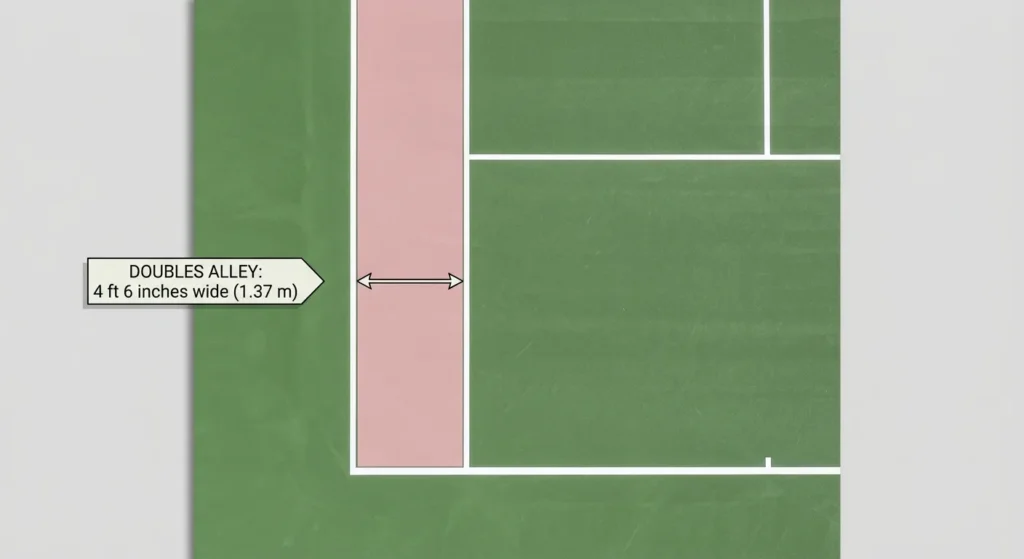
The doubles alley on each side is 4 feet 6 inches wide, equivalent to 54 inches or approximately 1.37 meters.
It may look narrow beside the full court, but that extra strip matters in doubles rallies. A shot that lands in the alley can be in during doubles play, while the same area lies outside the singles sidelines.
Picture a strip about as wide as a small doorway beside each side of the singles court. The comparison is approximate; door widths vary, so use the official 4-foot-6-inch figure for planning or marking lines.
7. The Service Line to the Net
The service line sits 21 feet from the net on each side. That distance is 252 inches, 6.40 meters, or 7 yards.
The service line creates the back edge of the service boxes. During a serve, the ball must land in the correct diagonal service box, so this distance is central to the game’s layout.
A useful way to picture it is to imagine seven yards from the net toward the baseline. That is the approximate depth of the service area.

8. The Net at Its Center
The tennis net is 3 feet high at the center, equal to 36 inches or 91.4 centimeters. At the posts, its height is 3 feet 6 inches.
The lower center is intentional: the net is supported at the posts and held down at the middle by a strap. This creates a slight dip across the net rather than a perfectly level top edge.
Three feet is approximately the height of a countertop in many kitchens, although actual counters vary. That gives you a familiar reference for the net’s center height.
9. The Court’s 36-Foot Doubles Width
The full doubles court is 36 feet wide, which is 432 inches or about 10.97 meters.
The width includes the singles court and both doubles alleys. This is the outer playing boundary for doubles, not the entire facility footprint with its safety margins.
Imagine a space stretching 12 yards across. Since one yard is 3 feet, 12 yards equals 36 feet. That is a straightforward way to picture the doubles width.
10. The Court’s 27-Foot Singles Width
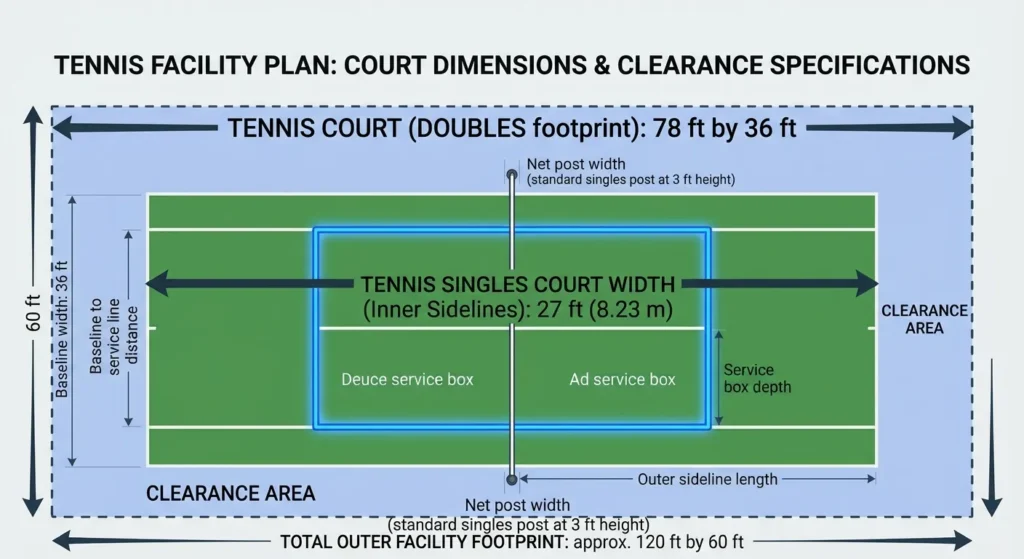
The singles court measures 27 feet wide, equivalent to 324 inches or about 8.23 meters.
It is 9 feet narrower than the doubles court because the doubles alleys are excluded. The length stays at 78 feet, so the singles rectangle is longer and narrower in proportion.
Think of 27 feet as 9 yards across. That makes the singles width easy to estimate when you are familiar with yard measurements.

11. A 120-by-60-Foot Court Facility Footprint
A commonly cited planning footprint for a tennis court with surrounding run-off space is about 120 feet long by 60 feet wide. This is larger than the painted doubles court, which measures 78 by 36 feet.
The extra space gives players room to chase shots beyond the lines. Actual recommended clearances depend on the facility, level of play, and applicable standards, so confirm the requirements before building.
Picture a 120-foot-long rectangle surrounding the court. The playing lines occupy the middle, while the remaining space provides room behind the baselines and beside the sidelines.

12. A Pair of Courts Side by Side
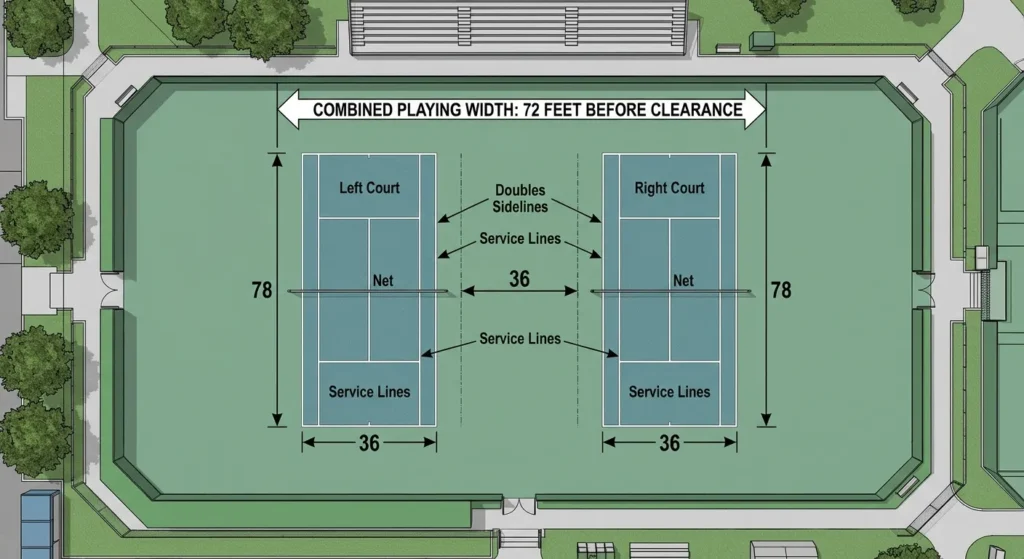
A single doubles court is 36 feet wide. Two such courts placed side by side would need 72 feet of combined playing width before allowing any gap or shared clearance.
That does not mean a facility should simply place two courts edge to edge. Players need safe space around the sidelines, and the required separation depends on the layout and standards being followed.
Still, the comparison helps when imagining a multi-court facility. Two playing rectangles alone already span 72 feet across, before adding the space between or around them.
How Much Space Do You Need to Build a Tennis Court?
If you are planning a tennis court at home, the biggest mistake is measuring only the painted playing area. The surrounding space matters because players need room to slow down, change direction, and reach balls near the boundaries.
Court dimensions versus total footprint
| Layout | Length | Width | Approximate area |
|---|---|---|---|
| Singles playing area | 78 ft | 27 ft | 2,106 sq ft |
| Doubles playing area | 78 ft | 36 ft | 2,808 sq ft |
| Example facility footprint | 120 ft | 60 ft | 7,200 sq ft |
The 120-by-60-foot figure is a commonly used planning reference for a full-size court with run-off space. It is not a universal requirement for every private or recreational court. For a formal facility, verify the current recommendations and local building rules. The ITF’s court-planning material includes clearance guidance for competition facilities.
What else should you consider?
Surface: Hard courts, clay courts, and grass courts use the same standard playing dimensions, but construction, drainage, maintenance, and ball behavior differ.
Fencing: The fence must sit outside the playing area and should not obstruct player movement. Include access gates and maintenance access in the plan.
Lighting and overhead clearance: Outdoor courts need appropriate lighting if used at night. Covered and indoor courts need adequate clearance above the playing surface so players can hit high shots safely.
Orientation and drainage: Sun direction, wind, and water runoff can affect court usability. A site assessment before construction can help prevent costly changes later.
Line placement: Court measurements are taken to the outside edges of the relevant lines. Accurate marking matters because the lines determine whether a ball is in or out.

Visualizing Tennis Court Dimensions Without a Tape Measure
You can get a rough sense of court size using familiar distances, but these methods are for visualization only. If you are marking a court, buying materials, or preparing a construction site, use a proper measuring tool and the applicable specifications.
1. Think in yards
A tennis court is 26 yards long because 78 feet divided by 3 equals 26 yards. The singles width is 9 yards, and the doubles width is 12 yards.
This is one of the easiest ways to remember the standard dimensions: 26 yards long, 9 yards wide for singles, or 12 yards wide for doubles.
2. Walk half the length
The net-to-baseline distance is 39 feet. Walk from the net toward a baseline to get a physical sense of one half of the court.
Your steps will only provide an estimate because stride length varies. If you need an accurate measurement, do not rely on counting steps alone.
3. Compare the two sidelines
Stand near the singles sideline and look toward the doubles sideline. The gap between them is 4 feet 6 inches on each side.
That narrow strip helps explain why the doubles court is 9 feet wider overall than the singles court.
4. Use a marked sports court as a reference
If you have access to a basketball, volleyball, or pickleball court, compare the shapes and lengths from a safe position. Remember that these sports have different official measurements, so a visual comparison is not a substitute for measuring.
5. Use a scaled diagram
A printed court diagram can help you understand the proportions before visiting a site. For a simple scale drawing, you could represent every 10 feet with one inch on paper; the 78-foot length would then be 7.8 inches on the drawing.
Keep the scale consistent across the length and width. A drawing that is stretched to fit a page can give a misleading impression of the court’s proportions.
Frequently Asked Questions
What are the official tennis court dimensions in feet?
A standard tennis court is 78 feet long. It is 27 feet wide for singles and 36 feet wide for doubles.
How many inches long is a tennis court?
The court is 936 inches long because 78 feet multiplied by 12 equals 936 inches.
How many meters is a tennis court?
The standard court is 23.77 meters long. It is approximately 8.23 meters wide for singles or 10.97 meters wide for doubles.
Are singles and doubles tennis courts different sizes?
They share the same length of 78 feet. Doubles uses the outer sidelines, making the playing area 9 feet wider than singles.
How tall is a tennis net?
The net is 3 feet high at the center and 3 feet 6 inches high at the posts. These heights are approximately 0.914 meters and 1.07 meters, respectively.
How far is the service line from the net?
Each service line is 21 feet from the net. That is 252 inches or approximately 6.40 meters.
How much land is needed for a tennis court?
The doubles playing area covers 2,808 square feet. A commonly used planning footprint with run-off space is approximately 120 by 60 feet, or 7,200 square feet, but the appropriate clearances depend on the facility and its requirements.
Are tennis court dimensions the same on grass, clay, and hard courts?
Yes. The standard playing dimensions are the same across these surfaces. The surface changes how the ball bounces and how players move, not the official length and width of the court.
Where That Leaves You
The easiest way to remember tennis court dimensions is to start with the length: 78 feet, or 23.77 meters. The singles playing area is 27 feet wide, while the doubles court is 36 feet wide.
For a quick mental picture, think of a 26-yard-long rectangle. Add the doubles alleys to visualize the wider playing area, then remember that a real facility needs extra space beyond the painted lines.
Those figures are enough to understand a court layout or compare sports spaces. If you are planning to build one, use the official specifications and measure the full site—including safe run-off areas—before making construction decisions.

Jack Harrison is a passionate writer who creates informative, engaging and easy-to-understand content for online readers. He enjoys researching new topics and sharing practical insights that help readers discover useful ideas and information.