
A Pokémon card looks small in your hand, but its dimensions are more precise than they first appear. If you are buying sleeves, designing a custom card, choosing a binder, or simply wondering how big a Pokémon card actually is, a few millimeters can make a noticeable difference.
The standard Pokémon TCG card is commonly described as 2.5 inches wide × 3.5 inches tall. More precise card-industry references give the physical size as about 63 × 88 mm, which converts to approximately 2.48 × 3.46 inches.
That puts a Pokémon card in the same general size class as a standard poker playing card and many other modern trading cards. It is small enough to fit comfortably in one hand but large enough to carry detailed artwork, text, symbols, and statistics.
A standard Pokémon card is about 2.5 × 3.5 inches, equal to 0 feet 2.5 inches × 0 feet 3.5 inches, 6.35 × 8.89 cm, 63.5 × 88.9 mm, and 0.0635 × 0.0889 meters.
In this guide, we will look at Pokémon card dimensions in inches, feet, centimeters, millimeters, and meters, then compare the card with familiar objects so you can picture its size without reaching for a ruler.
Every Pokémon Card Dimension Converted to Other Units
There are two figures worth knowing. For everyday shopping and collecting, you will often see Pokémon cards described as 2.5 × 3.5 inches. More precise references commonly use approximately 63 × 88 mm for the card itself.
For general measurement work, the familiar 2.5 × 3.5-inch figure is convenient because it matches the nominal standard trading-card format.
| Unit | Pokémon Card Size |
|---|---|
| Inches | 2.5 × 3.5 in |
| Feet | 0 ft 2.5 in × 0 ft 3.5 in |
| Decimal feet | 0.208 × 0.292 ft |
| Centimeters | 6.35 × 8.89 cm |
| Millimeters | 63.5 × 88.9 mm |
| Meters | 0.0635 × 0.0889 m |
| Yards | 0.0694 × 0.0972 yd |
| Pixels at 72 DPI | 180 × 252 px |
| Pixels at 96 DPI | 240 × 336 px |
| Pixels at 300 DPI | 750 × 1,050 px |
The pixel figures are calculated from the nominal 2.5 × 3.5-inch dimensions. They are useful when creating artwork or mockups, but pixels are not a physical measurement until you specify a resolution such as DPI or PPI.
The basic conversion is simple:
- Inches × 2.54 = centimeters
- Inches × 25.4 = millimeters
- Inches ÷ 12 = feet
- Inches × 0.0254 = meters
So, for example, 3.5 inches × 2.54 gives 8.89 cm, while 3.5 inches ÷ 12 gives about 0.292 feet.
One small detail is worth remembering: 2.5 × 3.5 inches is a rounded nominal description, while 63 × 88 mm is a commonly used reference for Pokémon and other standard TCG cards. The two descriptions are close enough for normal sleeve, binder, and size comparisons, but precision matters when you are making custom accessories.
Where Pokémon Card Size Fits Among Trading Cards
The interesting thing about Pokémon card dimensions is that they are not an unusual shape. The card belongs to the broad standard trading-card format, which is why so many accessories work across different card games.
TCGplayer’s card-conditioning reference lists Pokémon and Magic cards at 63 × 88 mm, while other standard trading-card products commonly use the rounded 2.5 × 3.5-inch description.
This standard format is also close to the familiar U.S. poker playing card, which measures 2.5 × 3.5 inches.
The practical result is important for collectors: you generally do not need a special physical card format just because a card is Pokémon. Standard-size sleeves, binders, and many protective products are designed around this general footprint. Standard sleeves for Pokémon are commonly around 66 × 91 mm, leaving room around the 63 × 88 mm card.
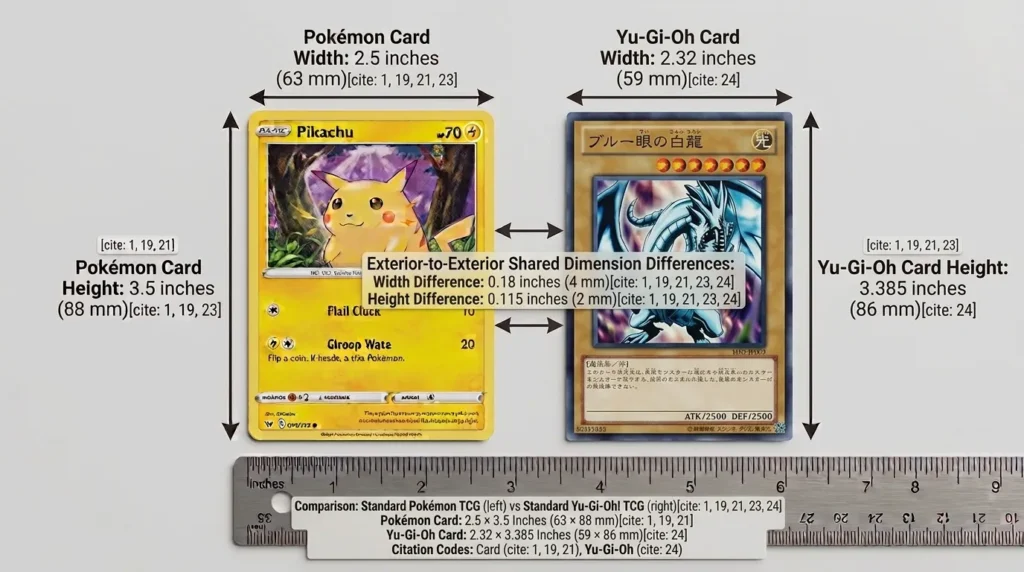
There is one major comparison worth remembering. Yu-Gi-Oh! cards are smaller, at about 59 × 86 mm, so they use a smaller sleeve category. That difference is only a few millimeters, but it is enough to make card-sleeve sizing important.
12 Things That Help You Visualize Pokémon Card Dimensions
A card measuring roughly 2.5 × 3.5 inches is easier to understand when you compare it with things you have actually held. Some examples below are almost identical in size, while others are deliberately a little larger or smaller to show the scale.
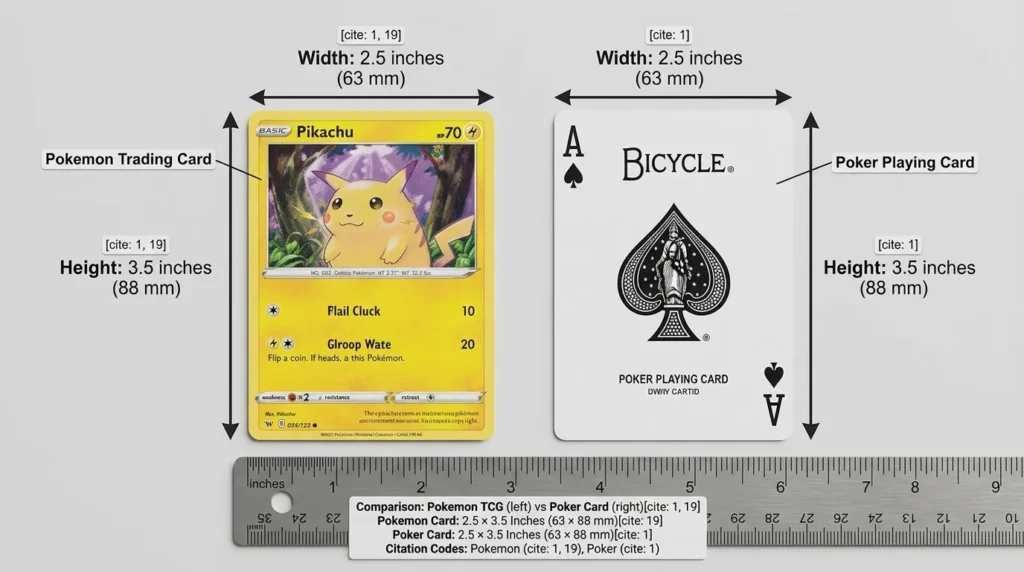
1. A Standard Poker Playing Card
A standard poker-size playing card is one of the easiest comparisons because it is essentially the same nominal footprint: 2.5 × 3.5 inches, or 63.5 × 88.9 mm.
Place a Pokémon card beside an ordinary poker playing card and the difference should be extremely difficult to notice without careful measurement. Both are designed around a portrait rectangle that is roughly five units wide for every seven units tall.
This is also why a deck of ordinary playing cards can give you a good mental reference for Pokémon card dimensions. Most people have handled a poker card at some point, so the shape is immediately recognizable.
If you can picture a single playing card standing vertically in your hand, you already have a very good visualization of a Pokémon card.
2. A Modern Baseball Card
A modern baseball card is another remarkably close comparison. Standard modern baseball cards are commonly listed at 2.5 × 3.5 inches, the same nominal dimensions used for standard trading cards.
That means a Pokémon card and a modern baseball card have essentially the same overall face size even though their artwork and purposes are completely different.
This is useful when shopping for storage supplies. The same general sleeve, binder, and protective-holder ecosystem can often accommodate both formats.
Imagine taking a baseball card from a typical collection and replacing it with a Pokémon card. From a dimensional perspective, the two would occupy almost the same space.

3. A Magic: The Gathering Card
Magic: The Gathering cards are another excellent reference because they use the same general standard as Pokémon. Industry card references list both Pokémon and Magic cards at approximately 63 × 88 mm.
This means collectors who own both types of cards can compare them directly without needing to account for a completely different card format.
The dimensions are particularly relevant when choosing sleeves. Standard sleeves are designed to accommodate cards in this size family rather than being unique to one game.
Visually, a Pokémon card and a standard Magic card should look almost identical in height and width when placed edge to edge.

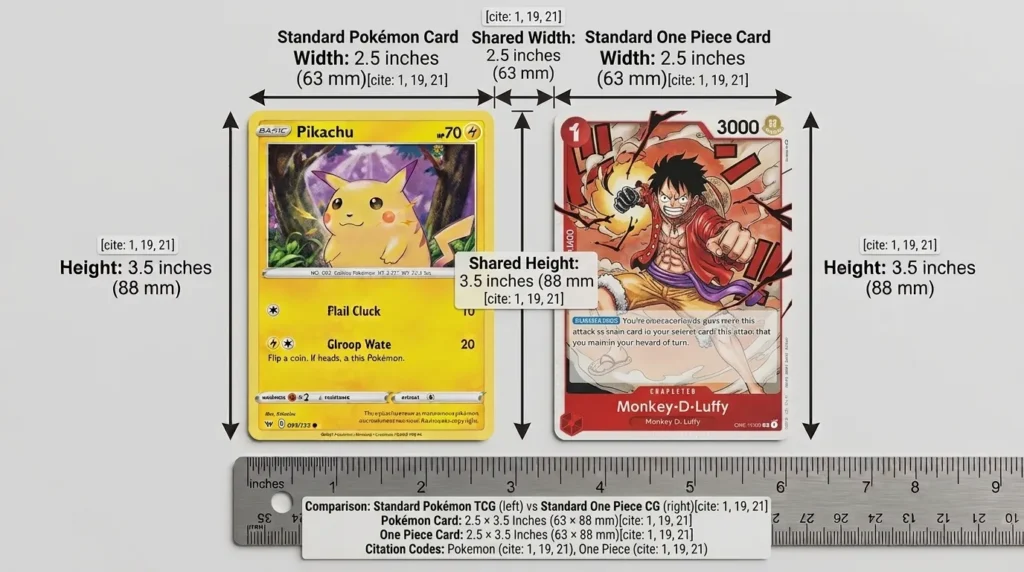
4. An One Piece Card Game Card
The One Piece Card Game provides another almost exact comparison. Its cards are commonly listed at 63 × 88 mm, matching the standard size used for Pokémon cards.
This is a useful example because it shows that the standard footprint extends beyond older trading-card formats. Different games can have completely different artwork and rules while sharing nearly identical physical dimensions.
For a collector, that shared footprint means one standard-size storage system can be useful across several collections.
Put an One Piece card and a Pokémon card together and you are looking at virtually the same rectangular footprint.
5. A Standard Trading Card Sleeve
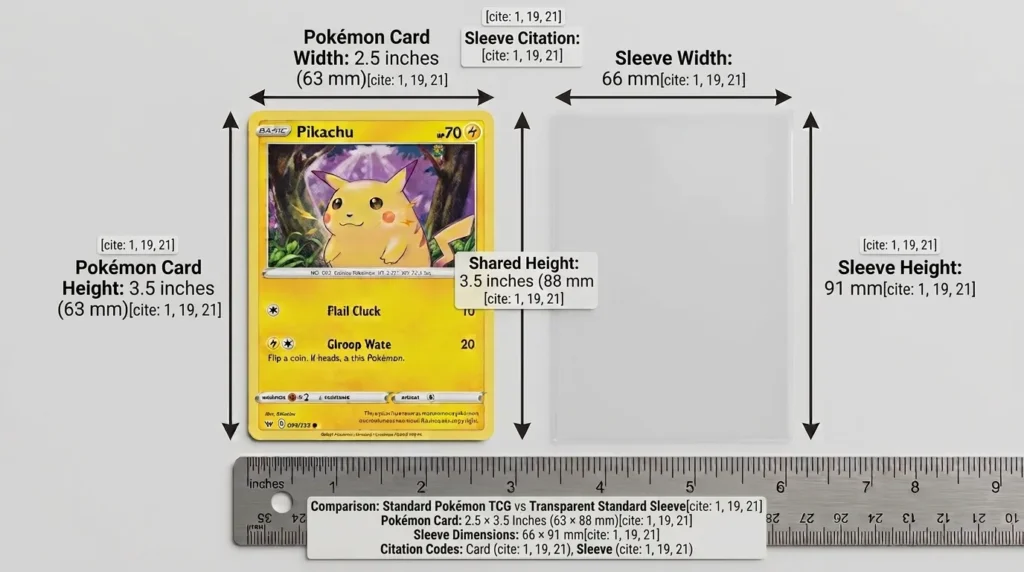
A standard card sleeve is slightly larger than the card it protects. Common standard sleeves are around 66 × 91 mm, compared with a Pokémon card reference size of approximately 63 × 88 mm.
That extra space is intentional. A sleeve cannot be exactly the same size as the card or you would struggle to insert the card without damaging its edges.
The difference is only a few millimeters, but those millimeters create enough clearance for the card to slide inside.
If you visualize the Pokémon card as a 2.5 × 3.5-inch rectangle, imagine placing that rectangle inside a slightly wider and taller transparent envelope.
6. A 3 × 4 Inch Top Loader
A standard 3 × 4-inch top loader is noticeably larger than a Pokémon card, but it is still close enough to make a useful visual reference. Top loaders with 3 × 4-inch outer dimensions are designed for standard-size trading cards.
The extra space is needed because the holder surrounds the card rather than simply matching its exact face dimensions.
A Pokémon card takes up roughly 2.5 × 3.5 inches, while the protective holder extends to about 3 × 4 inches externally.
So if you have seen a rigid plastic trading-card holder, you have probably already handled something only modestly larger than the card itself.

7. A Standard Credit Card
A credit card is smaller and wider in proportion than a Pokémon card. The common CR80 credit-card format measures about 2.125 × 3.375 inches.
The height difference is small: 3.375 inches compared with the Pokémon card’s nominal 3.5 inches. But the credit card is significantly narrower, at about 2.125 inches versus 2.5 inches.
Place them side by side with their long edges aligned and the difference becomes much easier to see. The Pokémon card looks taller and noticeably wider.
This is a particularly useful comparison because almost everyone has handled a bank card.

8. A Yu-Gi-Oh! Card
Yu-Gi-Oh! provides an interesting near-size comparison because its cards are deliberately smaller. A common reference is 59 × 86 mm, or about 2.32 × 3.39 inches.
That means the difference is not dramatic when you look at one card by itself. But put the two formats next to each other and the Pokémon card has a slightly larger footprint.
This small dimensional difference has a practical consequence: Yu-Gi-Oh! cards generally use smaller “Japanese-size” sleeves rather than standard sleeves.
It is a good reminder that even a few millimeters can matter when the fit needs to be precise.
9. A Standard 3 × 5 Inch Index Card
A 3 × 5-inch index card is larger than a Pokémon card in both dimensions. It measures 3 inches by 5 inches, or about 76.2 × 127 mm.
The width difference is only half an inch, but the five-inch length makes the index card considerably taller.
This comparison helps because index cards are familiar objects. If you have used one for studying or writing notes, imagine shrinking it down until its width drops from 3 inches to 2.5 and its height from 5 inches to 3.5.
The resulting rectangle is much closer to the size of a Pokémon card.

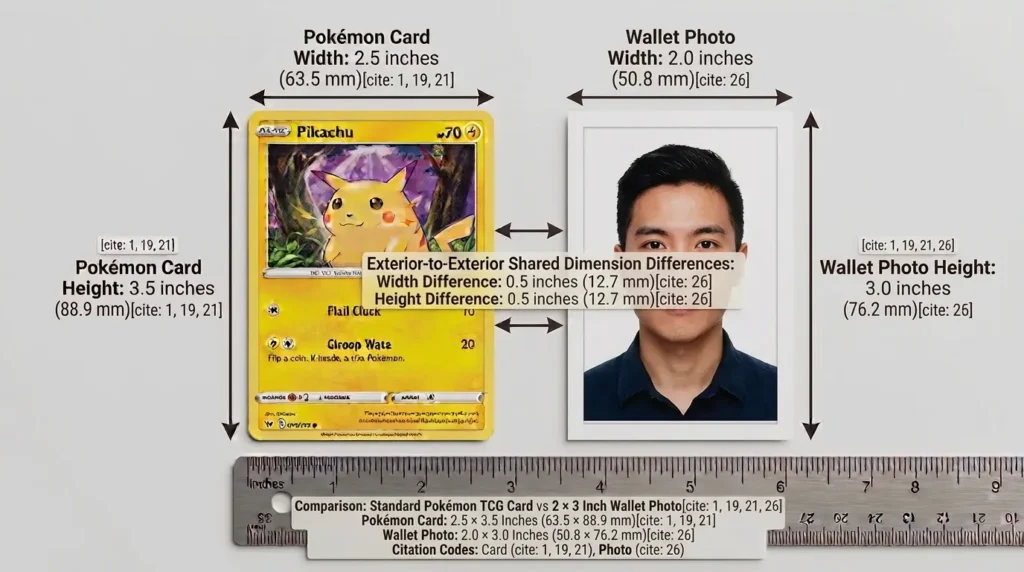
10. A 2 × 3 Inch Wallet Photo
A small 2 × 3-inch wallet photo provides a useful comparison from the opposite direction. It is narrower and shorter than a Pokémon card, measuring 2 inches by 3 inches.
The Pokémon card adds about half an inch to the width and half an inch to the height compared with this compact photo format.
That does not sound like much numerically, but on a small card, half an inch is a substantial visual difference.
Put the two rectangles together and you can see that a Pokémon card is closer to a small collectible card than to a tiny wallet photograph.
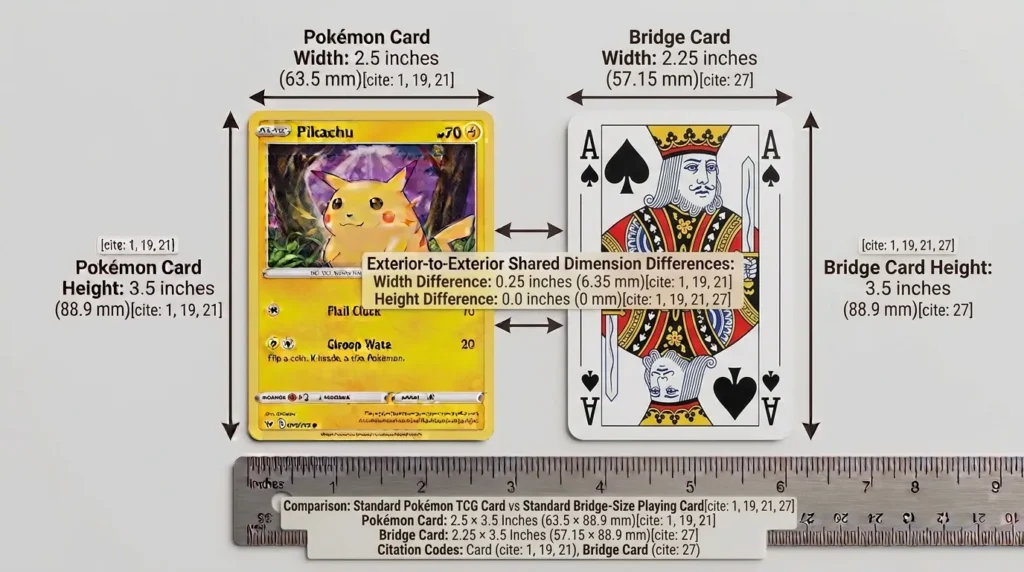
11. A Bridge-Size Playing Card
Bridge-size playing cards are another useful comparison because they have the same 3.5-inch height as a poker-size card but are narrower at about 2.25 inches wide.
Compared with a Pokémon card’s nominal 2.5-inch width, the difference is only a quarter of an inch.
That makes a bridge card a good way to visualize the Pokémon card’s width. If you have a bridge deck, imagine adding a quarter inch to the short edge.
The resulting shape is very close to the standard Pokémon card footprint.
12. A Standard Tarot Card
A standard tarot card is considerably taller than a Pokémon card, commonly measuring around 2.75 × 4.75 inches.
The widths are relatively close, but the tarot card extends much farther vertically. That makes it a useful visual contrast rather than an exact size match.
If you have handled a traditional tarot deck, picture the same general rectangular shape but shortened by about 1.25 inches and narrowed slightly.
This comparison makes one feature of Pokémon card dimensions especially obvious: they are compact compared with many illustrated card formats.

The Sleeve and Storage Question People Actually Mean
When someone searches for Pokémon card dimensions, they often are not simply curious about the measurement. They are trying to answer a practical question: What size sleeves, holders, or storage products do I need?
For a standard Pokémon card, the commonly referenced physical size is about 63 × 88 mm, while standard protective sleeves are commonly around 66 × 91 mm.
That difference gives the card enough clearance to enter the sleeve without being forced against the edges. If a product is advertised as “standard size” for Pokémon, that is generally the category you want rather than a smaller Japanese-size sleeve.
For rigid protection, standard 3 × 4-inch top loaders are another common option. Topps describes its 3 × 4-inch Ultra PRO top loader as designed for standard 2.5 × 3.5-inch cards up to 35 points thick.
The important distinction is that card dimensions and holder dimensions are not the same thing. A holder needs extra space around the card, while a sleeve needs enough internal clearance for easy insertion.
If you are buying protection for a valuable card, check the manufacturer’s stated interior dimensions and thickness capacity, not just the outside dimensions.
Getting to Pokémon Card Size Without a Tape Measure
You do not need a measuring tape to get a reasonable mental picture of a Pokémon card. You can use familiar objects, although these methods are estimates rather than precision measurements.
1. Compare it with a poker card.
This is probably the easiest method. A standard poker-size card is 2.5 × 3.5 inches, essentially matching the familiar nominal Pokémon card footprint.
2. Compare it with a credit card.
A credit card is about 2.125 × 3.375 inches, so a Pokémon card should look both wider and slightly taller.
3. Think of a small wallet photo.
A 2 × 3-inch wallet photo is smaller than a Pokémon card in both directions. The Pokémon card adds about 0.5 inch to each dimension.
4. Use a 3 × 5 index card.
A 3 × 5 card gives you a larger rectangle to mentally shrink. A Pokémon card is half an inch narrower and 1.5 inches shorter than the index card.
5. Use your existing card collection.
If you already own Pokémon, Magic, baseball, or other standard trading cards, place one against the next. Cards in the standard format are extremely close in size, which is more reliable than trying to estimate 2.5 inches with your hand.
These comparisons are useful for visualization, but if you are cutting material, printing a custom card, or buying a precision-fit accessory, use an actual ruler or the manufacturer’s dimensions.
[INTERNAL LINK: related trading card dimensions article]
Frequently Asked Questions
What are the standard Pokémon card dimensions?
A standard Pokémon TCG card is commonly described as 2.5 × 3.5 inches. A more precise industry reference is approximately 63 × 88 mm, or about 2.48 × 3.46 inches.
How many inches is a Pokémon card?
The commonly quoted Pokémon card dimensions are 2.5 inches wide × 3.5 inches tall. The 3.5-inch side is the longer dimension when the card is held vertically.
How many centimeters is a Pokémon card?
Using the nominal 2.5 × 3.5-inch dimensions, a Pokémon card is 6.35 × 8.89 cm. The commonly referenced 63 × 88 mm card measurement is slightly smaller because it uses a rounded metric reference.
How many millimeters is a Pokémon card?
A commonly used precise reference is 63 × 88 mm. You will also see 63.5 × 88.9 mm when the nominal 2.5 × 3.5-inch dimensions are converted mathematically.
How many feet is a Pokémon card?
A 2.5-inch width equals about 0.208 feet, while a 3.5-inch height equals about 0.292 feet. In feet-and-inches notation, that is 0 feet 2.5 inches × 0 feet 3.5 inches.
Is a Pokémon card the same size as a playing card?
A Pokémon card is approximately the same size as a standard poker playing card. Both are commonly described as 2.5 × 3.5 inches, although precise manufacturing references may list Pokémon cards at about 63 × 88 mm.
Are Pokémon cards the same size as Yu-Gi-Oh! cards?
No. Yu-Gi-Oh! cards are smaller, commonly listed at 59 × 86 mm, compared with approximately 63 × 88 mm for Pokémon. This is why the two games use different sleeve-size categories.
What size sleeves fit Pokémon cards?
Pokémon cards use standard-size trading-card sleeves. Common standard sleeves are around 66 × 91 mm, giving them enough internal space for cards around 63 × 88 mm.
What everyday object is about the same size as a Pokémon card?
A standard poker playing card is probably the best everyday comparison because its nominal dimensions are also 2.5 × 3.5 inches. Modern baseball cards and several other trading cards use essentially the same format.
Conclusion
The easiest number to remember is 2.5 × 3.5 inches. In metric terms, that is 6.35 × 8.89 cm, while Pokémon cards are also commonly referenced more precisely at about 63 × 88 mm.
For visualization, think of a standard poker playing card. It gives you almost exactly the right mental picture without needing to measure anything.
And if you are buying sleeves or holders, remember the practical lesson: the card itself is smaller than its protective sleeve or top loader. Card dimensions tell you the footprint; the accessory needs additional clearance around it.

Jack Harrison is a passionate writer who creates informative, engaging and easy-to-understand content for online readers. He enjoys researching new topics and sharing practical insights that help readers discover useful ideas and information.