

A refrigerator can look compact in a showroom but feel surprisingly large when you try to fit it between kitchen cabinets. The reason is simple: a fridge has three important measurements. Its width determines how much horizontal space it needs, its height affects overhead clearance, and its depth determines how far it extends into your kitchen.
Most full-size refrigerators in the United States are approximately 28–36 inches wide, 60–70 inches tall, and 28–35 inches deep. Smaller apartment models and compact fridges can be considerably narrower, while some large models exceed these ranges.
To put that into perspective, a refrigerator measuring 36 inches wide, 70 inches tall, and 32 inches deep is 3 feet wide and nearly 6 feet tall. That’s a substantial appliance, even before you account for its doors and handles.
This guide explains common fridge dimensions in inches, feet, centimeters, millimeters, and meters. You’ll also find 12 everyday comparisons, practical measuring tips, and answers to common refrigerator-sizing questions.
Every Fridge Dimension Converted to Common Units
There isn’t one universal refrigerator size. A mini fridge designed for a bedroom may be less than 20 inches wide, while a large French-door model can measure more than 36 inches across.
For a consistent example throughout this guide, imagine a full-size refrigerator measuring 36 inches wide, 70 inches tall, and 32 inches deep. These are representative example measurements, not a universal standard.
| Measurement | Width | Height | Depth |
|---|---|---|---|
| Inches | 36 in | 70 in | 32 in |
| Feet and inches | 3 ft | 5 ft 10 in | 2 ft 8 in |
| Centimeters | 91.44 cm | 177.8 cm | 81.28 cm |
| Millimeters | 914.4 mm | 1,778 mm | 812.8 mm |
| Meters | 0.9144 m | 1.778 m | 0.8128 m |
| Yards | 1 yd | 1.944 yd | 0.889 yd |
The conversions are easy once you know the original measurement:
- Inches to feet: Divide by 12.
- Inches to centimeters: Multiply by 2.54.
- Inches to millimeters: Multiply by 25.4.
- Inches to meters: Multiply by 0.0254.
For example, 70 inches divided by 12 equals 5 feet with 10 inches remaining. That’s why the example refrigerator is 5 feet 10 inches tall.
If you’re comparing fridge dimensions in feet or centimeters, check width, height, and depth individually. A fridge that is 3 feet wide won’t necessarily be 3 feet tall or deep.
Where Refrigerator Dimensions Fit on a Size Chart
Refrigerator dimensions depend on the style, capacity, manufacturer, and installation design. The following ranges are general shopping references, not guaranteed specifications for every model.
| Refrigerator type | Approx. width | Approx. height | Approx. depth |
|---|---|---|---|
| Mini fridge | 17–24 in | 19–35 in | 18–26 in |
| Apartment-size fridge | 24–30 in | 55–68 in | 26–32 in |
| Top-freezer refrigerator | 28–33 in | 60–69 in | 28–34 in |
| Bottom-freezer refrigerator | 29–33 in | 67–70 in | 29–34 in |
| Side-by-side refrigerator | 32–36 in | 65–71 in | 29–35 in |
| French-door refrigerator | 32–36+ in | 68–72 in | 29–36+ in |
| Built-in refrigerator | Varies | Varies | Varies by design |
These ranges overlap. A particular French-door refrigerator may be shorter or narrower than another style, so use the product’s specification sheet when exact measurements matter.
It’s also important to distinguish the appliance’s physical dimensions from its storage capacity. A refrigerator advertised as 20 cubic feet refers to its approximate interior capacity, not its outside height, width, or depth.
Depth deserves particular attention. The cabinet measurement may exclude handles or differ from the measurement with the doors open. A counter-depth refrigerator is designed to sit closer to the front of surrounding countertops, but its doors and handles can still project beyond them.
Before choosing a fridge, consider the installation opening, required ventilation space, door swing, and route from your entrance to the kitchen.
12 Things That Help You Visualize Fridge Dimensions
The numbers become easier to picture when you compare them with familiar objects. The examples below use the same reference refrigerator: 36 inches wide, 70 inches tall, and 32 inches deep.
These comparisons are approximate unless a standardized measurement is specified.
1. A Standard Interior Door

A typical US interior door is around 80 inches tall. A 70-inch refrigerator would be about 10 inches shorter, giving you a helpful reference for its height.
Picture the refrigerator standing beside the doorway. Its top would sit noticeably below the door’s upper edge, but it would still occupy most of the vertical space.
Door widths vary, with common sizes around 28–32 inches. That’s similar to the width of many narrower refrigerators, but a fridge’s ability to pass through a doorway depends on more than comparing two numbers.
For delivery planning, check the doorway’s clear opening and the refrigerator’s actual transport dimensions. Door handles, packaging, turning angles, and hallway space can all make a difference.
2. A Standard Kitchen Counter
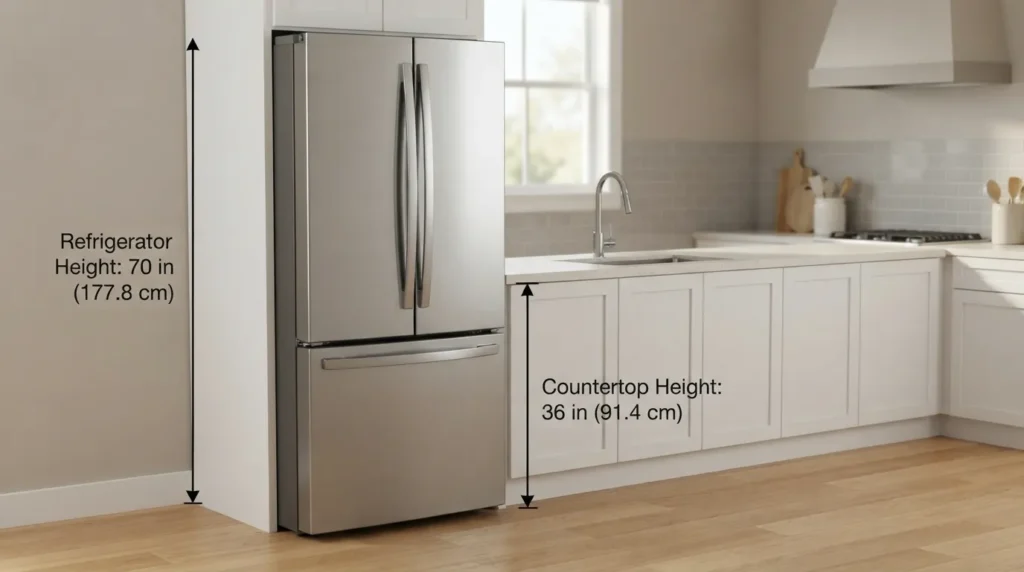
Many kitchen countertops are installed at roughly 36 inches above the floor. A refrigerator measuring 70 inches tall rises another 34 inches above that level.
This comparison helps explain why a fridge often becomes a dominant feature in the kitchen. Its upper half extends well beyond the counter, and it may sit beside cabinets or a pantry.
Counter-depth refers to the appliance’s front-to-back measurement, not its height. A counter-depth model can still be as tall as a conventional freestanding refrigerator.
If you’re planning a kitchen renovation, check both the fridge’s total height and any cabinets above it. A small clearance allowance can be important for installation and ventilation.
3. A Tall Adult

A refrigerator measuring 70 inches tall is exactly 5 feet 10 inches high. That’s a familiar reference for anyone who has stood beside a tall adult.
Imagine the person standing straight beside the appliance. If the person is also 5 feet 10 inches tall, their head height and the refrigerator’s top would be approximately level.
This comparison makes it easier to visualize how much vertical space the appliance occupies. It can also help you picture the refrigerator next to a low ceiling or an overhead cabinet.
People’s heights vary, so use this only as a visual reference. If the fridge must fit under a fixed surface, measure the available height directly.
4. A Three-Foot-Wide Opening

A 36-inch-wide refrigerator measures exactly 3 feet across. That’s the same nominal width as a three-foot opening, which makes this an easy measurement to remember.
However, an opening measuring exactly 36 inches may be too narrow for a refrigerator with a listed width of 36 inches. The manufacturer’s installation instructions may call for additional clearance on the sides.
Cabinets and walls aren’t always perfectly square, either. Measuring the opening at the top, middle, and bottom helps identify the narrowest point.
Use the smallest clear measurement when checking the fit, then compare it with the manufacturer’s installation requirements rather than relying on the advertised width alone.
5. A Standard Full-Size Mattress
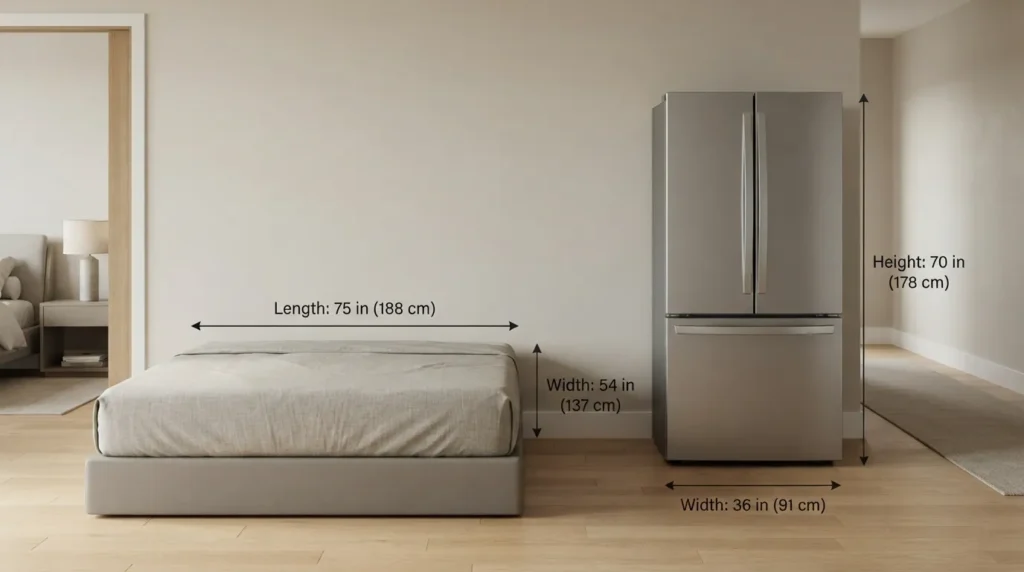
A standard US full-size mattress measures 54 inches wide and 75 inches long. That makes it 18 inches wider than the front of our 36-inch refrigerator.
The mattress’s 75-inch length is also 5 inches greater than the fridge’s 70-inch height. This provides another way to picture the refrigerator’s vertical scale.
The comparison is useful because mattresses are familiar objects with standardized dimensions. You can imagine the refrigerator standing almost as tall as the mattress is long.
Of course, the objects are shaped differently. The comparison helps visualize their measurements; it doesn’t mean either object will fit through a particular doorway.
6. A Standard Washing Machine

Many front-loading washing machines are around 27 inches wide and roughly 39 inches tall, although the exact dimensions vary by model.
Compared with a 36-inch-wide refrigerator, the washer is about 9 inches narrower. The refrigerator is also much taller, rising approximately 31 inches above a washer that stands 39 inches high.
Seeing these two appliances together makes the fridge’s overall scale easier to understand. Both are large household appliances, but they serve different purposes and often have different installation requirements.
This comparison is especially useful when planning a utility room or a home with a combined kitchen and laundry area. Remember to compare depth as well as width if both appliances need to fit along the same wall.
7. A Two-Foot-Wide Storage Cabinet

A cabinet measuring 24 inches wide is 2 feet across. A 36-inch refrigerator is 12 inches wider, or one and a half times the cabinet’s width.
Picture the two standing next to each other. The refrigerator would extend noticeably farther across the front, even before considering its height and depth.
Twenty-four-inch-wide cabinets are a familiar size in many kitchen layouts, although cabinet dimensions vary by type and installation. The outside measurement can also differ from the nominal size.
This comparison helps when reading kitchen plans. A few extra inches can affect nearby drawers, cabinet doors, and the available space for moving around the room.
8. Three Sheets of US Letter Paper

A US Letter sheet measures 8.5 by 11 inches. Three sheets placed end to end along their 11-inch sides create a span of 33 inches.
That’s only 3 inches less than the width of our example refrigerator. It offers a simple way to imagine a measurement using an object found in many homes and offices.
Paper is useful because its dimensions are standardized in the United States. You can place sheets alongside one another to build a rough visual reference for a width or length.
However, the method is not precise enough for appliance installation. Small alignment errors can add up, so use a proper measuring tool before ordering a refrigerator.
9. A Tall Bookshelf

A bookshelf measuring 72 inches tall is 6 feet high. That makes it just 2 inches taller than the example refrigerator.
When the two objects stand side by side, their tops would appear almost level. This is a particularly useful comparison because tall bookshelves are common in living rooms, offices, and study spaces.
Unlike a refrigerator, a bookshelf’s total height may be affected by items placed on top. For a fair comparison, measure the bookcase itself rather than including decorations or stored objects.
If you already own a tall bookcase, it can provide a quick visual reference for imagining a refrigerator around 70 inches high.
10. A Three-Foot Section of Kitchen Flooring

The width of a 36-inch refrigerator is exactly 3 feet. Imagine marking a three-foot span on the floor and looking at how much space it occupies across the front.
This is a practical way to plan a refrigerator’s location before delivery. Removable tape can help outline the intended footprint and show how much walking space remains nearby.
The depth matters just as much. A 32-inch-deep refrigerator extends 2 feet 8 inches from front to back, and the doors may project farther when opened.
Remember that a floor outline only shows the appliance’s footprint. You must also account for its height, ventilation clearance, door movement, and any nearby cabinets or islands.
11. A Rectangular Dining Table

Many rectangular dining tables are around 30–36 inches wide, although the size varies by design and seating capacity.
A 36-inch-wide table and a 36-inch-wide refrigerator can therefore have a similar horizontal span. The difference is that the refrigerator rises to nearly 6 feet, while a dining table sits much lower.
This comparison helps when visualizing the refrigerator in an open-plan kitchen. The fridge may occupy a similar width to the dining table but have a much greater visual presence.
When planning the layout, consider the space needed to walk around the table and open the refrigerator. Matching widths doesn’t automatically mean the two objects will fit comfortably in the same area.
12. A 32-Inch Interior Door

A 32-inch-wide interior door has the same nominal measurement as the depth of our example refrigerator. This offers a useful way to picture the distance from the fridge’s front to its back.
Depth is easy to overlook when shopping. A refrigerator may fit between cabinets but still extend far enough into the kitchen to obstruct a walkway or sit forward of the countertop.
The comparison doesn’t mean the fridge will pass through a 32-inch doorway. Doorway clearance, the refrigerator’s width and height, handles, packaging, and the angle needed to maneuver it all matter.
Before arranging delivery, measure the route into the kitchen and check the manufacturer’s transport dimensions. This can help avoid a situation where the appliance fits its final location but cannot reach it.
The Refrigerator Fit Question People Often Miss
When people search for fridge dimensions, the question behind the numbers is often straightforward: Will this refrigerator fit in my kitchen?
The answer depends on the appliance’s measurements and the space around it.
Measure the Opening
Measure the available width between cabinets or walls at the top, middle, and bottom. Use the smallest measurement as your starting point.
Check the height from the floor to the lowest obstruction, including any overhead cabinet. Measure the depth from the wall to the front edge of the countertop or cabinets.
Check Installation Clearance
Many refrigerators require space at the sides, top, or rear for ventilation and proper operation. The requirements vary by model, so follow the manufacturer’s installation instructions.
Don’t assume that a refrigerator can be pushed tightly against the wall simply because its advertised dimensions appear to fit.
Include Doors and Handles
The listed cabinet depth may differ from the overall depth with handles or doors. Look for separate specifications for depth without handles, depth with handles, and depth with doors open.
These details matter if you want the refrigerator to align with the countertop or if your kitchen has a narrow walkway.
Consider Door and Drawer Movement
A refrigerator can fit into its opening but still be awkward to use. French-door, side-by-side, and bottom-freezer models have different door and drawer movements.
Check whether the refrigerator doors can open far enough to reach shelves and remove drawers. Nearby walls, cabinets, islands, and handles can affect access.
Measure the Delivery Route
The appliance must travel from your entrance to its final position. Check door openings, hallways, stairs, corners, and tight turns.
Compare the available clearance with the refrigerator’s delivery dimensions, including packaging where relevant. Ask the retailer or delivery team about the manufacturer’s approved options if the route is narrow.
Separate Physical Dimensions From Capacity
A refrigerator listed as 20 cubic feet has a stated storage capacity; that number does not tell you its exact width, height, or depth.
Two refrigerators with the same capacity can have different exterior dimensions because of their design, compartment layout, and insulation.
Estimating Fridge Dimensions Without a Tape Measure
If you only need a rough idea of a refrigerator’s size, everyday objects can help. These comparisons are useful for visualization, but they aren’t a substitute for accurate measurements when ordering appliances or installing cabinets.
- Use a standard doorway for height. Many US interior doors are around 80 inches tall. A 70-inch fridge would be approximately 10 inches shorter.
- Picture three feet for width. A 36-inch refrigerator is exactly 3 feet wide. Imagine a three-foot span across the front.
- Compare it with a tall bookshelf. A bookcase around 72 inches high is close to a 70-inch refrigerator.
- Use a washing machine as a reference. A common front-loading washer is around 27 inches wide and 39 inches tall, making it noticeably shorter than many full-size refrigerators.
- Outline the footprint with removable tape. If you know the approximate width and depth, mark the intended area on the floor to see how it affects walking space.
If you’re planning a kitchen layout, use the manufacturer’s installation drawing and measure the actual space. A visual comparison can help you picture the size, but it cannot confirm whether a refrigerator will clear a cabinet by half an inch.
FAQs About Fridge Dimensions
What are the standard dimensions of a refrigerator?
Many full-size freestanding refrigerators are approximately 28–36 inches wide, 60–70 inches tall, and 28–35 inches deep. Exact dimensions depend on the style and model, so check the manufacturer’s specifications before buying.
How many feet wide is a refrigerator?
A 36-inch-wide refrigerator is exactly 3 feet wide. Narrower models may measure around 2 feet 4 inches to 2 feet 9 inches, while some larger models exceed 3 feet.
How tall is a fridge in inches?
Many full-size refrigerators are approximately 60–72 inches tall. A refrigerator measuring 70 inches is 5 feet 10 inches tall.
How many centimeters wide is a 36-inch fridge?
A 36-inch-wide refrigerator measures 91.44 centimeters across. Multiply inches by 2.54 to convert the measurement into centimeters.
How deep is a standard refrigerator?
Many freestanding refrigerators are around 28–35 inches deep, although handles and door position can increase the overall measurement. Counter-depth models are designed to sit closer to kitchen counters, but their doors and handles may still protrude.
What is the difference between counter-depth and standard-depth refrigerators?
Counter-depth refrigerators are designed to align more closely with the depth of kitchen counters, creating a more built-in appearance. Standard-depth models often extend farther into the room and may provide more storage space, depending on the model.
How much space should I leave around a refrigerator?
There is no single clearance requirement for every refrigerator. Follow the manufacturer’s installation guide for the required space at the sides, top, and rear, and allow enough room for the doors and drawers to open.
How do I know if a fridge will fit through my doorway?
Measure the doorway’s clear width and height, then compare them with the refrigerator’s delivery dimensions. Also consider handles, packaging, hallway turns, stairs, and the room needed to maneuver the appliance.
Where That Leaves You
Fridge dimensions are easier to understand when you compare them with familiar objects. A typical full-size refrigerator may be around 3 feet wide, nearly 6 feet tall, and about 2½ feet deep, although actual models vary.
For a concrete reference, picture a refrigerator measuring 36 inches wide, 70 inches tall, and 32 inches deep. That’s 3 feet wide, 5 feet 10 inches tall, and 2 feet 8 inches deep—roughly the height of a tall bookshelf and the width of a three-foot span.
Use these comparisons to visualize the appliance, then measure your kitchen opening, doorways, and delivery route before buying. The right refrigerator isn’t just one that looks the right size; it’s one that fits the space and works comfortably in your kitchen.

Jack Harrison is a passionate writer who creates informative, engaging and easy-to-understand content for online readers. He enjoys researching new topics and sharing practical insights that help readers discover useful ideas and information.


