

A twin mattress is one of the smallest standard adult mattress sizes in the United States, but its footprint can be surprisingly difficult to imagine until you compare it with familiar furniture. It may fit comfortably in a child’s bedroom, a college dorm, or a compact guest room, yet the same mattress can feel narrow when an adult sleeps on it every night.
The key is knowing both measurements, not just the name. A standard twin mattress is designed to provide enough length for many children, teenagers, and average-height adults while taking up less floor space than a full or queen bed.
You will commonly encounter twin mattress dimensions when shopping for a bed frame, arranging a small bedroom, furnishing a dorm, or comparing mattresses for children. The exact dimensions also matter when deciding whether an existing mattress will fit through a doorway or into a particular room.
Standard twin mattress dimensions equal 38 inches wide by 75 inches long, or 3 feet 2 inches by 6 feet 3 inches, 96.52 × 190.5 centimeters, 965.2 × 1,905 millimeters, and 0.9652 × 1.905 meters. That gives you a useful starting point for comparing the mattress with everyday objects and planning your space.
1. Every Twin Mattress Dimension Converted to Different Units
A standard twin mattress measures 38 inches across and 75 inches from head to foot. The width determines how much sleeping space one person has, while the length helps you decide whether the mattress is suitable for the sleeper’s height.
Standard twin mattress conversion table
| Unit | Width | Length |
|---|---|---|
| Inches | 38 in | 75 in |
| Feet and inches | 3 ft 2 in | 6 ft 3 in |
| Decimal feet | 3.167 ft | 6.25 ft |
| Centimeters | 96.52 cm | 190.5 cm |
| Millimeters | 965.2 mm | 1,905 mm |
| Meters | 0.9652 m | 1.905 m |
| Yards | 1.056 yd | 2.083 yd |
The mattress covers approximately 19.79 square feet of floor space before accounting for a bed frame, headboard, or space needed to walk around it.
How are these conversions calculated?
The math is straightforward:
- Inches to feet: Divide inches by 12. For example, 38 ÷ 12 = 3.167 feet, or 3 feet 2 inches.
- Inches to centimeters: Multiply by 2.54. For example, 75 × 2.54 = 190.5 cm.
- Inches to millimeters: Multiply by 25.4. For example, 38 × 25.4 = 965.2 mm.
- Inches to meters: Multiply by 0.0254. For example, 75 × 0.0254 = 1.905 meters.
If you’re searching for twin mattress dimensions in feet, the easiest description to remember is 3 feet 2 inches wide and 6 feet 3 inches long. In centimeters, the same mattress measures 96.52 × 190.5 cm.
These measurements describe the standard U.S. mattress size. The outer dimensions of a bed frame can be larger, so check the manufacturer’s specifications before buying furniture for a tight space.
2. Where a Twin Mattress Fits on a Mattress Size Chart
A twin mattress is designed to save room rather than provide a wide sleeping surface. It is commonly used in children’s bedrooms, guest rooms, bunk beds, and college dormitories.
Here’s how its dimensions compare with other common U.S. mattress sizes.
| Mattress size | Width | Length | Approx. area |
|---|---|---|---|
| Twin | 38 in | 75 in | 19.79 sq ft |
| Twin XL | 38 in | 80 in | 21.11 sq ft |
| Full | 54 in | 75 in | 28.13 sq ft |
| Queen | 60 in | 80 in | 33.33 sq ft |
| King | 76 in | 80 in | 42.22 sq ft |
| California king | 72 in | 84 in | 42 sq ft |
Mattress areas are approximate and based on nominal mattress dimensions.
A twin and a full mattress share the same standard length of 75 inches, but a full is 16 inches wider. That’s a substantial difference when someone moves around in their sleep.
A twin XL keeps the twin’s 38-inch width but adds 5 inches of length. That extra room can make a meaningful difference for taller teenagers and adults.
Remember that mattress sizes are standardized dimensions, not guarantees about the total space a bed will occupy. A thick frame, decorative headboard, or footboard may extend beyond the mattress itself.
3. 12 Real-World Comparisons to Picture a Twin Mattress
The numbers make more sense when you connect them with objects you already recognize. These comparisons help you picture the mattress’s width, length, and overall footprint without relying on a diagram alone.
1. A 6-Foot-Tall Adult
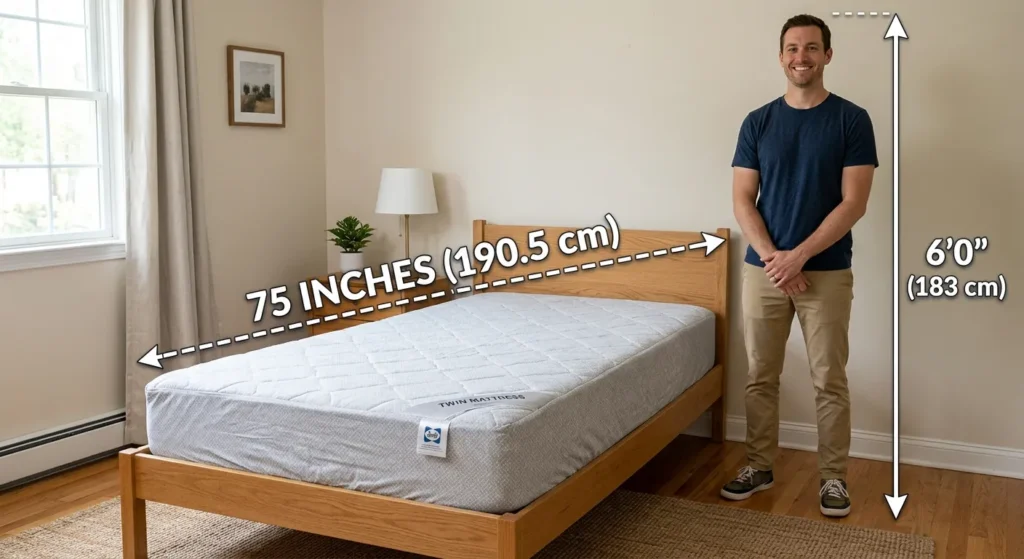
A 6-foot-tall adult is 72 inches tall, while a standard twin mattress is 75 inches long. The mattress is therefore only 3 inches longer than that person’s standing height.
That comparison helps explain why a twin can work for many adults. However, lying down requires enough room for the body to stretch comfortably, and some people prefer extra length.
A person’s height alone doesn’t determine mattress comfort. Sleeping position, pillow placement, and how much room someone wants at the foot of the bed all matter.
2. A Standard Interior Door Height
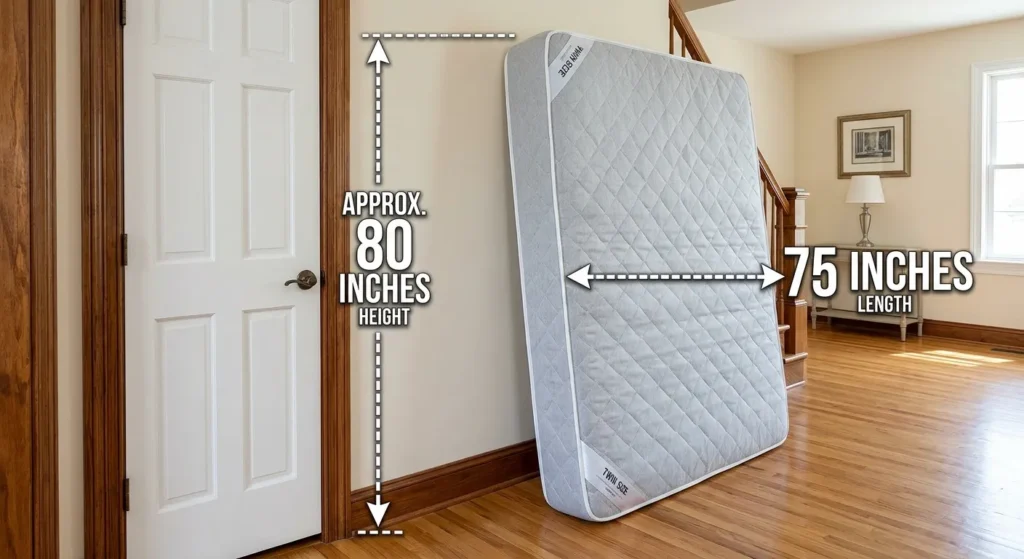
Many U.S. interior doors are around 80 inches tall, although actual door sizes vary. A twin mattress is 75 inches long, making it 5 inches shorter than that common door height.
This gives you a familiar way to imagine the mattress’s length. Picture a typical interior door standing upright, then imagine a twin mattress that is slightly shorter.
The comparison is useful for scale, but it does not tell you whether a mattress will fit through a doorway. A flexible mattress may be easier to maneuver than a rigid one, and hallway turns or staircases can create additional challenges.
3. A Full-Size Mattress
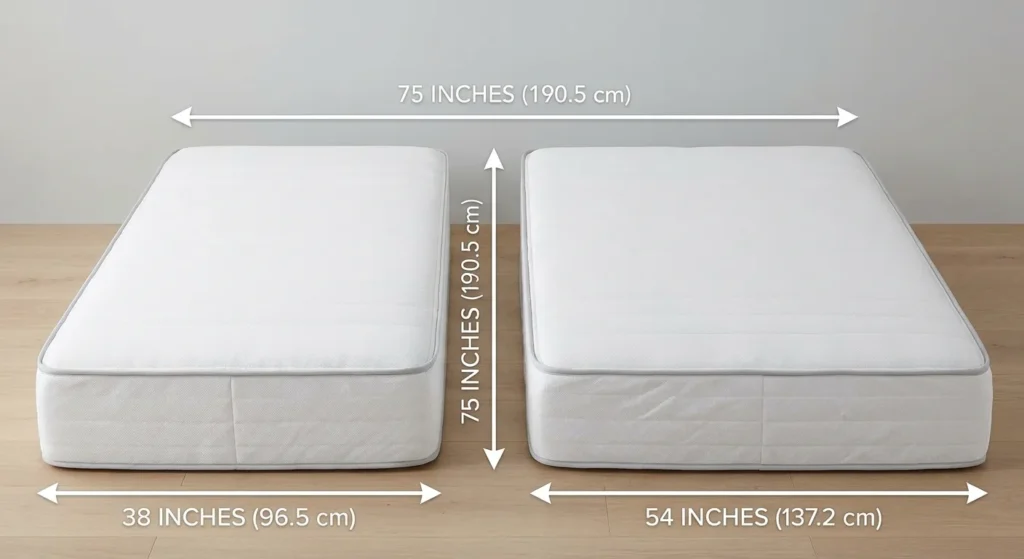
A full mattress is usually 54 inches wide and 75 inches long. It has the same standard length as a twin but provides 16 additional inches of width.
Imagine adding a strip of space 16 inches wide along one side of a twin mattress. That extra room makes a full bed feel noticeably less narrow for many sleepers.
The comparison is especially useful when choosing between the two sizes for a guest room. A twin saves floor space, while a full offers more room for a single sleeper who likes to spread out.
4. Two Twin Mattresses Side by Side
Two standard twin mattresses placed side by side create a combined surface measuring 76 inches wide by 75 inches long, assuming they touch with no gap.
That combined width is the same as a standard king mattress, which is 76 inches wide. However, the combined length remains 75 inches rather than the king’s 80 inches.
This distinction matters when arranging two separate beds in a guest room or comparing twin mattresses for a shared sleeping setup. Two standard twins do not make an exact king-sized mattress in both dimensions.
For an exact king footprint using two mattresses, two Twin XL mattresses are commonly paired together: each is 38 × 80 inches, producing a combined 76 × 80-inch surface.

5. A 75-Inch Television’s Screen Diagonal
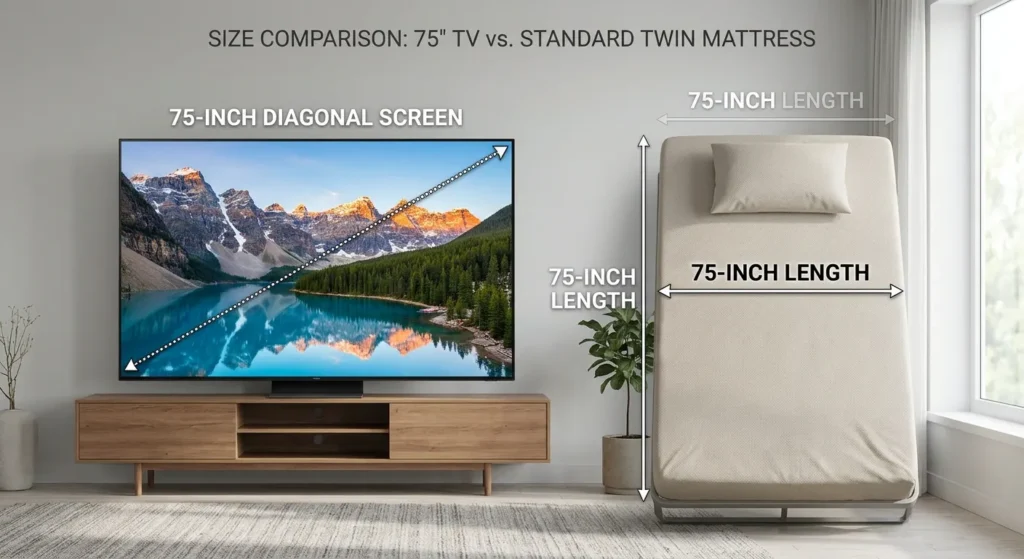
A television marketed as 75 inches has a screen diagonal of approximately 75 inches, measured from one corner of the display to the opposite corner. That diagonal is the same numerical length as a twin mattress’s 75-inch side.
The two measurements describe different things. A TV’s diagonal runs across its screen, while the mattress’s length runs from head to foot.
For a typical 16:9 television, a 75-inch screen is roughly 65 inches wide and 37 inches tall, excluding the frame. That means the mattress is longer than the TV is wide, but not by as much as the matching number might suggest.
This is a good reminder that the same measurement can describe very different shapes.
6. A 6-Foot Folding Table
A common folding table is 6 feet long, which equals 72 inches. A twin mattress is 75 inches long, so it extends about 3 inches beyond that table’s length.
The comparison works well because a 6-foot table is a familiar object in homes, classrooms, community halls, and event spaces. Its length provides a close visual reference for the mattress.
Table widths vary, so don’t use the table’s width to estimate the mattress’s 38-inch width unless you know the specific model’s dimensions.
Picture a 6-foot table, then add a little more length at one end. That gives you a quick sense of how long the mattress is.

7. A 4-by-8-Foot Plywood Sheet
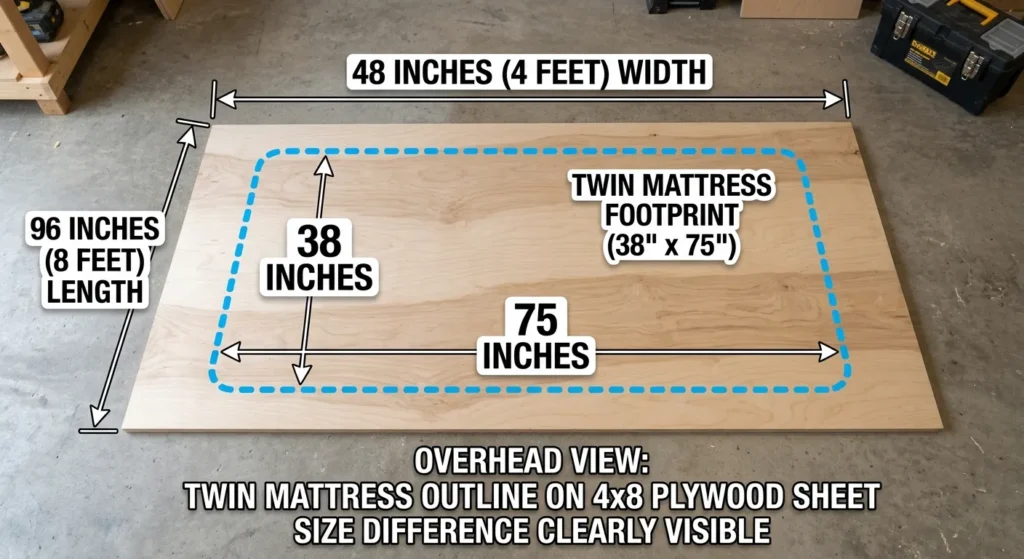
A standard sheet of plywood is commonly sold in a 4 × 8-foot format, measuring 48 inches by 96 inches. A twin mattress is narrower and shorter, at 38 × 75 inches.
The plywood sheet is 10 inches wider and 21 inches longer than the mattress. This makes it a useful comparison for understanding the mattress’s footprint on the floor.
Plywood sheets are large enough that many people immediately recognize their scale. Imagine a sheet of plywood with a smaller rectangular area marked inside it to represent the twin mattress.
The comparison is about surface dimensions only. A plywood sheet is rigid and thin, while a mattress is thick and soft, so handling and storage are entirely different.
8. A Yoga Mat
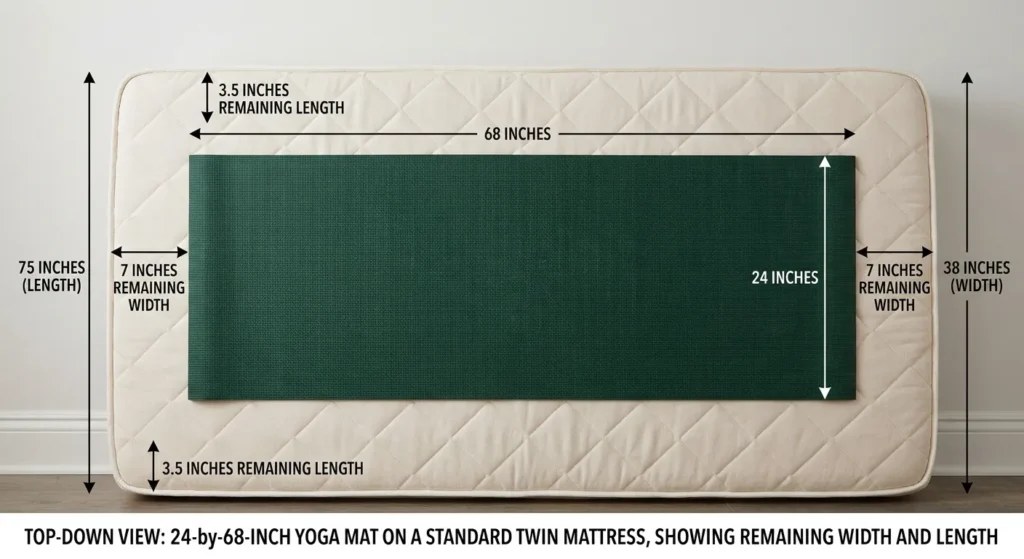
Many standard yoga mats are approximately 24 inches wide and 68 inches long, although product sizes vary. Compared with that example, a twin mattress is about 14 inches wider and 7 inches longer.
A yoga mat offers a useful starting point because it is a familiar rectangle designed for one person’s body. A twin mattress is substantially broader, giving the sleeper more room to turn and settle.
Not all yoga mats are the same length or width, so check the product specifications if you want a precise comparison. Extra-long yoga mats are also available.
Imagine placing a yoga mat down the center of the mattress. You would still have noticeable space on both sides and a little additional length at the head and foot.
9. A Compact Desk Around 3 Feet Wide
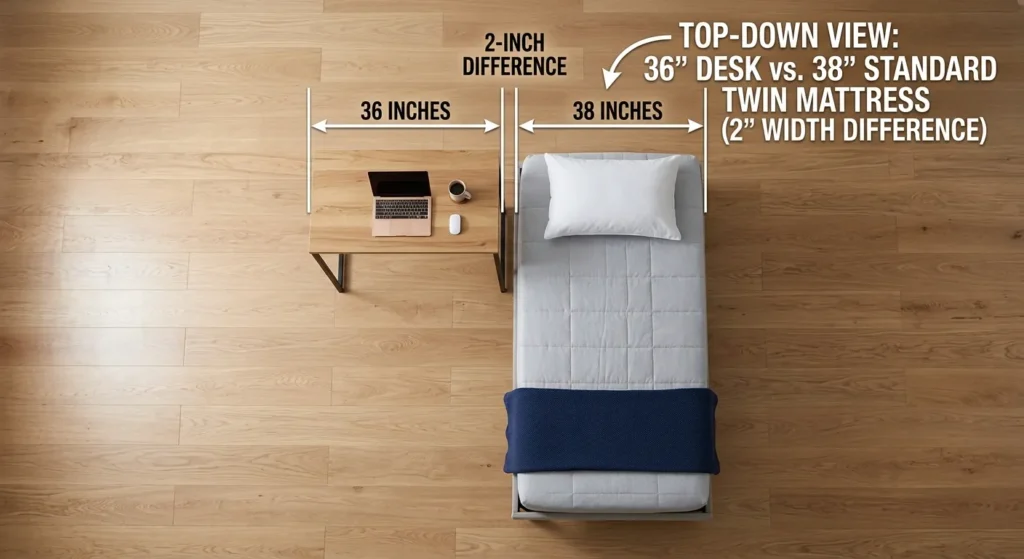
Some compact desks measure around 36 inches wide, close to the 38-inch width of a twin mattress. The mattress is only 2 inches wider than a desk of that size.
This is a useful comparison when planning a small bedroom. A narrow desk and a twin bed can each fit along a wall, but the room still needs enough clearance for a chair, drawers, and walking space.
Desk dimensions vary considerably, and many models are wider than 36 inches. Treat this as an example of a compact desk rather than a universal standard.
If you can picture a small desk spanning roughly 3 feet, imagine adding about 2 inches to its width. That’s close to the twin mattress’s width.
10. A 5-Foot Bathtub
Many standard residential bathtubs are approximately 60 inches long, although sizes and shapes vary. A twin mattress is 75 inches long, making it 15 inches longer than a 5-foot tub.
Bathtubs are a familiar household reference because people often know whether they have a 5-foot model. The comparison helps put the mattress’s length into perspective without needing to measure it.
A bathtub’s outside dimensions may differ from the usable interior length, so this is a visual comparison rather than a way to plan a mattress-sized space.
Picture a common 5-foot bathtub and imagine adding another 15 inches to one end. That gets you close to the twin mattress’s length.

11. A Standard 8-Foot Ceiling
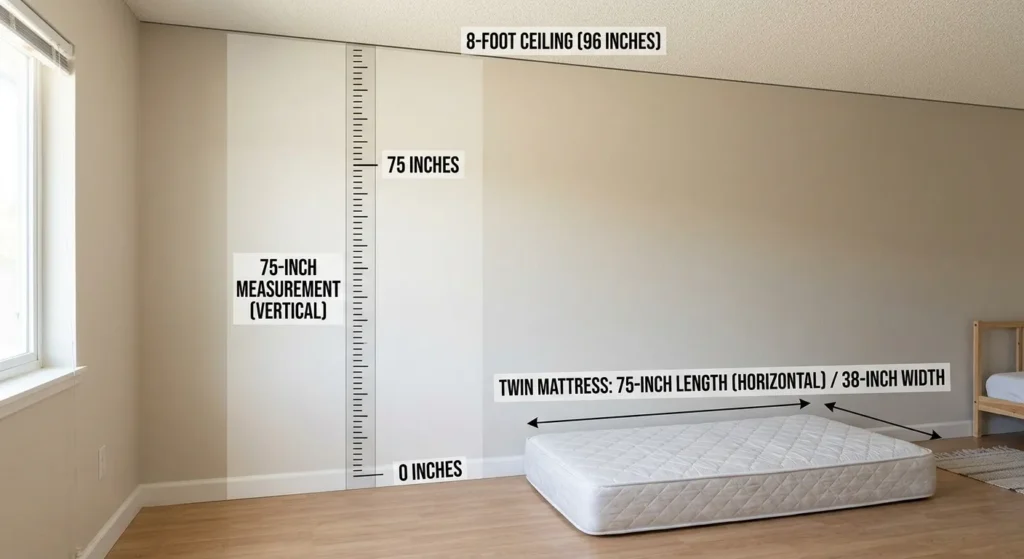
A typical U.S. room may have an 8-foot ceiling, which is 96 inches high. A twin mattress’s 75-inch length is 21 inches less than that ceiling height.
This comparison gives you a familiar vertical reference, but remember that the mattress is normally used horizontally. The ceiling measurement simply helps your brain understand a 75-inch span.
It also illustrates why the word “length” can be confusing. The same 75 inches could describe a horizontal mattress dimension or a vertical object, but the way it fits into a room would be completely different.
Imagine marking a 75-inch line up a wall in a room with an 8-foot ceiling. The mark would sit 21 inches below the ceiling.
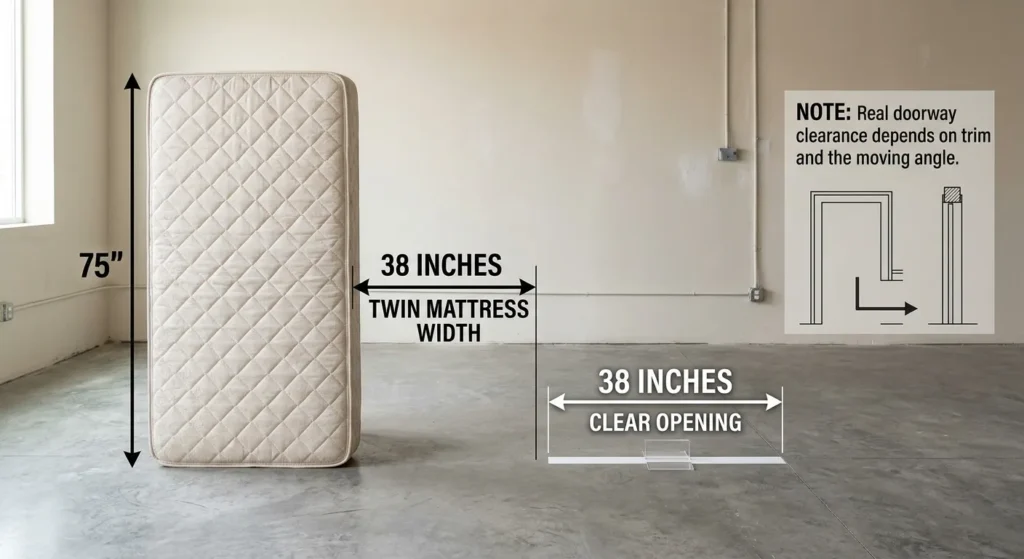
12. A 38-Inch-Wide Hallway Opening
A 38-inch-wide opening matches the nominal width of a standard twin mattress. That makes it a convenient comparison for understanding how much floor width the mattress occupies.
However, matching widths on paper do not guarantee that a mattress can be carried through an opening. Door trim, handles, turns, mattress thickness, and the angle at which the mattress is moved all affect clearance.
Soft mattresses can sometimes flex during moving, but they should not be bent or folded beyond the manufacturer’s guidance. If you are moving a mattress into a small room, measure the narrowest part of the route first.
Picture a doorway or opening that is about 3 feet 2 inches wide. The mattress’s width would use nearly all that span, leaving very little clearance if the opening were exactly 38 inches.
4. Twin vs. Twin XL: What Is the Actual Difference?
The most important size question many shoppers have is whether they need a standard twin or a Twin XL. Both sizes are typically 38 inches wide, but their lengths are different.
| Feature | Twin | Twin XL |
|---|---|---|
| Width | 38 in | 38 in |
| Length | 75 in | 80 in |
| Width in feet | 3 ft 2 in | 3 ft 2 in |
| Length in feet | 6 ft 3 in | 6 ft 8 in |
| Width in cm | 96.52 cm | 96.52 cm |
| Length in cm | 190.5 cm | 203.2 cm |
A Twin XL mattress adds 5 inches of length without taking up more width. This is why Twin XL beds are common in college dormitories and other spaces designed for taller single sleepers.
A standard twin may be suitable for children, smaller bedrooms, bunk beds, and many adults. For someone who is tall or prefers more room at the foot of the bed, the Twin XL can be the more comfortable choice.
Before ordering, confirm the mattress size required by the bed frame. A standard twin mattress and a Twin XL mattress are not interchangeable, even though they have the same width.
5. Getting to Twin Mattress Dimensions Without a Tape Measure
You can estimate the size of a twin mattress using familiar references. These methods are useful for visualization, but they are not a substitute for measuring when you’re buying a mattress or arranging furniture.
Method 1: Use a 6-Foot Table
A common 6-foot folding table measures 72 inches long. A twin mattress is 75 inches long, so add roughly 3 inches to the table’s length to picture the mattress.
Method 2: Compare It With a Full Mattress
A full mattress is 54 inches wide, while a twin is 38 inches wide. If you’ve slept on a full bed, imagine removing a 16-inch strip from its width while keeping the same 75-inch length.
Method 3: Mark the Width in Feet
The twin mattress is 3 feet 2 inches wide. If you can estimate a 3-foot span on the floor, add another 2 inches to get close to the mattress width.
Method 4: Use a Standard Interior Door as a Length Reference
A common interior door is about 80 inches tall. The twin mattress is 75 inches long, so imagine a span about 5 inches shorter than that door’s height.
Method 5: Outline the Mattress on the Floor
Use removable painter’s tape to mark a rectangle approximately 38 inches wide and 75 inches long. This gives you a practical view of how the mattress will occupy the room.
If you do not have a tape measure, you can use floor tiles or known furniture dimensions as rough guides, provided you know their size. For a precise fit, use an actual measuring tool and account for the bed frame as well as the mattress.
6. FAQs About Twin Mattress Dimensions
How many feet is a twin mattress?
A standard twin mattress is 3 feet 2 inches wide and 6 feet 3 inches long. In decimal feet, that is approximately 3.167 feet by 6.25 feet.
What are twin mattress dimensions in inches?
Standard U.S. twin mattress dimensions are 38 inches wide by 75 inches long. These are the mattress dimensions, not necessarily the outer dimensions of the bed frame.
What are twin mattress dimensions in cm?
A standard twin mattress measures 96.52 cm wide and 190.5 cm long. In millimeters, that is 965.2 × 1,905 mm.
How many meters long is a twin mattress?
A standard twin mattress is 1.905 meters long and 0.9652 meters wide. For everyday planning, you can round those figures to about 1.91 meters long and 0.97 meters wide.
Is a twin mattress big enough for an adult?
A twin can work for many adults, especially when bedroom space is limited. Its 38-inch width gives one person a relatively narrow sleeping surface, and its 75-inch length may be short for taller sleepers.
Is a twin mattress the same as a single mattress?
In the United States, “twin” is the common name for a standard single-person mattress size. However, mattress dimensions called “single” in other countries may differ, so always compare the actual measurements rather than relying on the name alone.
What is the difference between a twin and a Twin XL mattress?
Both are typically 38 inches wide. A Twin XL is 80 inches long, which makes it 5 inches longer than the standard twin mattress at 75 inches.
Can a twin mattress fit in a small bedroom?
Yes, a twin is often chosen for smaller bedrooms because its footprint is about 19.79 square feet. You should still leave room for walking paths, drawers, doors, and other furniture, and remember that the frame may be larger than the mattress.
7. Where That Leaves You
A standard twin mattress measures 38 × 75 inches, which equals 3 feet 2 inches wide by 6 feet 3 inches long, or 96.52 × 190.5 cm. Its compact footprint makes it useful for children’s rooms, dormitories, guest beds, and spaces where every bit of floor area matters.
For a simple mental picture, remember the 6-foot folding table: a twin mattress is about 3 inches longer than the table and much narrower than a full mattress. That comparison gives you a practical sense of the length without needing to memorize every conversion.
If you’re buying bedding or a bed frame, use the exact mattress dimensions as your starting point and check the manufacturer’s specifications. If you need more length, a Twin XL keeps the same width while adding 5 inches at the foot of the bed.

Jack Harrison is a passionate writer who creates informative, engaging and easy-to-understand content for online readers. He enjoys researching new topics and sharing practical insights that help readers discover useful ideas and information.