
A smartphone can look small in a product photo but feel quite different when you hold it in your hand. The iPhone 16 is a good example: its display is advertised as 6.1 inches, yet that number doesn’t tell you the phone’s actual height or width.
Those physical measurements matter when you’re choosing a case, checking whether the phone fits into a pocket, comparing it with another model, or deciding whether its size feels comfortable for one-handed use.
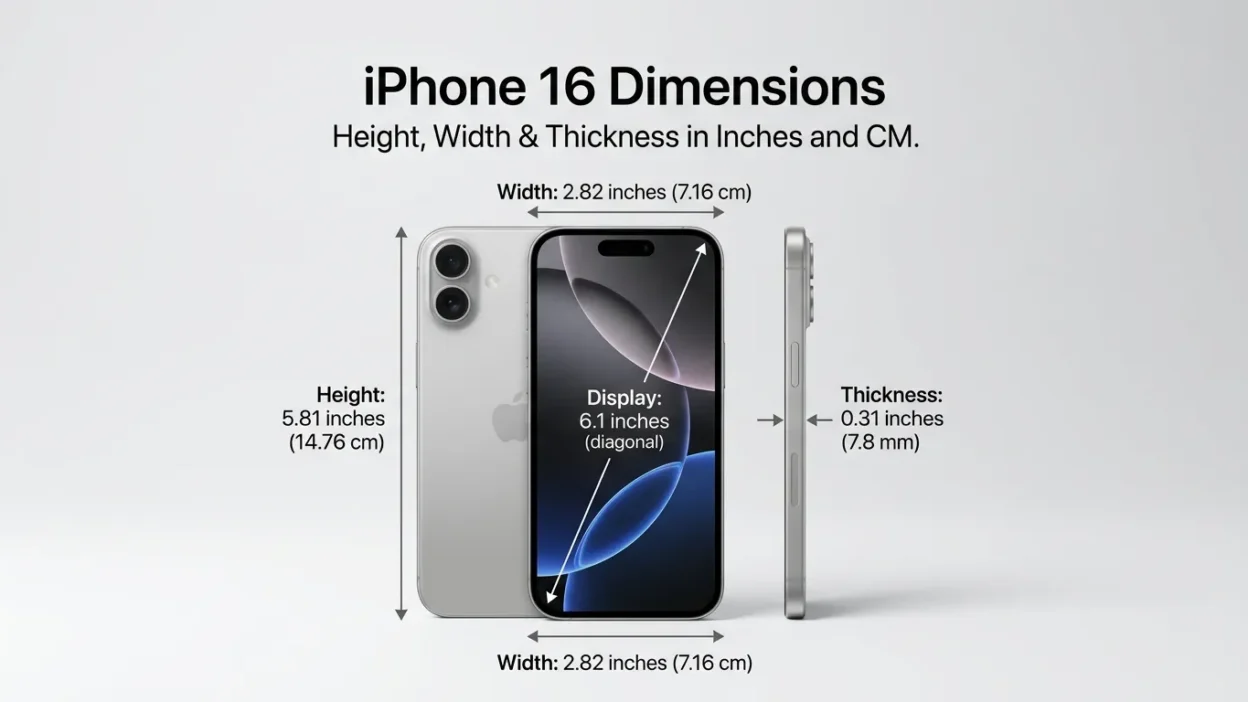
The standard iPhone 16 measures 5.81 inches tall, 2.82 inches wide, and 0.31 inches thick. That’s approximately 14.76 cm tall, 7.16 cm wide, and 0.78 cm thick.
In this guide, you’ll find the iPhone 16 dimensions in inches, feet, centimeters, millimeters, and meters, along with everyday objects that make its size easier to picture. We’ll also explain what the 6.1-inch screen measurement means and how to estimate the phone’s dimensions without a tape measure.
Every iPhone 16 Measurement Converted
The easiest way to understand a phone’s size is to separate its height, width, and thickness. The diagonal screen measurement is useful too, but it describes something different.
Here are the standard dimensions of the regular iPhone 16.
| Measurement | Inches | Feet | Centimeters | Millimeters | Meters |
|---|---|---|---|---|---|
| Height | 5.81 in | 0.484 ft | 14.76 cm | 147.6 mm | 0.1476 m |
| Width | 2.82 in | 0.235 ft | 7.16 cm | 71.6 mm | 0.0716 m |
| Body thickness | 0.31 in | 0.026 ft | 0.78 cm | 7.8 mm | 0.0078 m |
| Display diagonal | 6.1 in | 0.508 ft | 15.49 cm | 154.9 mm | 0.1549 m |
Conversions are rounded. The display diagonal is not the same as the phone’s physical height.
How to convert the measurements yourself
You don’t need complicated math to convert iPhone 16 dimensions into other units.
- Inches to feet: Divide by 12. The phone’s 5.81-inch height is about 0.484 feet.
- Inches to centimeters: Multiply by 2.54. Its 2.82-inch width is approximately 7.16 cm.
- Inches to millimeters: Multiply by 25.4. Its 0.31-inch thickness is about 7.87 mm before rounding.
- Inches to meters: Multiply by 0.0254. Its 5.81-inch height is approximately 0.1476 meters.
Because the original dimensions are rounded to two decimal places in inches, conversions may differ slightly depending on the precision used.
How much does the iPhone 16 weigh?
The standard iPhone 16 weighs approximately 170 grams, or about 6 ounces. Weight isn’t a physical dimension, but it helps explain how the device may feel in a pocket or hand.
Keep in mind that a protective case changes the overall measurements. A thick case can add several millimeters, while a slim case adds less. If you’re checking a tight phone holder, measure the phone with its case attached.
Where the iPhone 16 Fits on a Smartphone Size Chart
At 5.81 inches tall, the iPhone 16 is a compact rectangle compared with a tablet, yet it is substantially larger than a bank card. Its width of 2.82 inches gives it a relatively narrow profile compared with many everyday objects.
Each measurement answers a different practical question.
- Height: Useful when checking pocket depth or the height of a phone compartment.
- Width: Important for grip, one-handed handling, and narrow storage spaces.
- Thickness: Helps determine whether the phone slides comfortably into a pocket or fits a fitted holder.
- Screen diagonal: Describes the display size, rather than the overall dimensions of the device.
The 0.31-inch body thickness is less than one-third of an inch. That makes the phone relatively slim, although its rear camera area protrudes and may prevent it from lying completely flat on a table.
Is the iPhone 16 a large phone?
The regular iPhone 16 has a 6.1-inch display, placing it below the larger 6.7-inch display used by the iPhone 16 Plus. However, screen size alone doesn’t determine how comfortable a phone feels.
Someone with smaller hands may pay more attention to width and reachability, while someone who watches videos frequently may care more about display area. The best size depends on how you use the device.
iPhone 16 versus iPhone 16 Plus
The iPhone 16 Plus has a larger body and display than the regular iPhone 16. Their cases are not interchangeable because the exterior dimensions and camera cutouts differ.
If you’re buying a case, screen protector, car mount, or fitted holder, make sure the product specifically supports the iPhone 16, rather than relying on the shared model name alone.
10 Everyday Objects That Help Visualize the iPhone 16
The numbers become more useful when you compare them with objects you already know. The following examples help you picture the iPhone 16’s height, width, and overall footprint. These are visual references, not claims that every item has a fixed size.
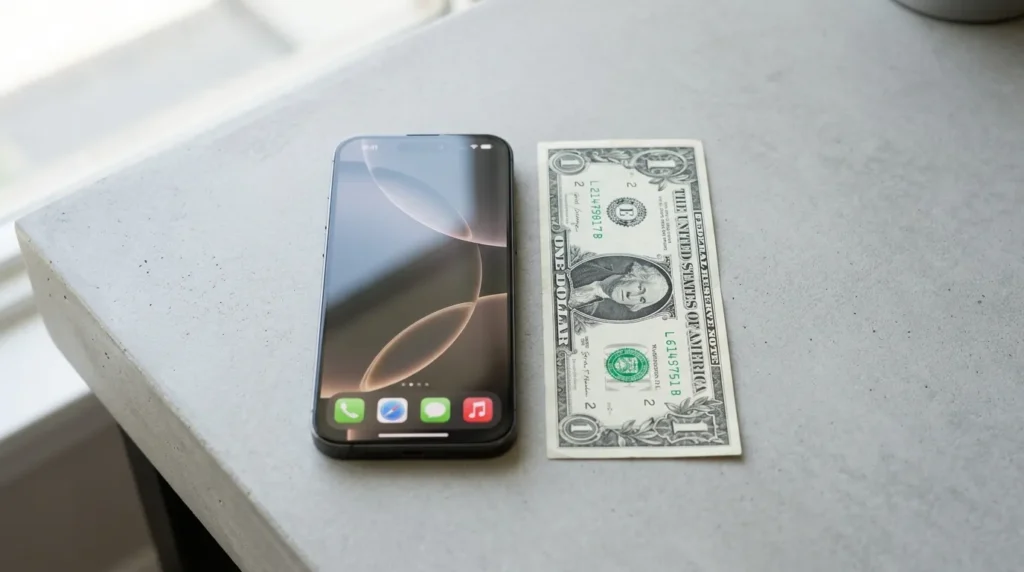
1. A US Dollar Bill
A US dollar bill is approximately 6.14 inches long and 2.61 inches tall. Its long edge is slightly longer than the iPhone 16’s 5.81-inch height.
The bill’s short edge is also fairly close to the phone’s 2.82-inch width. This makes it a useful comparison for understanding both dimensions at once.
Currency is manufactured to standardized dimensions, which makes this a more dependable reference than an arbitrary household item. A worn or folded bill may be harder to align accurately, though.
Imagine laying a dollar bill beside the phone: the phone would be a little shorter and somewhat wider than the bill’s short edge.
2. A Standard Bank Card
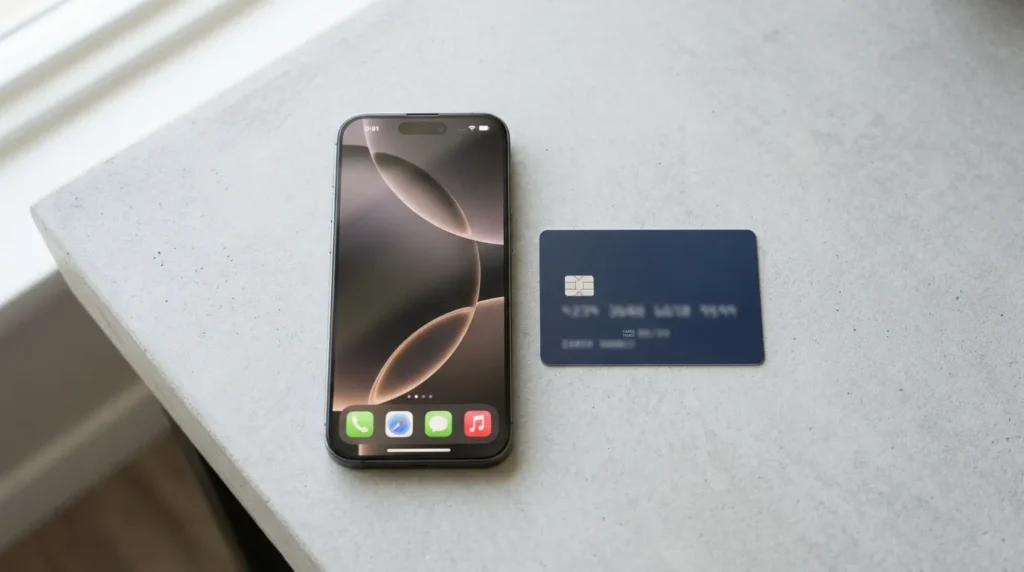
A standard bank card is about 3.37 inches long and 2.125 inches wide. The iPhone 16 is taller and wider than the card, making it a useful reference for the phone’s footprint.
The card’s short edge is noticeably smaller than the phone’s width. Place the card next to the phone rather than on top of it to compare their outlines clearly.
Bank cards follow a widely used standard size, so this comparison is fairly consistent across many countries. Avoid using a card with a bulky sleeve or holder because it will be larger than the card itself.
This comparison is particularly helpful if you’re trying to imagine the width of the phone: it extends roughly seven-tenths of an inch beyond the card’s short edge.
3. A 6-Inch Ruler
A ruler marked in inches gives you a direct way to picture the phone’s height. The iPhone 16 is 5.81 inches tall, so it reaches just short of the 6-inch mark.
Rulers are designed for measurement, making them more reliable than visual comparisons with furniture or clothing. A standard 12-inch ruler is also long enough to compare the phone’s height, width, and other small objects.
If you have a ruler at home, align the phone’s bottom edge with the zero mark and look at where its top edge falls. Make sure you measure the bare phone if you want to compare against the manufacturer’s body dimensions.

4. A 3 × 3-Inch Sticky Note
A common square sticky note measures 3 inches on each side. The iPhone 16 is nearly twice as tall as the note and slightly narrower than its height? More precisely, the phone’s 2.82-inch width is just under the note’s 3-inch side.
That makes a sticky note an especially convenient reference for the phone’s width. Its 3-inch edge is only about 0.18 inches wider than the phone.
Sticky notes are sold in different formats, so check the packaging if you need a dependable comparison. The familiar square shape, however, makes the relative size easy to understand.
Place one sticky note beside the phone and compare their widths. You’ll see that the phone is almost as wide as the note is long.

5. A Compact Paperback Book
Many pocket-sized paperbacks are around 5 to 6 inches tall, although their exact dimensions vary by publisher. A book near the upper end of that range may be close to the iPhone 16’s height.
A paperback is usually much wider and thicker than the phone. That contrast helps you picture how narrow the device is despite having a height similar to a small book.
Books aren’t manufactured to one universal size. A pocket edition, trade paperback, and large-format book may have very different dimensions, so use a book you already own as a rough reference.
Set the book upright beside the phone. If their top edges are close, you’ll have a useful visual estimate of the phone’s height.

6. A Small Notebook
Some pocket notebooks measure around 5 to 6 inches tall. A notebook near 5.8 inches can therefore be a useful height comparison for the iPhone 16.
The phone is generally narrower than a notebook of similar height, and the two objects have very different surfaces. The notebook’s paper cover also makes it easy to see the phone’s smooth glass-and-metal outline.
Notebook sizes vary by brand and intended use, so this is not a standardized measurement. Check the notebook’s product details if you want a closer match.
A notebook you carry every day can still help you visualize the phone’s size. Put the two side by side and compare their top and bottom edges.

7. A Standard Pencil
A typical wooden pencil is around 7 to 7.5 inches long, making it longer than the iPhone 16’s height.
This comparison works because pencils are familiar and easy to find. The phone would stop noticeably before the pencil’s tip if both were aligned at one end.
Pencil lengths vary, especially between short classroom pencils and full-size writing pencils. Use a normal, unsharpened pencil for the closest everyday comparison.
Place the pencil and phone parallel to each other. The extra length beyond the phone gives you a quick visual sense of how far the phone falls short of seven inches.

8. A Small Kitchen Spatula Blade
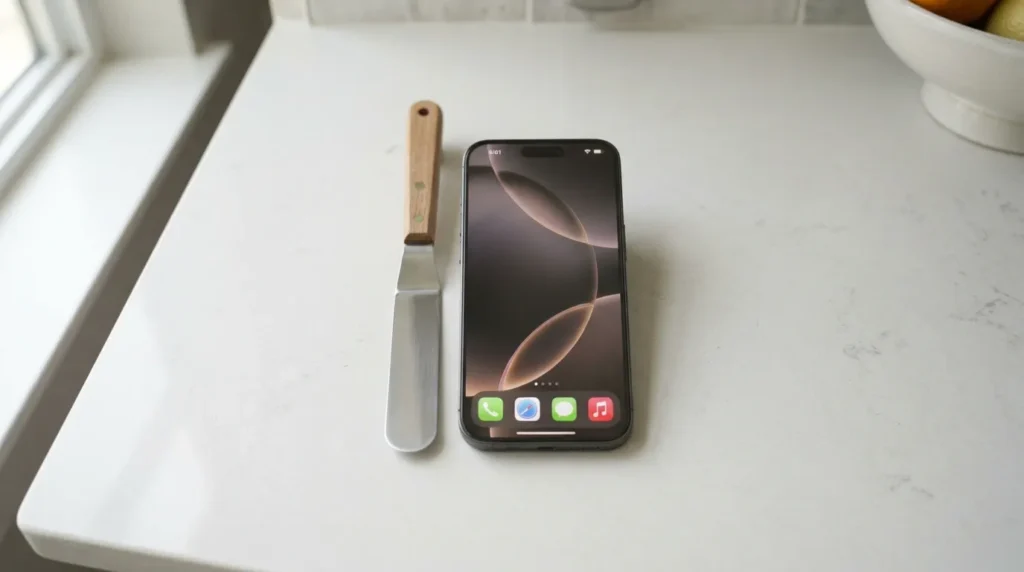
Some small kitchen spatulas have blades around 5 to 6 inches long, putting them near the iPhone 16’s height. Compare only the blade, not the complete utensil, because the handle makes the overall object much longer.
The blade provides a flat, easy-to-compare shape. Depending on the spatula, it may be narrower than the phone or similar in width.
Kitchen utensils vary substantially by purpose and manufacturer, so this is an approximate comparison rather than a standard size. A small silicone spatula may differ from a metal turner or serving spatula.
Lay the blade beside the phone and align their lower ends. If the blade is close to six inches, its length should look similar to the phone’s height.
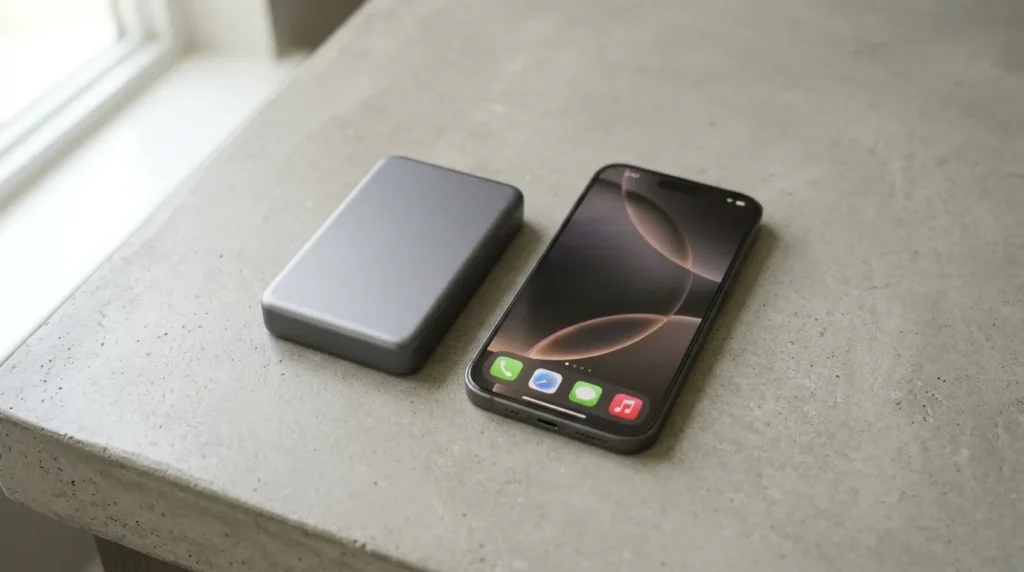
9. A Compact External Battery
Small power banks often have rectangular bodies several inches long, and some are close to the iPhone 16’s height. Their exact dimensions depend on capacity, battery layout, and design.
A power bank is a particularly relevant comparison because it is another portable electronic device. Some models are thicker than a phone, while slim versions may have a similar footprint.
Do not assume all power banks are close to 5.81 inches long. Check the specifications of your own device if you want a more accurate comparison.
Place the power bank next to the iPhone 16 and compare their height and thickness. This can help you estimate how much space both items may take up in a bag.
10. A Compact Wallet
A small wallet may be around 4 to 5 inches wide and 3 to 4 inches tall, although designs differ considerably. The iPhone 16 is taller than many compact wallets and may have a similar width to some larger styles.
This comparison is practical when you’re checking the space available in a handbag, backpack pocket, or travel pouch. A wallet’s thickness can change depending on how many cards and notes it contains.
Unlike a bank card, a wallet has no single standard size. Use your own wallet for a meaningful comparison rather than assuming all wallets have the same dimensions.
Place the wallet beside the phone with both lying flat. Their outlines will help you judge whether the phone takes up noticeably more space in one direction.

What Does the 6.1-Inch Screen Measurement Actually Mean?
The 6.1-inch display figure is one of the most misunderstood parts of smartphone specifications. It refers to the screen’s diagonal, measured from one corner of the display area to the opposite corner.
It does not mean the phone is 6.1 inches tall or 6.1 inches wide. The standard iPhone 16’s physical height is 5.81 inches, and its width is 2.82 inches.
A screen’s diagonal, height, and width are different measurements. The diagonal cuts across the display, while height and width follow the device’s vertical and horizontal edges.
Why screen size doesn’t equal phone height
Smartphone displays are rectangular, and the diagonal is longer than either side. The overall body dimensions also include the phone’s outer edges, while the advertised screen size describes the display measurement.
Rounded display corners can make the exact visible area slightly more complicated than a simple rectangle. That’s why it’s best to use Apple’s listed physical dimensions when checking whether the phone fits a space.
Do cases change iPhone 16 dimensions?
Yes. A case adds material around the phone’s edges and back, increasing the total width, height, or thickness. Rugged protective cases can add more bulk than thin silicone or clear cases.
If you’re buying a case, choose one designed for the standard iPhone 16. If you’re checking a car mount or tight compartment, measure the phone with the case attached.
Estimating iPhone 16 Dimensions Without a Tape Measure
You can get a reasonable sense of the phone’s size without carrying a measuring tool. The best approach is to use a familiar object with known dimensions and treat the result as an estimate.
Compare it with a bank card
A standard bank card is about 2.125 inches wide, while the iPhone 16 is 2.82 inches wide. The phone is wider by roughly 0.7 inches, giving you a quick way to picture its horizontal measurement.
Use a US dollar bill
A US dollar bill is approximately 6.14 inches long, compared with the phone’s 5.81-inch height. Aligning their ends gives you an easy estimate of how much shorter the phone is.
Look at the 6-inch mark on a ruler
If you have a ruler nearby, the phone’s top edge should fall just below the 6-inch mark when measured from its bottom edge. This is more reliable than estimating from memory.
Check the space in your pocket or bag
If your goal is to see whether the phone fits, test it in the actual pocket, compartment, or holder. Fabric seams, pocket shape, and protective cases can change how much usable room is available.
Use the bare phone for official dimensions
For the manufacturer’s listed measurements, compare the phone without a case. For practical everyday fit, measure the complete setup you plan to carry, including any case or accessory.
Frequently Asked Questions
How many inches tall is the iPhone 16?
The standard iPhone 16 is 5.81 inches tall. It measures 2.82 inches wide and approximately 0.31 inches thick.
What are the iPhone 16 dimensions in cm?
The phone is approximately 14.76 cm tall, 7.16 cm wide, and 0.78 cm thick. These figures describe the device body without a protective case.
How many feet tall is the iPhone 16?
Its height is approximately 0.484 feet, just under half a foot. The equivalent measurement is 5.81 inches, or about 14.76 cm.
What are the iPhone 16 dimensions in mm?
The iPhone 16 is approximately 147.6 mm tall, 71.6 mm wide, and about 7.8 mm thick. These are rounded conversions, so small differences can appear depending on the rounding method.
Is the iPhone 16 screen 6.1 inches tall?
No. The 6.1-inch screen measurement is the display’s diagonal, not its height. The complete phone measures 5.81 inches from top to bottom.
Is the iPhone 16 smaller than the iPhone 16 Plus?
Yes. The standard iPhone 16 has a 6.1-inch display, while the iPhone 16 Plus has a 6.7-inch display and a larger body. Cases made for one model should not be assumed to fit the other.
Will the iPhone 16 fit in a small pocket?
It may fit in many pockets, but pocket sizes vary. Check whether the usable space accommodates a phone measuring 5.81 inches tall and 2.82 inches wide, with additional room if you use a case.
How thick is the iPhone 16 with a case?
The phone itself is approximately 0.31 inches thick, but the total thickness depends on the case. For a reliable fit, check the case specifications or measure the assembled phone.
Where That Leaves You
The regular iPhone 16 measures 5.81 inches tall, 2.82 inches wide, and 0.31 inches thick—approximately 14.76 × 7.16 × 0.78 cm. Its 6.1-inch display is measured diagonally, not vertically.
For a simple mental picture, compare its height with a US dollar bill: the phone is slightly shorter than the bill’s 6.14-inch long edge. If you’re buying a case or checking a tight holder, use the phone’s actual dimensions and allow for any added bulk.

Jack Harrison is a passionate writer who creates informative, engaging and easy-to-understand content for online readers. He enjoys researching new topics and sharing practical insights that help readers discover useful ideas and information.


