
A stacked washer and dryer can fit neatly into a narrow laundry closet, but its height may surprise you. Picture two large front-loading appliances arranged vertically, almost reaching the top of a standard interior door. That is the kind of space you may need to set aside.
The tricky part is that stackable laundry appliances do not come in one universal size. Full-size models are commonly around 27 inches wide, while compact machines are often closer to 24 inches. Their combined height and depth also vary by model, so measuring your available space before buying is essential.
Typical full-size stackable washer and dryer dimensions are approximately 27 inches wide, 77–80 inches tall, and 32–34 inches deep. That equals 2.25 feet wide, 6 feet 5 inches to 6 feet 8 inches tall, and about 2 feet 8 inches deep. These are representative measurements, not specifications for every appliance.
This guide explains the conversions into inches, feet, centimeters, millimeters, and meters. It also compares laundry appliances with familiar household objects, explains the space needed for installation, and shows how to estimate the dimensions before getting out a measuring tape.
Stackable Washer and Dryer Dimensions in Every Unit
The easiest way to understand a stacked laundry setup is to look at the width, height, and depth separately. Width tells you how much wall space the machines occupy, height determines whether they fit beneath the ceiling or cabinets, and depth affects how far they extend into the room.
Here are typical planning estimates for a full-size front-loading washer and dryer designed to be stacked.
| Measurement | Approximate value |
|---|---|
| Width of each machine | 27 inches |
| Width in feet | 2.25 feet |
| Width in centimeters | 68.58 cm |
| Width in millimeters | 685.8 mm |
| Width in meters | 0.6858 m |
| Height of each machine | 38–40 inches |
| Total stacked height | 76–80 inches |
| Total height in feet | 6 ft 4 in–6 ft 8 in |
| Total height in centimeters | 193.04–203.2 cm |
| Total height in meters | 1.9304–2.032 m |
| Typical depth of each machine | 30–34 inches |
| Depth in feet | 2.5–2.83 feet |
| Depth in centimeters | 76.2–86.36 cm |
| Depth in meters | 0.762–0.8636 m |
These ranges describe common full-size appliances rather than a guaranteed fit. Compact units, laundry centers, and newer models may have substantially different dimensions.
How to convert the measurements
The calculations are straightforward once you know the original measurement in inches.
- Inches to feet: Divide the number of inches by 12. For example, 27 inches ÷ 12 = 2.25 feet.
- Inches to centimeters: Multiply by 2.54. For example, 27 × 2.54 = 68.58 cm.
- Inches to millimeters: Multiply by 25.4. A 27-inch width equals 685.8 mm.
- Inches to meters: Multiply by 0.0254. A 27-inch width equals 0.6858 meters.
For height, a 76-inch stack measures 6 feet 4 inches, while an 80-inch stack measures 6 feet 8 inches. In metric terms, that is approximately 1.93–2.03 meters.
One important detail: the total stacked height is not always the exact sum of the two individual heights. The stacking arrangement, kit, and appliance design affect the final installed measurement. Always check the manufacturer’s specifications for the actual pair you plan to buy.
Where Stackable Washer and Dryer Sizes Fit on the Appliance Scale
Stackable laundry appliances generally fall into three broad categories: compact separate machines, full-size separate machines, and laundry centers manufactured as a combined unit.
| Appliance type | Typical width | Approximate overall height | Typical depth |
|---|---|---|---|
| Compact separate washer and dryer | About 24 inches | Varies by model; often around 66–72 inches when stacked | About 24–26 inches |
| Full-size separate washer and dryer | About 27 inches | Often around 76–80 inches when stacked | About 30–34 inches |
| Combined laundry center | Varies, often around 24–28 inches | Commonly around 70–78 inches | Varies by model |
These figures are broad estimates. The product’s technical specification sheet should take priority over a general size chart.
A compact setup is often suitable for a small apartment or a narrow laundry closet. Full-size machines are a common choice for households that want more washing capacity, although the exact drum capacity depends on the model.
The depth deserves special attention. A machine listed as 33 inches deep may require more room once hoses, vent connections, or other installation components are accounted for. That extra space can make the difference between a comfortable fit and an appliance that sticks out too far.
Also consider whether the dryer is vented or ventless. Installation requirements differ, so there is no single clearance figure that works for every stacked washer and dryer.
10 Things That Help You Visualize Stackable Washer and Dryer Dimensions
The numbers become easier to understand when you compare the machines with familiar objects. The following examples help you picture the appliance’s width, height, and depth without confusing one measurement with another.
1. A Standard Interior Door
A typical US interior door is about 80 inches tall, making it a useful reference for the overall height of a full-size stacked laundry pair.
Many stacked washer and dryer setups reach approximately 76–80 inches, so the top of the dryer may come close to the top of the door itself. This gives you a clear sense of how tall the installation will look in a room.
Door sizes vary, and a door’s height does not tell you whether an appliance will fit through its opening. You must also account for the machine’s depth, width, delivery angle, and available maneuvering room.

2. A Small Home Office Desk
A small desk may be around 24–30 inches wide, which is close to the 27-inch width of many full-size laundry machines.
Imagine replacing that desk with a tall appliance tower. The laundry pair would occupy a similar amount of wall width while extending much farther upward.
Desk dimensions vary, so use this comparison to picture the width rather than to establish an exact measurement. If the gap between your cabinets is tight, measure it directly before choosing a machine.

3. A Kitchen Counter
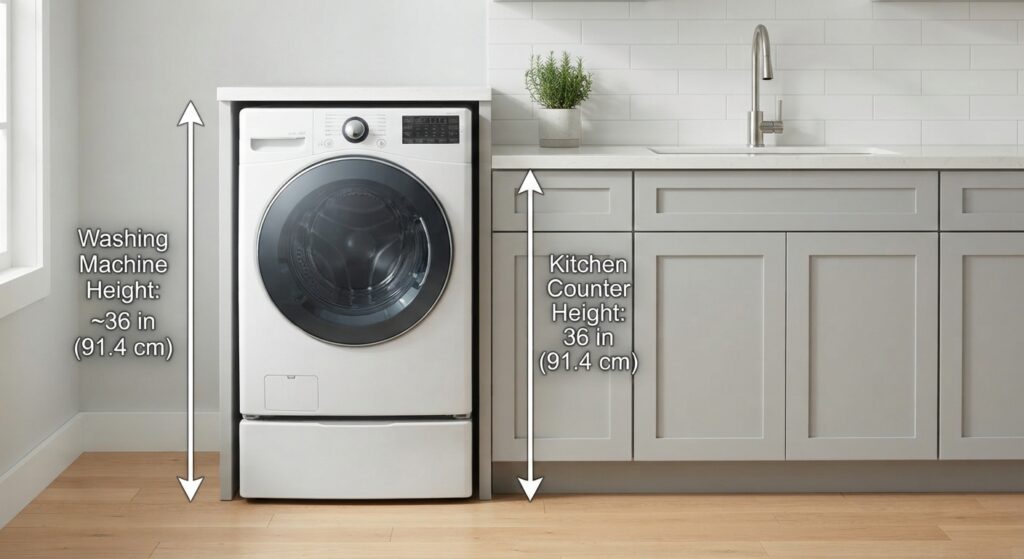
Many standard kitchen countertops are around 36 inches high. A full-size front-loading washer may be approximately 38–40 inches tall, making it slightly taller than a typical counter.
This helps you picture the bottom machine before the dryer is placed on top. The washer alone already reaches a substantial height, and adding the dryer creates a tall column of appliances.
The comparison is especially useful if you have cabinets or shelving above the intended laundry area. A shelf positioned above a countertop may interfere with the stacked dryer, so check the available vertical space carefully..
4. A Tall Refrigerator
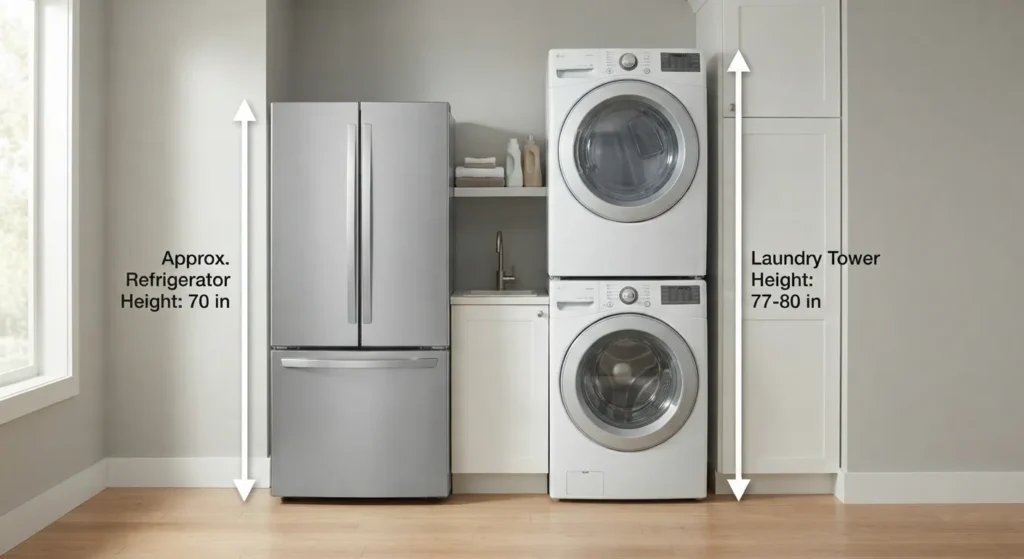
Many freestanding refrigerators measure around 66–72 inches tall, although the dimensions vary considerably by model.
A full-size stacked washer and dryer can reach approximately 76–80 inches. This means the laundry tower may stand several inches higher than a refrigerator that already looks tall in your kitchen.
Picture a refrigerator in your home and imagine the stacked dryer extending above its top. That is a practical way to visualize the vertical footprint, although the refrigerator’s own specification should be checked if you want an accurate comparison.
5. A 24-Inch Built-In Dishwasher
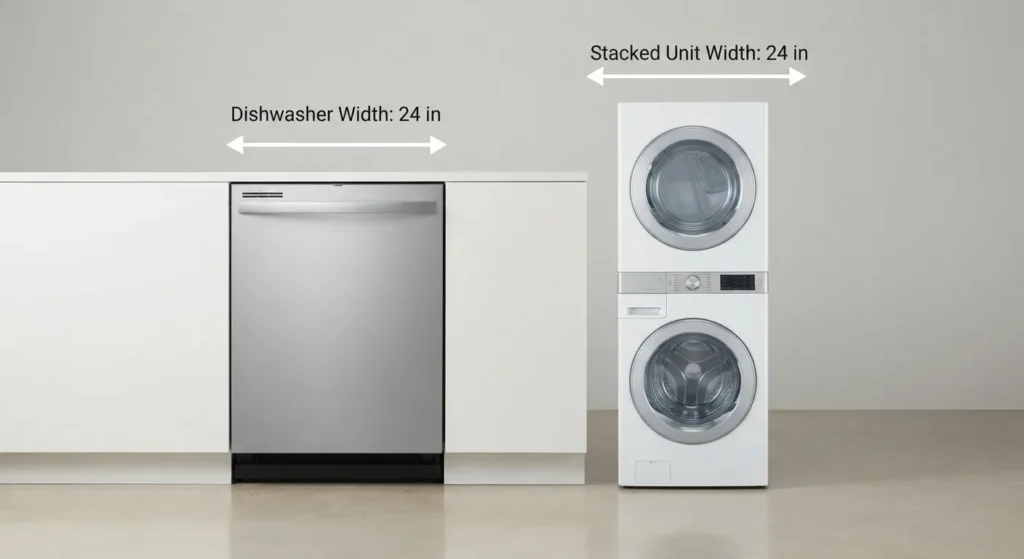
Many built-in dishwashers are designed around a 24-inch width. This is close to the width of a compact washer and dryer, which are often approximately 24 inches across.
A full-size laundry machine at 27 inches is three inches wider. That difference may seem minor, but it can matter when fitting appliances between walls or through a narrow opening.
A dishwasher is much shorter than a stacked laundry pair, so this comparison works for width only. It is not a useful reference for the total height or depth of the installation.
6. A Standard 8-Foot Ceiling
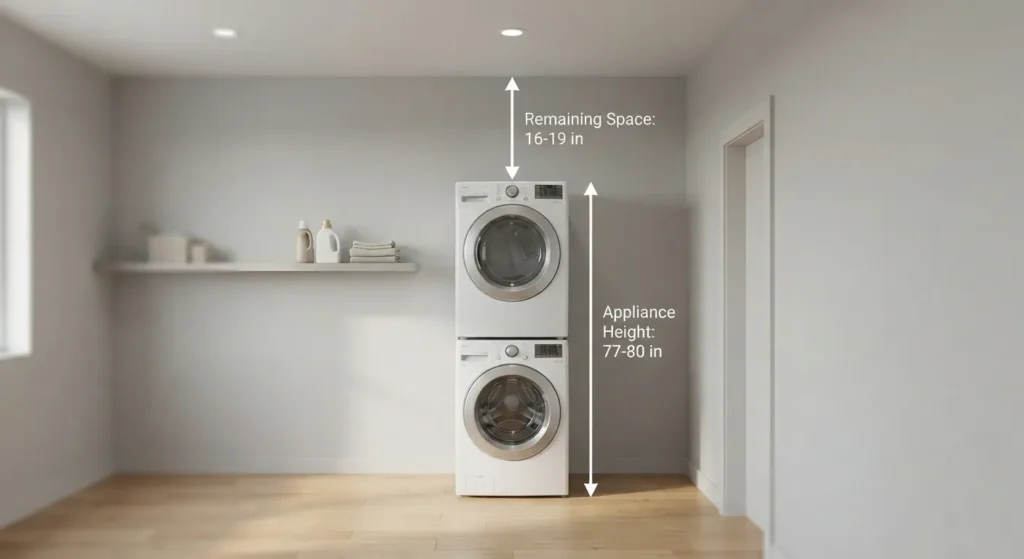
An 8-foot ceiling measures 96 inches from the floor to the ceiling. If your stacked washer and dryer is 77–80 inches tall, the theoretical remaining vertical gap is 16–19 inches.
That gap can make the setup possible in many ordinary rooms, but it does not automatically mean the installation is suitable. Ceiling-mounted shelves, low beams, sloped ceilings, and the space needed to position the dryer can reduce the usable room.
For a practical visualization, imagine a door-sized appliance tower beneath your ceiling. Then account for the exact clearance required by the manufacturer before deciding where to place it.
7. A Compact Washer on Its Own
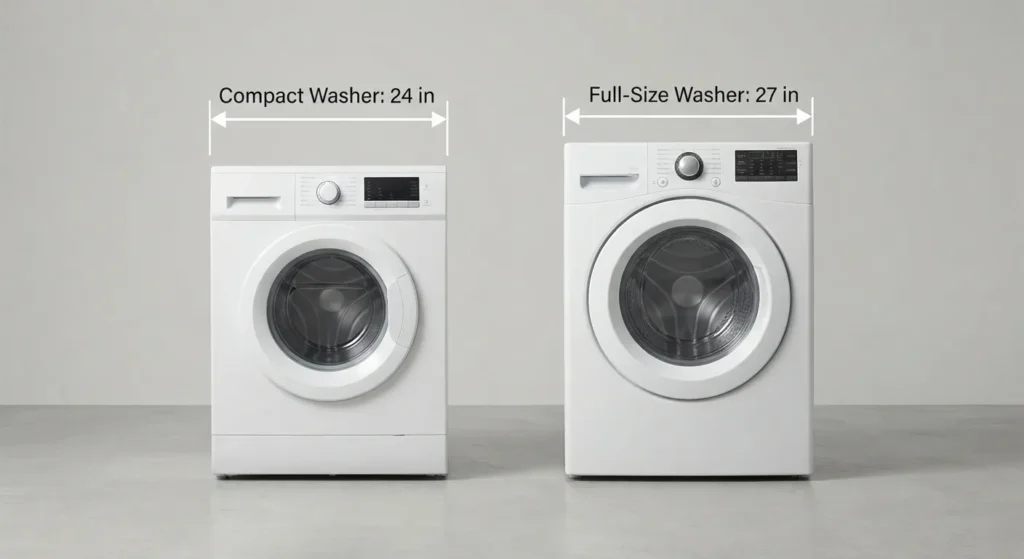
A compact front-loading washer is often around 24 inches wide, compared with approximately 27 inches for a typical full-size model.
That three-inch difference can be important in small apartments or narrow utility closets. A compact machine may fit where a full-size appliance would leave too little room for installation or access.
Compact models vary in height, depth, and drum capacity. Use the width as a first comparison, then check the complete specification sheet rather than assuming every compact model shares identical dimensions.
8. A Side-by-Side Washer and Dryer Pair
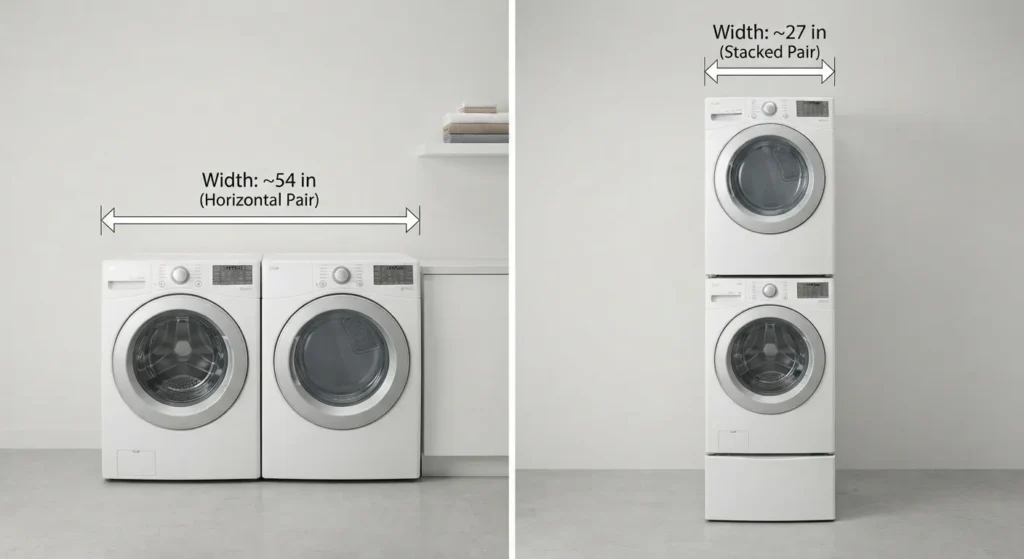
Two full-size machines measuring 27 inches wide each need about 54 inches of combined appliance width when placed side by side, before allowing for any gaps or installation considerations.
Stacking the same pair reduces the main floor footprint to approximately 27 inches in width. That can free up roughly half the appliance width along the wall, although the exact space saved depends on the models and arrangement.
This is one of the most useful comparisons for people planning a laundry renovation. If your room cannot accommodate a wide side-by-side pair, stacking may be a practical alternative provided there is enough vertical clearance.
9. A Laundry Closet Opening
A 30–33-inch opening may be a useful initial planning reference for an appliance that is approximately 27 inches wide, but it is not a universal minimum.
The opening must accommodate the actual machine and allow for the delivery route and installation method. Door frames, hinges, trim, and nearby walls can reduce the usable opening.
Depth is just as important. A full-size machine that measures 32–34 inches deep may need additional space for connections and ventilation. The front also needs room for the doors to open and for you to load and unload laundry comfortably.

10. A Standard Bathtub
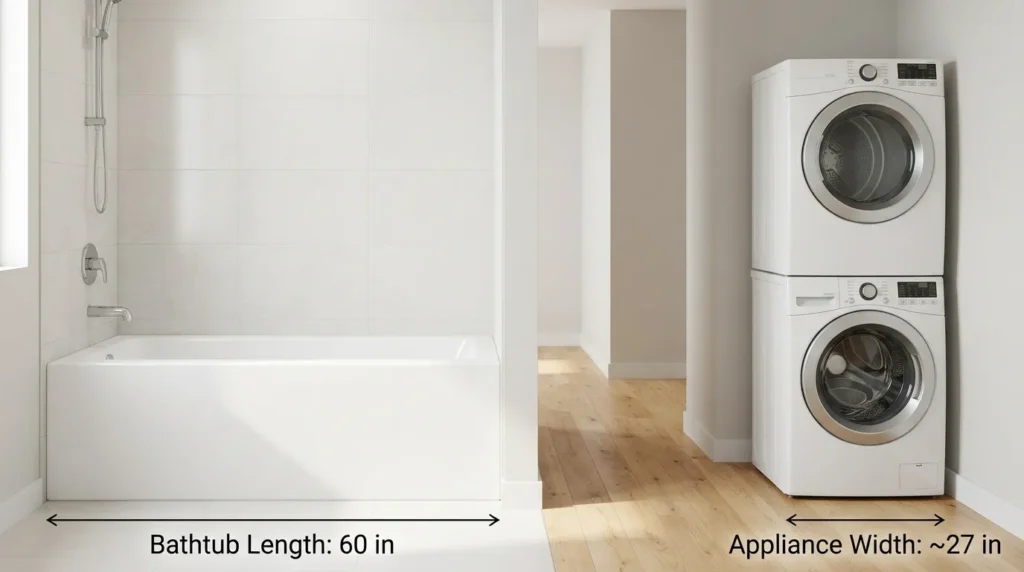
A common US alcove bathtub is about 60 inches long. Although this is much longer than the width of a stacked laundry pair, it gives you a familiar reference for thinking about floor space.
A stacked pair around 27 inches wide occupies less than half the length of a typical 60-inch tub when the measurements are compared numerically. However, the bathtub’s length and the appliance’s width are different dimensions, so this is a scale reference rather than a direct fit comparison.
Picture the tub along a bathroom wall, then imagine a laundry tower occupying a narrow section of that wall. It helps illustrate why stacking can be valuable when floor space is limited.
How Much Space Do You Need for a Stackable Washer and Dryer?
The machine’s exterior dimensions are only the starting point. A successful installation also depends on the closet opening, the available depth, the height beneath the ceiling, and the manufacturer’s clearance requirements.
For a full-size pair, these estimates are useful when planning the space:
| Installation detail | Initial planning estimate |
|---|---|
| Appliance width | About 27 inches |
| Stacked height | About 77–80 inches |
| Appliance depth | About 32–34 inches |
| Closet opening width | Around 30–33 inches may be a useful starting point |
| Rear space | Depends on hoses, connections, and venting |
| Overhead space | Follow the installation manual |
| Front space | Allow the doors to open and provide room to handle laundry |
These are not guaranteed minimum clearances. Some models require different spacing, and the installation manual takes priority over general guidance.
Can you stack any washer and dryer?
No. Separate machines should only be stacked when the manufacturer approves the specific combination and the correct stacking kit or securing system is used. Similar exterior dimensions do not guarantee compatibility.
Does stacking reduce the required floor space?
Usually, yes. A pair of machines that would occupy about 54 inches of appliance width side by side may occupy approximately 27 inches when stacked. The arrangement uses less floor width but requires sufficient height and safe access to the upper dryer.
Should you measure the appliance or the laundry closet first?
Measure the laundry area first to establish the available space, then compare it with the appliance’s complete installation dimensions. Measure the narrowest doorway and the route into the room as well, especially if the machines must pass through tight turns.
Estimating Stackable Washer and Dryer Dimensions Without a Tape Measure
You can get a rough idea of the size using familiar references, although these methods are not accurate enough for final installation decisions.
1. Compare the height with a door
A typical US interior door is about 80 inches tall. A full-size stacked laundry pair may approach the same height, giving you a quick visual reference for the top of the dryer.
2. Use a desk to picture the width
Many small desks are around 24–30 inches wide. Imagine a desk-sized section of wall occupied by a tall laundry tower to picture the approximate width of a full-size machine.
3. Estimate the depth using floor tiles
If you know the actual size of your floor tiles, count how many tiles span the intended appliance area. For example, two 16-inch tiles span 32 inches when placed edge to edge without gaps.
Tile sizes and grout lines vary, so this is only a rough estimate unless the tile dimensions are known.
4. Mark out the footprint
Use a known-length ruler or yardstick to outline a rectangle approximately 27 inches wide and 34 inches deep. This gives you a practical sense of how much floor space the appliance might occupy.
The outline represents the approximate machine footprint, not necessarily the full space required for hoses, ventilation, or door movement.
5. Check the ceiling and access route
Look at the height below any shelf or cabinet and consider the route from the entrance to the laundry area. A machine may fit in its final position but still be difficult to move through a doorway or around a corner.
When the time comes to purchase, confirm the actual width, height, depth, and installation clearances using the manufacturer’s specifications and a measuring tape.
FAQs About Stackable Washer and Dryer Dimensions
What are the standard stackable washer and dryer dimensions?
A typical full-size pair is approximately 27 inches wide, 77–80 inches tall when stacked, and 32–34 inches deep. Compact models may be narrower and shorter, so check the exact model before buying.
How many feet wide is a stackable washer and dryer?
A 27-inch-wide machine measures 2.25 feet across. A compact 24-inch-wide machine measures 2 feet across.
How many centimeters wide is a stackable washer and dryer?
A 27-inch-wide appliance measures 68.58 centimeters. A 24-inch-wide compact machine measures 60.96 centimeters.
How tall is a stackable washer and dryer in feet?
A stacked height of 77–80 inches equals approximately 6 feet 5 inches to 6 feet 8 inches. The final height depends on the machines and stacking hardware.
How many meters tall is a stacked washer and dryer?
A height of 77–80 inches is approximately 1.96–2.03 meters. This is the appliance height and does not include any additional overhead clearance that may be required.
How deep is a stackable washer and dryer?
Full-size models are commonly around 32–34 inches deep, while compact models may be around 24–26 inches deep. Connections and ventilation requirements can increase the total installation depth.
What size laundry closet do I need for a stacked washer and dryer?
For a full-size model about 27 inches wide, a closet opening around 30–33 inches wide may be a reasonable starting point. You must also check the height, depth, connections, door movement, and the manufacturer’s installation requirements.
Can I stack a washer and dryer without a stacking kit?
Do not stack separate appliances unless the manufacturer specifically permits the arrangement and provides an approved securing method. Use the compatible stacking hardware and installation instructions for the selected models.
Where That Leaves You
A full-size stackable washer and dryer is roughly 27 inches wide, 77–80 inches tall, and 32–34 inches deep. In everyday terms, imagine a machine about as wide as a small desk and a complete appliance tower nearly as tall as an 80-inch interior door.
That comparison makes the dimensions easier to picture, but actual measurements matter when you are buying appliances. Check the model specifications, measure the available space, and leave the clearances required for installation and access.
The main advantage of stacking is straightforward: you can fit two laundry appliances into a single vertical footprint instead of placing them side by side. Just make sure your room has the width, depth, and height to accommodate the complete setup safely.

Jack Harrison is a passionate writer who creates informative, engaging and easy-to-understand content for online readers. He enjoys researching new topics and sharing practical insights that help readers discover useful ideas and information.