
A king-size bed can look enormous in a furniture showroom but feel surprisingly different once you place it inside your own bedroom. The mattress needs room for two people, but it also takes up a substantial amount of floor space that could otherwise hold bedside tables, a dresser, or a walking path.
The tricky part is that “king size” sounds like a single, universal measurement. In reality, mattress dimensions vary by country, and a king-size mattress is not the same thing as the complete bed frame surrounding it.
In the United States, a standard king mattress measures 76 inches wide by 80 inches long. That makes it 6 feet 4 inches wide and 6 feet 8 inches long, giving two adults plenty of sleeping width compared with many smaller mattress sizes.
Standard US king size dimensions equal 76 × 80 inches, 6 feet 4 inches × 6 feet 8 inches, 193.04 × 203.2 centimeters, 1,930.4 × 2,032 millimeters, and 1.9304 × 2.032 meters.
Below, you’ll find the main conversions, comparisons with other mattress sizes, 12 practical ways to picture a king bed, and simple tricks for estimating its footprint before buying one.
Every King Size Dimension Converted
For a standard US king mattress, the width is 76 inches and the length is 80 inches. These measurements describe the mattress itself, not necessarily the outside dimensions of the bed frame.
| Unit | Width | Length |
|---|---|---|
| Inches | 76 in | 80 in |
| Feet and inches | 6 ft 4 in | 6 ft 8 in |
| Decimal feet | 6.33 ft | 6.67 ft |
| Centimeters | 193.04 cm | 203.2 cm |
| Millimeters | 1,930.4 mm | 2,032 mm |
| Meters | 1.9304 m | 2.032 m |
| Yards | 2.11 yd | 2.22 yd |
The mattress covers approximately 42.2 square feet of floor area. That’s the mattress footprint alone; a headboard, thick frame, or bedside furniture will increase the space needed in the room.
How to Calculate King Size Dimensions
The conversions are straightforward once you know the two measurements.
- Inches to feet: Divide inches by 12. For example, 76 ÷ 12 = 6.33 feet.
- Inches to centimeters: Multiply inches by 2.54. So, 80 × 2.54 = 203.2 cm.
- Inches to millimeters: Multiply inches by 25.4. Therefore, 76 inches = 1,930.4 mm.
- Inches to meters: Divide the centimeter measurement by 100. An 80-inch length equals 2.032 meters.
If you’re comparing furniture listings, remember that a product described as a “king bed” may refer to the mattress size it accepts rather than the full width and length of the assembled furniture.
Where King Size Fits on a Mattress Size Chart
A king mattress is especially wide, making it a popular option for couples who want more personal sleeping space. In the US, it is 16 inches wider than a standard queen mattress, while both are typically 80 inches long.
Here’s how the main US mattress sizes compare.
| Mattress Size | Width | Length | Approx. Area |
|---|---|---|---|
| Twin | 38 in | 75 in | 19.8 sq ft |
| Twin XL | 38 in | 80 in | 21.1 sq ft |
| Full | 54 in | 75 in | 28.1 sq ft |
| Queen | 60 in | 80 in | 33.3 sq ft |
| King | 76 in | 80 in | 42.2 sq ft |
| California King | 72 in | 84 in | 42 sq ft |
Mattress dimensions are standard US examples. Always confirm the specifications for the model and country where you plan to buy.
A standard king is 4 inches wider than a California king, but the California king is 4 inches longer. That distinction can matter if you are tall or have a narrow bedroom where every inch of width counts.
A king mattress is also considerably wider than a queen, but it does not automatically fit comfortably in every large bedroom. You still need to account for doors, drawers, walking space, and any furniture you want to keep beside the bed.
12 Things That Help You Visualize King Size Dimensions
The easiest way to understand a king mattress is to compare its dimensions with objects and spaces you already know. The following examples focus on either its 76-inch width, its 80-inch length, or its overall footprint.
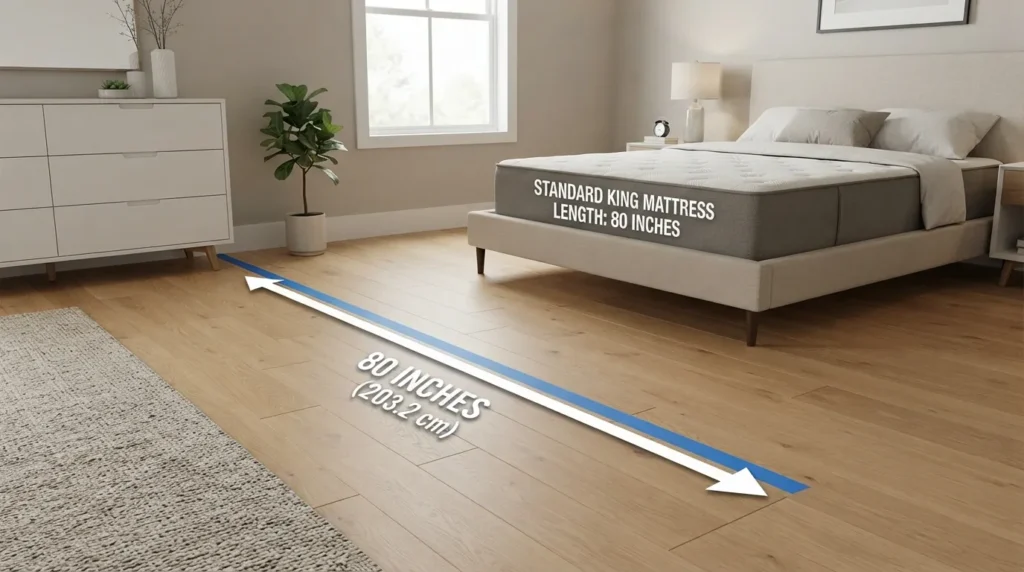
1. A 6-Foot-8-Inch Line on the Floor
An 80-inch line measures 6 feet 8 inches from end to end, matching the length of a standard US king mattress.
Imagine marking that distance on the floor with removable tape. It gives you a quick idea of how far the mattress will extend from the headboard toward the foot of the bed.
This is particularly useful when planning a bedroom layout. You can check whether a dresser, door, or walking route will interfere with the mattress area.
The mattress length is not the same as the full bed length, though. A frame with a prominent headboard or footboard may extend beyond the 80-inch mattress.
2. A 6-Foot-4-Inch-Wide Rectangle
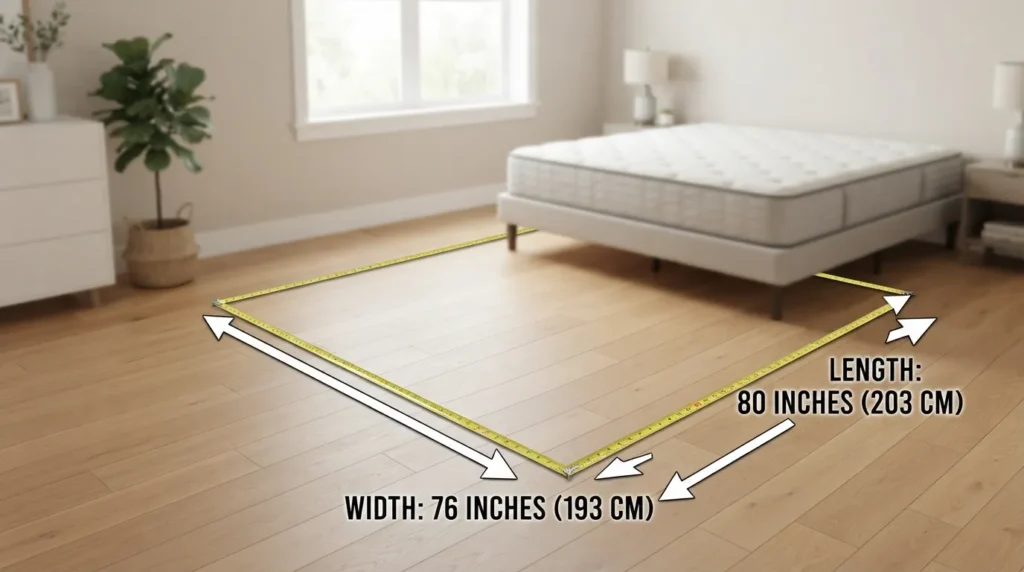
The width of a king mattress is 76 inches, or 6 feet 4 inches. That is the distance from one side of the mattress to the other, not its length.
You can picture this by marking a 76-inch line across an open section of bedroom floor. It immediately reveals why a king mattress can dominate a room when placed beside a nightstand or dresser.
The extra width is useful for couples who prefer more room to stretch out. However, it also means that a king bed can leave less space for other furniture than a queen bed would.
For a practical estimate, mark both the 76-inch width and the 80-inch length to create a rectangular outline. That will give you a more reliable impression than looking at a mattress in a large showroom.
3. Two Twin XL Mattresses Side by Side
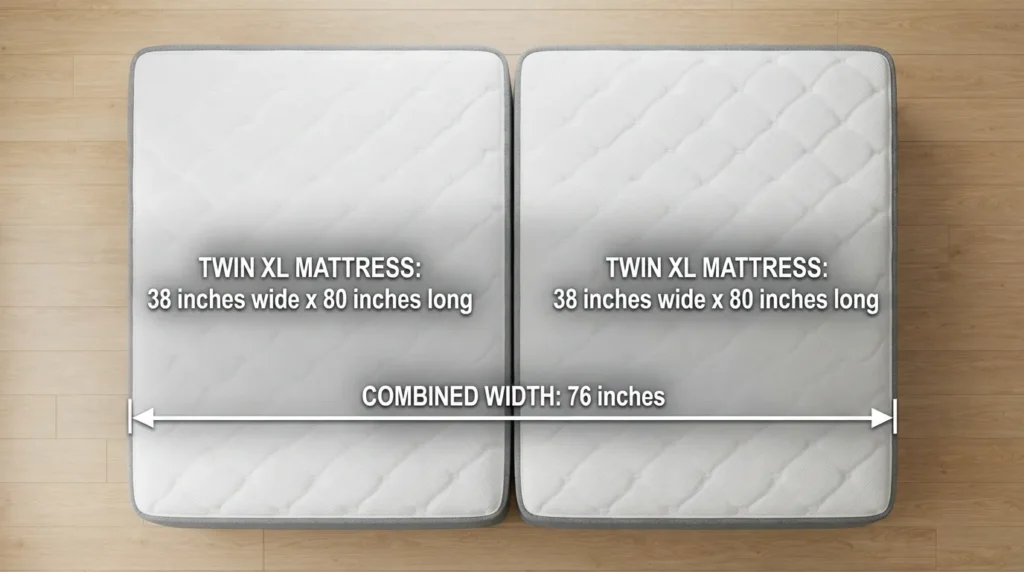
Two standard Twin XL mattresses placed side by side measure 76 inches wide in total and 80 inches long. Together, they match the nominal dimensions of a standard US king mattress.
This is the basic idea behind a split king bed, which uses two separate Twin XL mattresses instead of one continuous mattress.
The arrangement can be helpful for couples who prefer different mattress firmness levels or use adjustable bed bases. Each person can have an individual sleep surface while sharing the same overall bed size.
Visually, imagine two long, narrow mattresses meeting down the center. Their combined width is the same as a king, although the seam between them makes the sleeping surface different from a single-piece mattress.
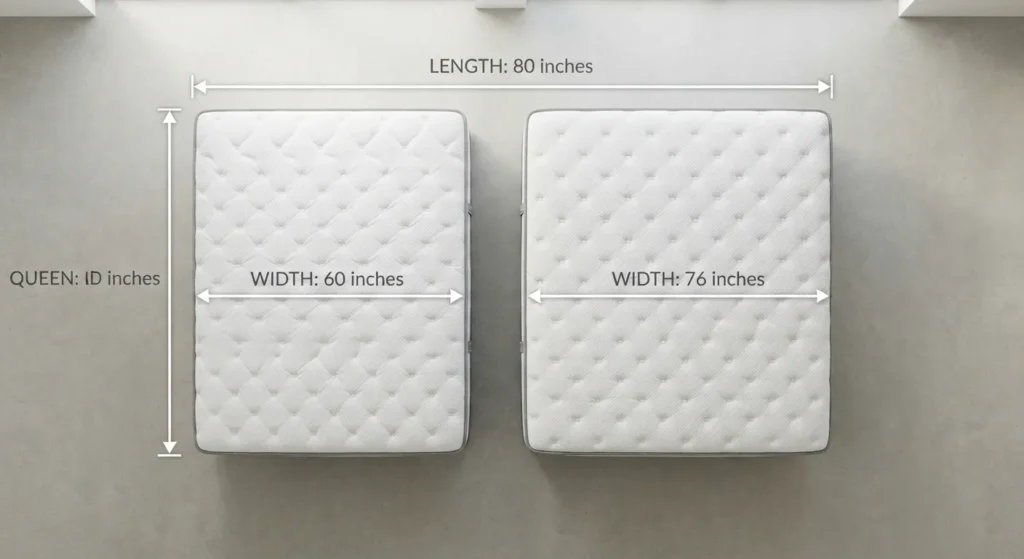
4. A Queen Mattress Plus 16 Inches of Width
A standard US queen mattress measures 60 inches wide by 80 inches long. A king mattress keeps the same typical length but adds 16 inches of width.
That extra width is roughly the size of a small cushion laid across the mattress, although cushions vary considerably in their dimensions. The important point is that the difference runs across the entire bed, not just one small section.
For couples, those additional inches can make a noticeable difference in personal space. For a bedroom, they can also determine whether two nightstands fit comfortably on either side.
If you already own a queen bed, picture adding 8 inches to each side while leaving the length unchanged. It is a simple way to understand the difference without seeing both mattresses in person.
5. A Standard Interior Doorway as a Width Reference
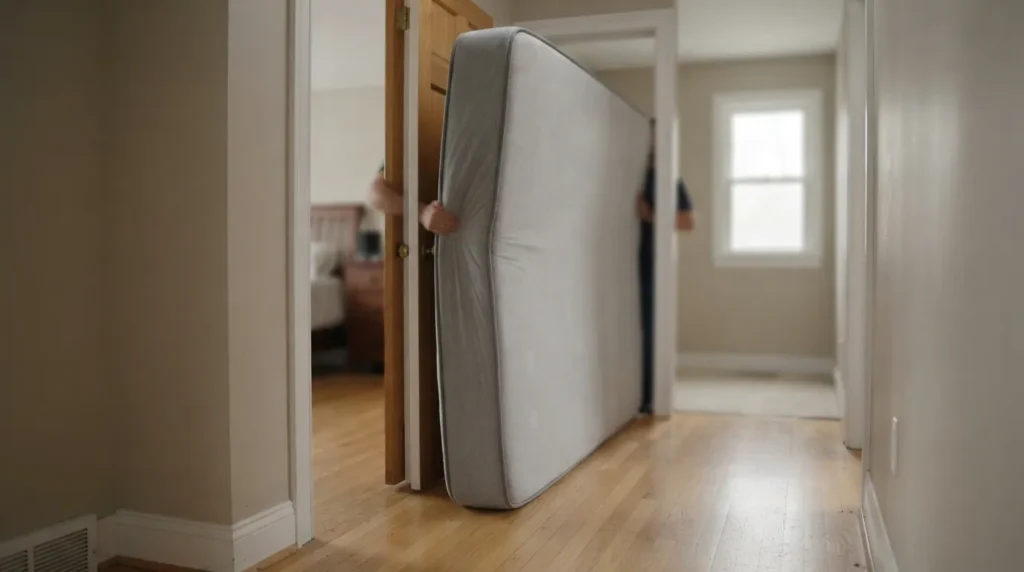
Many US interior doors are around 30–32 inches wide, although door sizes vary. A 76-inch king mattress is therefore more than twice the width of a common 30-inch doorway.
This comparison helps explain why moving a king mattress into a bedroom can require more planning than measuring the bedroom floor alone. A large mattress may need to be angled or maneuvered through hallways and door openings.
Actual clearance depends on the mattress construction, whether it can flex, the doorway’s clear opening, and the route through the house. The mattress should not be assumed to pass through every doorway just because the room itself is large enough.
Before delivery, measure the narrowest point along the route, including stair turns and hallway corners. Those restrictions can be just as important as the bedroom dimensions.
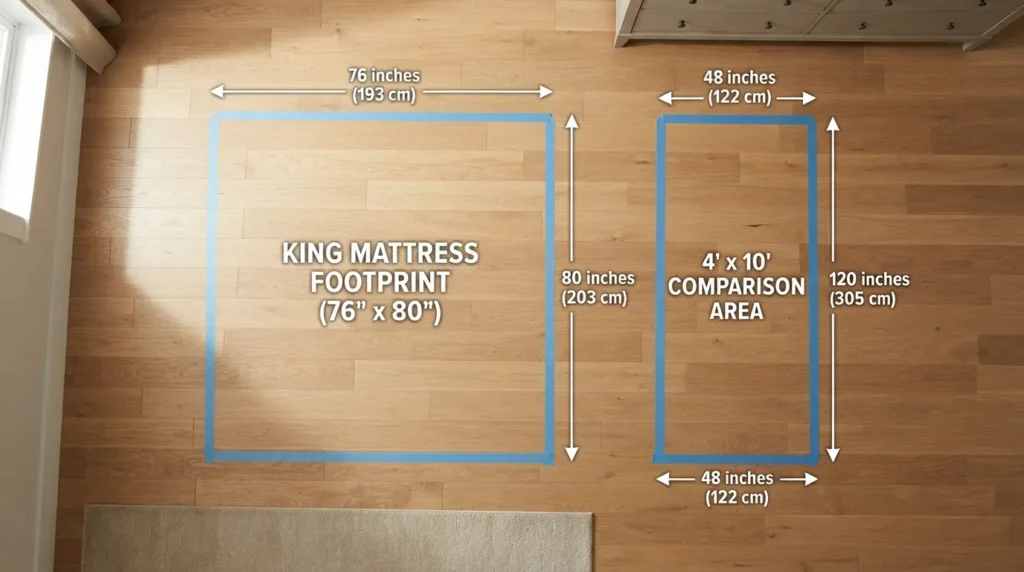
6. A 4-by-10-Foot Area of Floor Space
A rectangle measuring 4 feet by 10 feet covers 40 square feet. A king mattress covers approximately 42.2 square feet, so the two areas are fairly close, even though their shapes differ.
The comparison is useful because it gives you a sense of how much floor area the mattress occupies. A king mattress is about 6 feet 4 inches wide and 6 feet 8 inches long, so its footprint is closer to a broad rectangle than a narrow strip.
Area alone does not tell you whether a mattress fits a room. A 40-square-foot space might have the wrong proportions, and you still need room to walk around the bed.
Think of this comparison as a quick sense of scale rather than a substitute for measuring the actual mattress footprint.
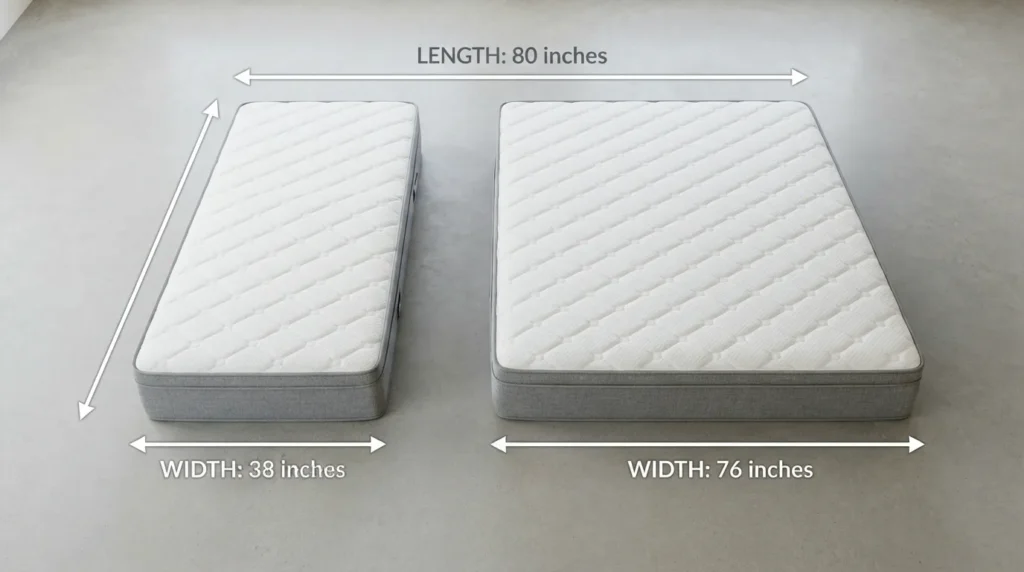
7. A Standard 80-Inch Mattress Length Compared With a Twin XL
A Twin XL mattress is typically 38 inches wide by 80 inches long. Its length is therefore the same as that of a standard US king mattress.
The difference is width: the Twin XL is designed for one sleeper, while the king provides a much broader surface for two people or anyone who prefers extra room.
This makes the Twin XL a useful comparison when you are trying to picture the length of a king bed. If you’ve seen a Twin XL in a dorm room, imagine keeping that same length but expanding the width to 76 inches.
Remember that bed frames can add a few inches to either dimension. When planning a room, use the mattress measurements first and then check the frame’s published outer dimensions.
8. Two Adults Lying Side by Side
A king mattress provides 76 inches of total width. Divided equally between two people, that works out to 38 inches of width per person.
That is the same nominal width as a standard US Twin or Twin XL mattress. In other words, two adults sharing a king can each have a width comparable to an individual Twin mattress if they divide the space evenly.
Real sleeping habits are not so tidy, of course. People shift position, spread out, or share space with children and pets, so the available width may feel different from the simple calculation.
Still, this comparison explains the appeal of a king for couples. The bed offers substantial room to share while allowing each person a generous section of the mattress.

9. A 75-Inch Television’s Diagonal Screen Measurement
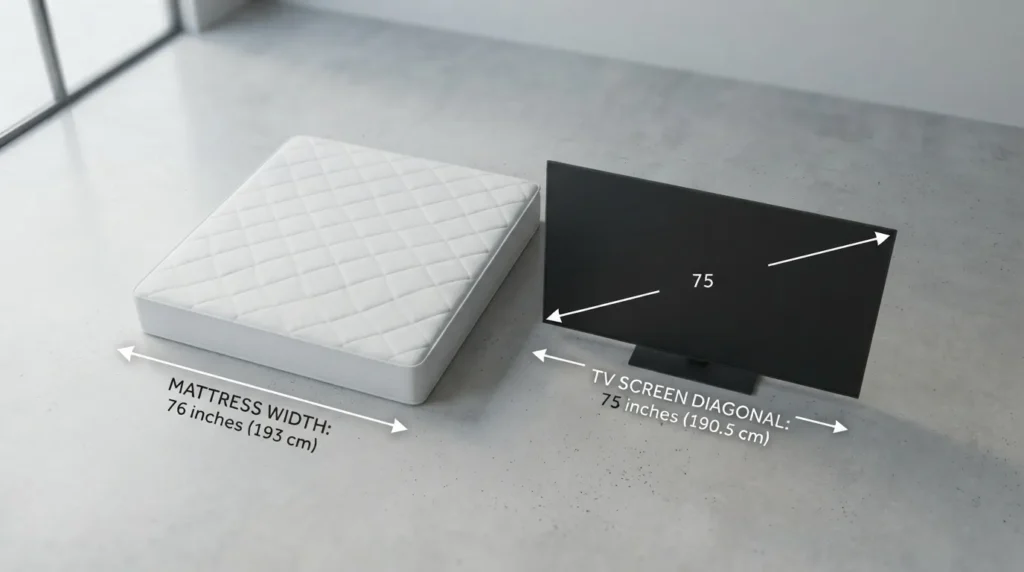
A television advertised as 75 inches is measured diagonally across the visible screen, not horizontally from side to side. That makes it a useful reminder that equal numbers do not always describe equal dimensions.
A 75-inch TV with a common 16:9 aspect ratio has a screen width of roughly 65 inches and a screen height of about 37 inches, excluding the bezel and stand. Its screen is therefore narrower than a king mattress’s 76-inch width.
This comparison is most helpful when you have seen a large television in a living room and want a familiar visual reference. A king mattress is wider than the screen of a typical 75-inch 16:9 TV, even though the advertised diagonal number is close to the mattress width.
Do not compare the diagonal measurement directly with the mattress width. The orientation and the way the dimensions are measured are different.
10. A Pair of 38-Inch-Wide Sections
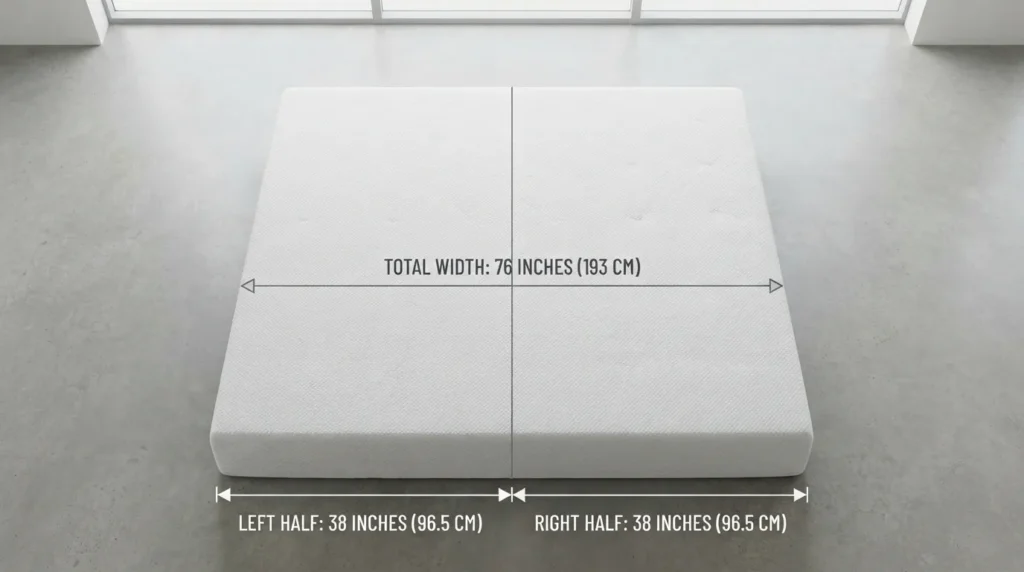
A king mattress is 76 inches wide, which can be divided into two equal sections of 38 inches each.
This is more than a mathematical trick. It makes the width easier to picture because a 38-inch section is the same nominal width as a standard US Twin mattress.
Imagine placing two Twin mattress outlines next to each other, with their long edges touching. The resulting rectangle is king-width and king-length when both are Twin XL mattresses.
The same idea is handy when sketching a room layout on paper. Mark the center of the mattress width at 38 inches, then use each half to estimate the space available to each sleeper.
11. A Bedroom Rug Under the Bed
A large area rug can help you visualize the scale of a king bed, although rugs come in many sizes and are not exact measurement standards. A rug measuring 8 by 10 feet, for example, covers 80 square feet—considerably more floor area than the mattress alone.
The mattress measures approximately 6 feet 4 inches by 6 feet 8 inches. An 8-by-10-foot rug can extend beyond those edges, depending on how the bed is positioned and whether the rug sits under the bedside tables.
This is why rug dimensions matter when furnishing a bedroom. A rug that looks generous in a shop may appear much smaller once it is placed beneath a king bed and surrounding furniture.
For a realistic layout, mark the mattress footprint first and then draw the rug around it. That lets you see how much rug will remain visible at the sides and foot of the bed.

12. A King Bed Frame Compared With the Mattress It Holds
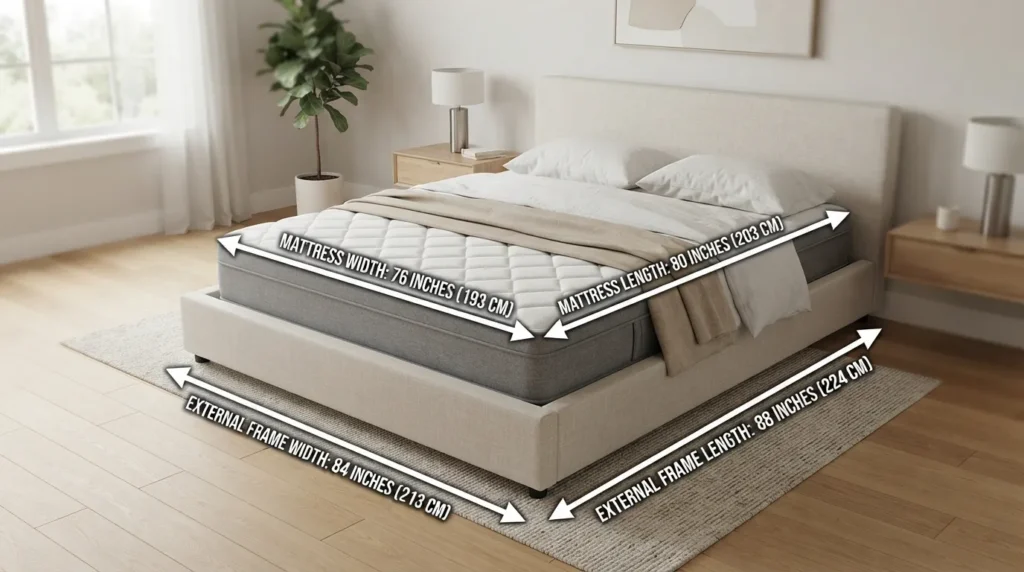
A king mattress measures 76 by 80 inches, but the outside of the bed frame can be larger. Upholstered rails, wide headboards, decorative edges, and built-in storage can all add to the final footprint.
For example, a frame with rails that extend an inch beyond each side could add about 2 inches to the overall width. Other designs add much more, so that example should not be treated as a universal rule.
This distinction matters when a bedroom has limited walking space. The mattress might fit between two walls on paper, but the frame could make it difficult to open drawers or move around the bed.
When buying furniture, look for both the mattress size and the product’s external dimensions. The first tells you what mattress fits; the second tells you how much room the complete bed will actually occupy.
The King vs. California King Question
One of the most common questions about king size dimensions is whether a standard king or California king is bigger. The answer depends on which direction you mean.
A standard US king measures 76 inches wide by 80 inches long. A California king measures 72 inches wide by 84 inches long, making it narrower but longer.
| Feature | Standard King | California King |
|---|---|---|
| Width | 76 in | 72 in |
| Length | 80 in | 84 in |
| Width in feet | 6 ft 4 in | 6 ft |
| Length in feet | 6 ft 8 in | 7 ft |
| Approx. area | 42.2 sq ft | 42 sq ft |
If you want more side-to-side room, a standard king generally offers the advantage. If you are particularly tall and need additional length, a California king may be worth considering.
Neither option is automatically best for every bedroom. Measure the room, check the external frame dimensions, and leave enough space to move around the bed comfortably.
Also, mattress naming conventions can differ internationally. If you are buying a bed outside the United States, check the exact width and length in the manufacturer’s listing instead of relying on the name alone.
Getting to King Size Dimensions Without a Tape Measure
You can estimate a king mattress footprint without owning a measuring tape, but household comparisons are approximations. If the bed needs to fit a tight space, use a proper tape measure before making a purchase.
Here are four practical ways to get a feel for the size.
1. Mark the Floor With Paper or String
Use string, removable tape, or another safe marker to outline a rectangle approximately 76 inches wide and 80 inches long. You can adjust the corners until the shape looks right and then walk around it as you would around a real bed.
This is one of the most useful methods because it shows both dimensions at once. It also helps you see whether there is enough room for nightstands, wardrobes, and open drawers.
2. Use Two Twin XL Mattress Outlines
A Twin XL mattress is approximately 38 by 80 inches. Two of them placed side by side form a rectangle that matches a standard king mattress’s nominal size.
If you have access to two Twin XL beds, you can use them as a visual reference. Otherwise, draw two 38-by-80-inch rectangles next to each other on paper or a floor plan.
3. Compare It With a Queen Mattress
A queen mattress is typically 60 by 80 inches. If you already own one, the length of a king mattress is similar, while the king is 16 inches wider.
That makes an existing queen bed a helpful reference point. Picture adding 8 inches on either side to understand the extra width, then check whether your room has the space to accommodate it.
4. Check the Room’s Walking Space
A mattress can fit on the floor but still leave a bedroom feeling cramped. After marking the mattress footprint, include the frame, bedside tables, and any drawers that need to open.
There is no single walking clearance that works for every room layout, but the goal is to avoid squeezing through narrow gaps or blocking doors. Your room’s shape and furniture arrangement matter just as much as its total floor area.
For a final decision, measure the actual product specifications. The outline and comparisons are excellent planning tools, but they cannot replace exact measurements when space is limited.
FAQs
What are standard king size dimensions in inches?
A standard US king mattress measures 76 inches wide by 80 inches long. The full bed frame may be larger, depending on its design and construction.
How many feet is a king-size bed?
The mattress is 6 feet 4 inches wide and 6 feet 8 inches long. In decimal feet, those measurements are approximately 6.33 feet by 6.67 feet.
What are king size dimensions in cm?
A standard US king mattress is approximately 193.04 cm wide by 203.2 cm long. These conversions use the exact relationship of 1 inch to 2.54 centimeters.
How many meters is a king mattress?
The standard US king mattress measures about 1.9304 meters wide and 2.032 meters long. For everyday planning, you can round those figures to approximately 1.93 by 2.03 meters.
Is a king bigger than a California king?
A standard king is wider, measuring 76 inches across compared with 72 inches for a California king. A California king is longer at 84 inches, compared with 80 inches for a standard king.
Is a king bed too big for a small bedroom?
It depends on the room’s dimensions and the other furniture you need. Measure the mattress footprint, add the frame’s outer dimensions, and check that doors, drawers, and walking paths remain usable.
What everyday object is close to a king mattress’s length?
An 80-inch line on the floor is a direct reference for the mattress length. You can mark it with removable tape or string to see how far the bed extends across your room.
Can I estimate king size dimensions without a tape measure?
Yes. Two Twin XL mattress outlines placed side by side give you the same nominal 76-by-80-inch footprint as a standard king mattress. This is useful for visualizing the size, but use a proper measuring tool before ordering furniture.
Where That Leaves You
Standard US king size dimensions are 76 inches wide by 80 inches long, or approximately 6 feet 4 inches by 6 feet 8 inches. The mattress covers about 42.2 square feet before you account for the bed frame or nearby furniture.
One of the simplest ways to picture the size is to imagine two Twin XL mattresses side by side. Together, they form the same basic footprint as a standard king mattress and help explain why the size offers generous room for two sleepers.
Before choosing a king bed, mark a 76-by-80-inch rectangle on your bedroom floor, then allow extra space for the frame and walking paths. That quick test can tell you much more about how the bed will feel in your room than its name ever could.

Jack Harrison is a passionate writer who creates informative, engaging and easy-to-understand content for online readers. He enjoys researching new topics and sharing practical insights that help readers discover useful ideas and information.